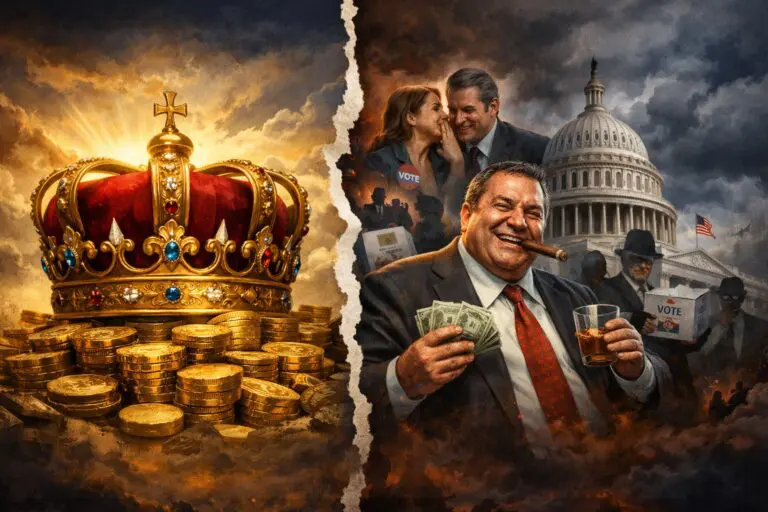
Democracy creates an avenue for politicians to access your pocketbook and liberty. It offers everyone who desires to get at your money or to regulate you a legal avenue to do so. Hereditary kingship eliminates the potential for these sorts to gain power over you; instead, the leeches and busybodies must produce for themselves. Removing the crown enabled those who craved dominion over you to achieve it.
The desire to control others often stems from a dislike or hatred for them. When you love something, you allow it freedom; you might attempt to guide, but you ultimately want the object of your love to make a choice. When you hate something, you wish to eradicate it, or at least control it, minimize it and mold it to your image. Democracy invites those who hate us to rule us.
The typical Christian libertarian does not want to be involved with the moral degradation and corruption of politics. They want to be far from a place like D.C., much less live or work there. Most libertarians desire only to live and let live. They lack the desire to control others’ money or boss them around. So, naturally, most of them will never run for office, and those lacking the drive for power and control will not succeed in elections as often as those who have it.
In competitive elections (the higher the level, such as federal, the more competitive), only those who are the most eager, who desire power the most, will be victorious. Those willing to lie, cheat and steal will have the advantage over a more moral candidate; elections attract and install the wrong people to govern. History demonstrates in democracy the moral candidates are removed from power, and the worst characters rise to the top.
The established national political parties and their major backers support candidates they can use. They need candidates willing to obey and to do whatever it takes to gain access to the money and power available in and through D.C. After the victory, the politician must repay his donors through legislation. He must repay his backers and support the national party agenda to maintain his standing. Likewise, the secular politician is after his own gain; he is rarely a local representative at the national level. This helps explain the disconnect between what politicians tell their voters before the election and their actions after gaining office.
To win a competitive national election, politicians must bribe, be bribed, conform to donors’ desires, and tell voters what they want to hear rather than the truth. Journalist H. L. Mencken summarized election oratory as “the art of…one who preaches doctrines he knows to be untrue to men he knows to be idiots.”
A moral and honorable Christian candidate refrains from lying or telling voters what they crave to hear; therefore, such candidates will upset sections of the country, lack excitement among the base, and be at a disadvantage. They will be principled, “rigid,” “uncompromising,” and unwilling to work with the system, further impeding their success. They will tend to be honest, tell the truth, run on principles, and act on their beliefs. Political parties weed out such candidates often before they even attempt to run for national office.
Professor Hans-Hermann Hoppe argues political competition ensures the worst will rise to the top. The more competitive the more corrupt one needs to be to succeed. So the town-level local politicians will generally be more honest and unwilling to bribe their way to the top. But at the federal level, due to the greater competition, they must battle competitors and do favors necessary to achieve power. It would be nearly impossible for a politician to tell voters the truth and reach a federal seat.
Hoppe argues competitive elections will “lead to the cultivation and perfection of the peculiar skills of demagoguery, deception, lying, opportunism, corruption, and bribery. Therefore, entrance into and success within government will become increasingly impossible for anyone hampered by moral scruples against lying and stealing.” And again Hoppe wrote, “Thus democracy virtually assures only bad and dangerous men will ever rise to the top of government.” Elections necessitate moral decay among politicians, which will follow all competitive elections. Historian Christophe Buffin de Chosal wrote:
“The qualities necessary to ascend to power through democratic vote are precisely what make for defective leaders. To rise to the head of a political party and win elections at the national level, one must pander to the voters and tell them not what is, but what they want to hear. One must bow down to particular interests, especially to those of the money powers. One must not let any scruples get in the way; one must be about superficial externals rather than about substance; one must also be devoted to one’s party.”[1]
In a democracy, secularists and relativists are heavily favored; they are fighting on their home turf, as philosopher Erik von Kuehnelt-Leddihn explained:
“The true Christian as a candidate in a thoroughly democratic state is almost unthinkable; only in rare cases will he succeed in maintaining his position…The Christian candidate would be sincere, frank, serious. He would confess ignorance where need be, he would oppose his constituents when his conscience advocated disagreement, he would refuse to distort facts by popularizing them or by “boiling them down” to a deceptive simplicity, thus flattering the intellectual vanity of the credulous masses. The bad pagan simply lies to his voters…He pretends to understand problems he is not acquainted with, and simulates knowledge; he is determined not to stick to his promises or even to act against his conscience. The good pagan is in the worst situation of all: he lies, quite subconsciously, to himself. He believes, perhaps in all sincerity, that one can square the circle…The good Christian’s position is an almost hopeless one, since he is not willing to sacrifice ethical values to the Moloch of popularity.”
People don’t like hearing the truth; they enjoy living in a world of their own making. Jesus would never be elected in a democracy because he constantly told the truth. He purposely drove away people following him for his miracles, or for what he might do for them. Truth was more important than popularity.
While politicians portray themselves as experts in multiple areas, the only thing they really do well is sell an image voters desire. For success, they only need to be experts in manipulation, knowing the right people and lying. Mencken wrote, “Will any of them venture to tell the plain truth…will any refrain from promises that he knows he can’t fulfill…they will promise every man, woman and child in the country whatever he, or she wants…votes are collared under democracy not by talking sense but by talking nonsense…the winner will be whoever promises the most with the least probability of delivering anything.” Elections are advertisements where politicians create an image they think will be successful in achieving votes.
Politicians hire campaign advisors to determine what is best to say in each area. They will categorize us into herds and discover this number of “suburban women” live here, so say this, but when you are over there where there are plenty of evangelicals, don’t say this, this here is an industrial town, so preach on this. Then, after the election, you will hear both parties “congratulate” the victors for “running a good campaign,” in other words, great job manipulating people and saying the right things in a suitable place to achieve votes.
Undomesticated people like those in the Middle Ages would never submit to a corrupt system of elected officials campaigning for power. They would rid us of the whole system, and you would see the return of a king.
[1] (Buffin de Chosal 2017, 132-133)






;?>/smartquizbuilder/includes/images/sqb-registration-img.jpg)