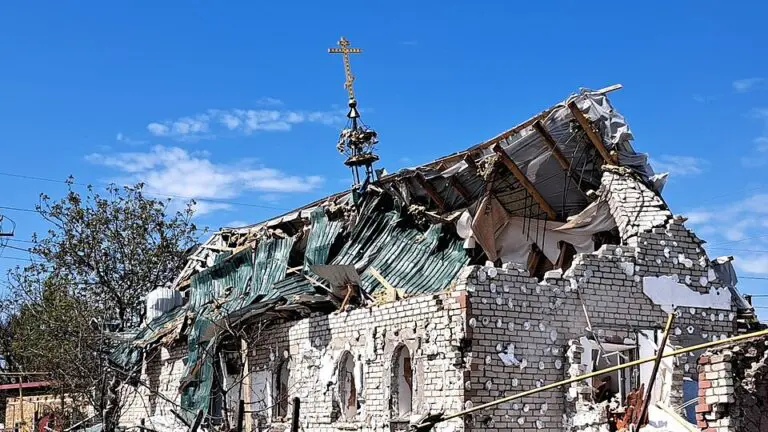
Christians must be discerning when our leaders call for another war. Our last interventions in places like Iraq and Syria didn’t bring stability or liberation. They devastated ancient Christian communities that had survived for nearly two millennia. So before we repeat the cycle, we need to pause and consider what’s actually at risk: Iran’s deep Christian history, the reality behind the justifications being offered, and the response our faith truly calls us to.
Iran, like much of the Middle East, looks nothing like the version Americans inherit from Hollywood or the nightly news. Yes, Christians in Iran face real persecution: arrests, surveillance, imprisonment, and even death. But what almost never makes it into our headlines is the other half of the story. Since 1979, both the legal ethnic churches and the underground Persian‑speaking church have grown to nearly a million believers. To anyone who knows the history of Christianity in Iran, this shouldn’t be surprising. The church there has always grown under pressure. At one point, it was the beating heart of global mission, sending the gospel eastward long before Europe ever imagined itself the center of Christianity.
Christianity has been present in Iran since the beginning of the church. Acts 2 names Parthians, Medes, and Elamites as some of the first people to hear the gospel at Pentecost and carry it back to the regions that make up modern Iran. Over the next centuries, that small witness grew into a distinctly Persian church centered in Seleucia Ctesiphon, the capital of the Persian Empire. This became the Church of the East, a missionary movement that carried the gospel along the Silk Road into Central Asia, India, and even China.
Islam arrived in the seventh century and changed the church’s status but not its existence. Christians became a restricted minority, yet they endured for centuries by running schools, translating Scripture, and maintaining monasteries. The real decline came much later when the Safavid dynasty enforced Shi’a Islam and pushed Christians into ethnic enclaves.
After the 1979 revolution, Persian language churches were shut down and pastors imprisoned. Yet in the shadows of repression, an underground church quietly grew and now includes hundreds of thousands to more than a million believers. Despite surveillance, raids, imprisonment, and the constant threat of death, Iran is home to one of the fastest‑growing Christian movements in the world.
Before the 2003 invasion, Iraq told a similar story. Nearly 1.5 million believers whose roots stretched back to the first centuries of the church. They worshiped in Aramaic, the language of Jesus. They lived in cities like Mosul and Baghdad, where Christian monasteries had stood for over a thousand years. When the U.S. toppled Saddam Hussein, it didn’t usher in freedom for these communities. It unleashed chaos. Militias filled the power vacuum. Churches were bombed. Priests were kidnapped and murdered. Families fled by the hundreds of thousands. Today, fewer than 200,000–300,000 Christians remain. Entire neighborhoods that once echoed with ancient liturgies now sit empty. Iraq’s Christians weren’t targeted because Muslims suddenly hated them. They were destroyed because war destabilizes everything, and minorities are always the first to be swept away in the collapse.
Syria tells the same story with different names. Before the civil war, Christians lived with a measure of stability under Assad’s authoritarian but predictable rule. They were not free in the Western sense, but they were protected. They worshiped openly, ran schools, and maintained communities that traced their lineage back to the apostles. When the war began, Syria fractured. Christians are now kidnapped, raped, sold in open‑air slave markets, and have been forced to flee ancestral homes. Towns like Maaloula, were emptied. Fewer than 400,000 Christians remain in a land that once held more than double that number.
In both Iraq and Syria, the pattern was the same: the United States and other foreign powers attacked directly and indirectly through a maze of proxy groups. At one point, Pentagon‑backed militias were fighting CIA‑backed militias on the same battlefield. The push for regime change was justified by false claims and destabilized these nations leaving two ancient Christian communities defenseless in the chaos. That’s why we cannot rush into another conflict on the strength of slogans or fear. We have to examine the reasons being offered for this war with a sober mind.
Prophetic sensationalism: Christians have always been tempted to cast geopolitical enemies as characters in an end‑times drama. But turning Iran into “Gog and Magog” is not discernment, it is fear dressed up as prophecy. It replaces the real people of Iran with an apocalyptic caricature and baptizes our anxieties as divine insight.
“Defending Israel”: Many believers assume supporting modern Israel militarily is a biblical mandate. But the New Testament never commands Gentile nations to wage war on Israel’s behalf. When American Christians treat geopolitics as theology, it is often the local church; Jewish, Muslim, and Christian alike that suffers the consequences.
“They started it in 1979”: This story begins long before the hostage crisis. The 1953 U.S.-backed coup that overthrew Iran’s elected government set the stage for decades of mistrust and hostility. Pretending history began in 1979 allows us to moralize a conflict we helped create.
“Iran is racing for a bomb”: Ayatollah Khamenei issued a religious ruling against nuclear weapons, and the 2015 nuclear agreement was verifiably constraining Iran’s program until the U.S. withdrew. The current crisis is not the result of Iranian inevitability but of diplomatic collapse much of it of our own making.
Righteous nationalism: The belief that “God is on our side” is the oldest temptation in the politics of war. It baptizes violence, blinds us to the human cost, and turns national interest into a divine mandate. Once we assume our nation’s cause is God’s cause, there is no limit to what we will justify.
Beneath these justifications lies a harder truth: the people who call for war are never the ones who bear its cost. In every conflict, it is the poor, the young, and the powerless who bleed. War is the luxury of the rich, paid for with the blood of the poor and the vulnerable. If Christians cannot see through the romance of violence, we will bless the suffering of those Christ commands us to love.
Scripture calls us to a different ideal. Jesus rejected retaliation and entrusted judgment to God alone. Peter told persecuted believers to endure suffering without vengeance. Paul warned the church not to be conformed to the patterns of this world, patterns that always justify violence in the name of peace. The uncomfortable truth: both the United States and its adversaries claim they are protecting the vulnerable when they wage war. The logic is the same on both sides but Christians are called to break that cycle.
The call to enemy‑love is the point where many Christians quietly step off the path of Jesus. It’s easy to love victims; it’s far harder to love the people we’ve been taught to fear, but the gospel doesn’t give us an escape clause. God’s love does not stop at national borders or political narratives. It extends to the names we would rather not say out loud: Saddam, Gaddafi, Assad, Khamenei. It extends to the Iranian soldier on the front line, the mother in Tehran trying to keep her children safe, and the underground pastor who knows he may be arrested at any moment. They are all image‑bearers. They are all people Christ died for.
Enemy‑love is the most demanding form of discipleship. It requires refusing to let propaganda shape our ethics, or to let the state tell us who counts as human. In a world where every side justifies violence as moral necessity, enemy‑love is the only posture that keeps us from being swallowed by the logic of war. This is the same narrow way the historic Anabaptists, Mennonites, and other peace‑churches tried to walk, refusing the sword even when every nation around them claimed God’s blessing for its wars.
If western Christian thought has been shaped by fear and war, then the first step is to refuse the reflex. We don’t have to accept the narratives that rush us toward violence or equate national interest as a divine mandate. Instead, we can choose the slower, harder work of discernment. We can refuse to let headlines or political pressure decide who counts as our neighbor. We can pray for those we’re told to fear, advocate for peace when others demand escalation, and remember the global church.
What we can do now is return to the ancient Christian path of peaceful resistance. That means speaking with clarity when our leaders move toward war. We can insist that our elected officials pursue de‑escalation, diplomacy, and the protection of vulnerable communities rather than another cycle of destruction. Inside the church, we have to correct the narratives that try to shape this conflict as necessary for Jesus’ return. Christ’s coming is not a summoning ritual, and no nation may sacrifice the civilians of another to hasten it.
Silence in moments like this is not neutrality. It is consent. To speak is to stand with the global church, with the image‑bearers caught in the crossfire, and with the crucified King who calls His people to truth, courage, and peace.

Articles posted on LCI represent a broad range of views from authors who identify as both Christian and libertarian. Of course, not everyone will agree with every article, and not every article represents an official position from LCI. Please direct any inquiries regarding the specifics of the article to the author.
Did you read this in a non-English version? We would be grateful for your feedback on our auto-translation software.
*by signing up, you also agree to get weekly updates to our newsletter
Sign up and receive updates any day we publish a new article or podcast episode!