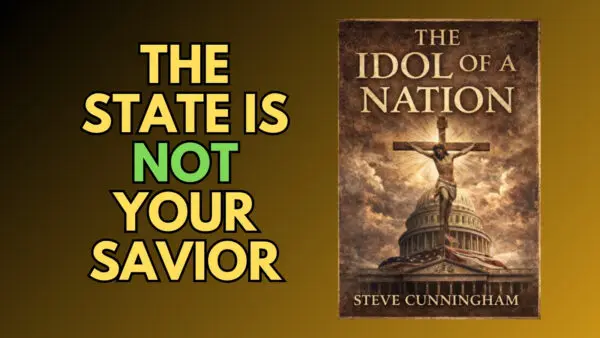
Steve Cunningham, founder of the popular traditional Catholic YouTube channel and website Sensus Fidelium, has written an important book titled The Idol of a Nation. Cunningham asks the reader a question that he believes modern political systems have forgotten to ask: “How large can a political community become before self-government ceases to be possible?
This excellent, well-sourced book is a deep dive into the historical and philosophical transformation in politics that engulfed the West during the 19th and 20th centuries. He writes, “The nineteenth century witnessed several political consolidations. In each case, a landscape of multiple semi-sovereign polities was compressed into a centralized nation-state.” Using Italy, Germany, France, and the United States as prime examples, Cunningham reveals to the reader the secular philosophical reasons behind the modern centralized, managerial and authoritarian states that, for convenience and necessity and often driven by war, have consolidated massive amounts of power at the center, or federal level. Everything became permissible in the name of the “will of the people,” but in reality “the people” are controlled by bureaucratic elites. The institutionalization of nationalized education, uniform legal codes and central taxation, among other measures, compelled formerly diverse local customs and politics into a top-down formula.
But at every step this centralization has constrained and eventually removed the ability of local communities to live as they desire. Increasingly, they become mere statistics, production units to be managed by distant bureaucracies in a manner that gives no concern to local interests and desires. They are no longer treated as humans, but as products. Self-governance is lost in the name of efficiency and the survival of the nation-state, now elevated above the common man. And colonization and globalization are simply an expansion of the logic of centralization and the removal of the self-rule of now-powerless minority groups to the benefit of managerial states.
Further negatives arise in centralized politics, where voting becomes warfare, each side forcing its way on the other. Centralization drives hatred and anger, making politics a bigger issue than it needs to be, and political losses become more devastating to the many who don’t get their way. Instead of diverse local self-governing communities, a centralized government enforces uniformity on all. A large, diverse empire or nation is simply too hard to control; thus, all must be alike for functional managerial purposes, and all must think alike. Media and education shape political thought and teach each nation’s beliefs, myths, and forms of partisanship. Further, Cunningham is concerned with accountability, which dissipates at larger levels. Local school boards, mayors, sheriffs, and more can be held more easily accountable by the local community, but non-elected bureaucrats and judges cannot.
As a counterpoint to the centralizing policies of the West during these centuries, Cunningham delves into social Catholic teachings that arose in response to them, grounded in subsidiarity and human dignity. He says local control and subsidiarity’s priority is not efficiency, economics, or military progress, as in a central state, but is first based on human dignity. Politics is not simply a political issue, but a moral one based on humanity. He writes, “Subsidiarity is not merely an administrative preference. It is a defense of human dignity.” In sum, politics is not separated from morality. It is immoral to subjugate people and dehumanize them with centralized systems.
And part of this Catholic local control and human-first approach (as opposed to prioritizing military necessity, economics, etc.) involves levels of control: not everything begins at the center and filters down to all, but the opposite. Locals decide and have various policies, with higher state levels doing only what the local cannot, and Cunningham reminds us a few times that this position is not anti-government; the central government still plays a role, but it is minimal and only what the lower levels cannot do. The government is local first. And in this decentralized system based on self-governance and benefiting humanity, secession is also acceptable to throw off tyranny and abuse when human dignity is subjugated by over-mighty centralized powers. Secession is not so much a political movement (as decentralization should provide self-government) but a “moral corrective” and a “mercy” to humanity being dehumanized.
The crux of the book is in where sovereignty and authority are placed. Do Catholics declare Christ as King, or a parliament, president, or “the will of the people”? The Catholic Church opposed this “idolatry of state”. Cunningham states from various Church teachings that true authority comes from the Cross, not parliament. Popes during the political transformations of recent centuries opposed the direction of modernity and declared that Christ was king above the state.
Cunningham goes back into history to the Middle Ages, when Christ and the Church were the highest authority. Christ was King above any governing body, and all law was restricted and had to conform to His law. Natural law and divine law left large segments of “politics” outside of political thought and discussion; those belonged to the church. The church and this Christ-as-King mindset prevented modern authoritarian states from becoming the highest authority, as they did once secularism diminished opposing forces, and the state was elevated above all. Families, parishes, local communities, distant authorities, all contested, challenged, opposed, and played a part; now all these are wiped out or under the central state.
Nationalism placed priority and authority with the state, allowing the government to build unprecedented military might, utilizing industry, taxation, forced recruitment, and more to deadly effect, leading to WW1 and WW2. Further, when the state becomes the ultimate authority, its morality and laws become the priority and assume a religious character. The secular state did not remove the Church, it incorporated it into a single ideology: the nation. By overcoming its competitor, it was able to declare what was moral and what was evil. Also, Cunningham writes, “The nation provided saints, martyrs, relics, shrines, monuments, and feasts, national holidays. heroes, rituals, commemorations, etc. Its existence, maintenance, and symbolism became an all-encompassing worldview and belief system. Because the nation and its economic and political system are elevated above humans, its preservation must be maintained at all costs, allowing it to compel slaves (conscripts) to fight on its behalf and for its survival. The state that educated its people will treat this sacrifice as the highest honor; they are martyrs willing to die for nationalism and will have statues erected in their praise.”
Central states do not see people as individuals but as collectives. Cunningham points out that this mindset makes sense of current demands for reparations. He explains that it views nations as sinners, collectives, not individuals, and nations are moral agents who must atone for sins. So, for example, if only a small minority of people in the United States owned slaves, it matters not; all are guilty, all must make amends for the sin committed by the state. Redemption becomes nationalist instead of individualistic.
The Idol of a Nation is a wonderful attempt at calling Catholics back to Church teachings and local human political systems, and to rid the reader of the idolatry of elevating the modern state above the kingship of Christ. Cunningham writes, “If modern societies wish to preserve liberty, responsibility, and moral clarity, they must rediscover the beauty of the small and the sovereignty of Christ above every throne.”

Articles posted on LCI represent a broad range of views from authors who identify as both Christian and libertarian. Of course, not everyone will agree with every article, and not every article represents an official position from LCI. Please direct any inquiries regarding the specifics of the article to the author.
Did you read this in a non-English version? We would be grateful for your feedback on our auto-translation software.
*by signing up, you also agree to get weekly updates to our newsletter
Sign up and receive updates any day we publish a new article or podcast episode!