To our brightest minds in our best institutions, whether in technology, academia, or beyond, do not shy away from the ultimate questions.
If you are serious about seeking the truth, about how the world really works, about what holds history and civilization together, you will eventually find yourself face-to-face with Jesus.
Every path of inquiry, if pursued honestly and deeply enough, leads back to the foot of the Cross. I did not believe that for many years. But now I am fully convinced it is true.
Part I: My Journey to Christ Began With Leaving Him
My journey was long and heterodox.
I was born and raised in Kentucky, on a farm with cows and horses. Today, I live in Manhattan with my wife and our three sons, far from the fields of my childhood.
Between those two worlds, rural Kentucky and urban New York, I’ve had to constantly synthesize experiences that could not be more different. That willingness to cross boundaries and explore the unknown has defined me.
It is why I left a high-paying job to build a company. And it is why I left the Pentecostal and non-denominational Protestant faith of my upbringing to embrace atheism.
That decision was not made in a vacuum.
Growing up in Kentucky, I was surrounded by churches. There are probably more churches than anything else, even schools. My mother was devoutly Christian. My maternal grandfather was a pastor, and so was my uncle.
Christianity was deeply woven into my family and my surroundings.
It often emphasized emotional intensity—revival services, speaking in tongues, altar calls, and the ever-present fear of Hell.
That atmosphere carried weight, but as I became a young man, it didn’t provide the kind of intellectual grounding I was searching for.
My mind was drawn to patterns, logic, and the deeper structures of how the world works.
It pushed me toward questions that demanded clarity, answers that could be tested and proven. It’s why I went to Columbia University to study computer science, and why I became a software engineer.
I loved logic, building systems, and making sense of complex problems. Above all, I loved knowing when I had reached an answer that was objectively true.
That pursuit of clarity stood in stark contrast to my upbringing. By early adulthood, I was afraid to fall asleep for fear that if I didn’t pray with absolute sincerity, and if I didn’t wake up, I would be sent to Hell.
It felt wrong. I longed for truth, yet what I carried was anxiety.
I concluded that this could not be genuine belief. Logically, if God existed, I could not fool Him with hollow prayers or fear-driven rituals. If sincerity was the standard, then I was damned regardless.
One night I said enough and I walked away.
The anxiety was lifted and I felt as though I had broken a spell.
Part II: In Pursuit of First Principles
I’ve always had a burning desire to have purpose, meaning, and to understand the world.
In my late teens, I had already begun turning to philosophy, economics, and politics in search of coherence.
Politics quickly became more than a hobby, it became my framework for understanding. Campaigns, debates, and theories of liberty gave me something to believe in, something to pursue with conviction.
Philosophy and economics added intellectual scaffolding, and for a time, these pursuits felt like enough.
But politics and philosophy, for all their explanatory power, could not touch the deeper questions of existence. They could diagnose the structures of society, even offer solutions for governance, but they could not answer the ache at the center of human life.
I had read all the great works of the Austrian economists—Mises, Hayek, Rothbard and many others—whose writings on liberty and order spoke to me. And through them, I encountered Ayn Rand.
Rand’s philosophy of Objectivism provided an integrated worldview that contrasted sharply with the fear-driven religion I had left behind. She presented human life as a pursuit of reason, self-interest, and achievement.
Her critique of religion, through the archetypes of Attila and the Witch Doctor, was searing. Attila represented raw force, while the Witch Doctor represented those who used myth and superstition to control people through guilt and fear.
When I read that, I immediately thought of the fire-and-brimstone preaching of my youth. Christianity, as I had known it, seemed unnecessary and manipulative. The Witch Doctor embodied everything I wanted to escape.
But Rand provided more than a critique of religion. She critiqued Nietzsche for exalting power and rejecting objective morality, and she reserved similar disdain for figures who cloaked irrationalism in philosophy or culture.
By contrast, she admired minds that pursued reason, clarity, and creative achievement. This contrast gave her philosophy a moral framework, anchored in the defense of reason against the chaos of relativism, that I found bracing and liberating.
For many years it shaped my entire way of seeing the world.
I lived fully convinced that God was myth and that none of it was true. I was not militant in my unbelief. I felt tolerant of those who still believed. But there was no part of me that considered it real.
Religion, to me, was a cultural artifact with no claim on the present or future. The question of Christ did not linger at the edges; it was absent altogether.
I thought I had closed the book for good.
Part III: “I consider myself religious, but not spiritual”
The years passed, and my focus shifted from politics toward building a career in technology.
The transition felt natural.
Politics had taught me how ideas could shape societies. Technology showed me how ideas could shape the future.
Immersed in the world of technology, I came across Peter Thiel.
His talks, essays, and interviews quickly became a staple for me. I consumed nearly everything he produced. Admittedly, I still do.
At first, it was his insights on startups, how to build lasting companies, how to think about competition, and how monopoly could actually foster innovation, that drew me in. His mental model for technology and business felt as true as anything I had encountered in economics or philosophy.
But gradually, I began to notice something else woven into his talks, something I had not expected from a Silicon Valley investor. Thiel spoke not only about technology and markets, but about Christianity.
I was shocked.
The same man whose insights on monopoly and innovation shaped my thinking was also insisting that the figure of Christ, and the anthropology behind Him, were central to understanding history and society.
I had assumed all serious thinkers in science and technology had long since abandoned Christianity.
Yet here was Thiel, a figure I respected deeply, speaking openly and in detail about Christ. He framed Christianity not as myth, but as anthropology and logic, truth woven into the structure of civilization itself.
What had I missed?
Again and again Thiel returned to Christianity, often through his evangelizing of René Girard.
And so my journey back to Christ began with this introduction of Girard.
Reading Girard required me to step out of my modern lens. I had to imagine the world as it once was, before nation‑states, codified laws, or Christianity.
Girard argues that we are imitative creatures; we learn what to want by desiring what others desire.
This “mimetic desire” fosters language and human culture, but also rivalry. When two people mirror one another’s desires, “double mimesis” spirals into escalating competition.
In large bands, that spiral turns deadly with feuds, vendettas, and cycles of revenge. Without limits, societies collapse into violence.
This was the reality of much of human history.
So how did humanity escape that trap? Girard’s answer is the scapegoat mechanism.
Communities discovered, unconsciously, a way to defuse internal chaos: unite against a single victim, an outsider, or a suddenly accused member. The victim’s death or expulsion bought peace, at least for a time.
In killing or casting out one, the many were reconciled. For the community, it felt miraculous.
That’s why myth, sacrifice, and ritual are universal: humanity’s earliest “technologies” for containing violence.
Examples are everywhere. In Greek myth, Oedipus is accused of bringing plague upon Thebes; his expulsion restores order.
In Leviticus 16, the Hebrew tradition makes the scapegoat literal: “And Aaron shall lay both his hands upon the head of the live goat, and confess over him all the iniquities of the children of Israel… and shall send him away… into the wilderness.” One goat is sacrificed, another driven out. Guilt is transferred, community is restored.
Ancient religions institutionalized sacrifice, animal and often human, because it “worked.” It kept groups from tearing themselves apart.
But it was never a final answer. The mechanism “worked” by concealing its injustice.
The victim had to be declared guilty. Only if everyone believed the victim guilty could peace hold. It was a fragile peace, built on a lie.
It took months for me to fully digest this fundamental truth that Girard had discovered.
But the realization finally struck me with full force.
You see, myths almost never take the side of the scapegoat; they portray the victim as deserving.
In this context, the Bible is unique and unlike myth.
Across the Old Testament, the innocence of the scapegoat victim begins to be revealed.
Cain and Abel: envy culminates in murder, and God declares, “Your brother’s blood cries out to me from the ground.” The teaching sides with the murdered.
Joseph: betrayed by his brothers, sold, falsely accused, imprisoned, then publicly vindicated. Job: stripped of everything, accused by friends, yet declared righteous by God.
Again and again, Scripture unmasks this scapegoat mechanism. Victims are not necessarily guilty; often they are innocent.
The unveiling is gradual but it ultimately reaches its climax in the New Testament. Christ is arrested, accused, mocked, and crucified.
Pilate admits, “I find no fault in him.” The mimetic and raging crowd still cries, “Crucify him!”
For the first time, myth openly and definitively sides with the victim. The scapegoat mechanism is exposed in full.
And what follows is even more radical. Hanging on the cross, Christ does not call down God’s wrath on His accusers. Instead, He prays: “Father, forgive them, for they know not what they do.” (Luke 23:34).
In a world where vengeance was the only imaginable response to injustice, this was unprecedented. The completely innocent one, publicly condemned and brutally executed, offers forgiveness to His executioners.
This is not weakness; it is the ultimate unveiling. It reveals that forgiveness, not sacrifice or revenge, is the true foundation of peace.
That moment is not just a theological claim. It is an anthropological earthquake.
Humanity no longer needed to rely on scapegoating to hold societies together. There was now another way: forgiveness and reconciliation.
The crucifixion unveiled the futility of scapegoating and pointed toward an order grounded in truth and mercy.
The Gospels unveil the innocence of the victim and overturn the cycles of sacrifice, offerings to appease the gods and blood to purchase peace, that societies had been built.
A new moral order begins. The weak, the poor, the marginalized, once expendable, are granted dignity.
Christ proclaims, “Blessed are the meek, for they shall inherit the earth.” In the ancient world, this is an inversion bordering on insanity. In Christianity, it becomes the center of gravity.
If violence and sacrifice no longer underwrite social order, what replaces them? Forgiveness.
Cycles of revenge give way to reconciliation. Endless feuds yield to the possibility of law and justice grounded in mercy.
The cross exposes the futility of scapegoating; the resurrection points to a new basis for community.
From my acknowledgement of mimetic desire and scapegoating, I began to see Christianity not as superstition but as a civilizational catalyst.
The crucifixion reordered culture itself and everything downstream of it.
It eventually inspired science. It grounded law. It reshaped morality. It made possible the world we inhabit today.
If the gods are capricious, nature is arbitrary and not worth systematic study.
But modern science rests on the conviction that nature is law‑like and consistent, a conviction nurtured by Christianity. The old gods were unpredictable, their whims shaping nature in arbitrary ways. Christianity introduced the belief in a rational Creator, making it possible to expect order and discover natural laws.
Francis Bacon explicitly framed scientific inquiry as faithful stewardship of creation, an obedient search for the order God embedded in the world.
Isaac Newton, whose laws still structure physics, wrote extensively on theology and saw his equations as glimpses of divine rationality. For them, Christianity wasn’t an obstacle; it was the foundation.
Without the Christian belief in an intelligible, law‑governed universe, science as we know it would not have emerged.
The Church, contrary to popular caricature, often nurtured this growth. Monasteries preserved manuscripts and pursued natural study. Medieval universities, born under ecclesial auspices, became engines of learning. Clergy like Copernicus stood at the frontier.
The narrative of inherent “conflict” between Christianity and science is modern mythology. Historically, Christian institutions and convictions gave science room to grow.
I started evangelizing everything that I had learned to everyone who would listen.
Many saw themselves as spiritual but not religious. I argued the opposite: I now considered myself religious, but not spiritual.
Our society is downstream of Christianity, and we need it.
But I wasn’t quite convinced that Christ was divine.
However, I could not deny that I was starting to come full circle.
Part IV: From Cultural Framework to Divine Reality
After Christ, the early church endured waves of persecution under Rome. Christians were imprisoned, tortured, and executed for refusing to bow to the gods of empire. Yet Christianity did not disappear, it grew.
By the time of Constantine, Christianity had spread across the empire. What had begun with a small band of persecuted believers became the moral and cultural foundation of Rome itself.
At first, I could see this only in political or cultural terms. I began to acknowledge that Christianity had provided the framework society needed to move beyond endless cycles of violence.
But soon I had to reckon with more.
Unlike myth, Jesus was universally acknowledged by historians as a real historical figure who was crucified.
Unlike myth, the apostles suffered brutal deaths rather than deny their belief that the Resurrection was true.
Unlike myth, the Gospels gave honor to women as the first witnesses of the resurrection.
Unlike myth, the texts were written within decades of the events, too close to be legend.
And unlike myth, the message spread with astonishing speed across hostile territory.
This one singular moment, the Cross and the empty tomb, had changed the course of human history. It could not be explained away as politics or myth alone.
And so I began to see clearly: once you acknowledge the singular importance of Christianity, you are brought to the threshold of faith.
At that point, the question is no longer whether Christianity shaped society, and whether we need it, it is whether Christ Himself is divine.
From unmasking violence to offering a path of forgiveness that forever alters the trajectory of the human history, the answer is clear.
I believe in Christ because of the coherence of truth, the testimony of history, and the transformation of forgiveness.
This belief matters now more than ever before.
The crucifixion did not end violence overnight. We have human agency. We still scapegoat in politics, in culture, in war.
But the mechanism has been unmasked. And the old “cure” buys less peace each year.
Many in America have walked a path like mine, leaving Christianity behind. In its absence, hyper‑forms of politics and ideology rush to fill the void.
Identity politics, cultural crusades, and tribal battles take on religious intensity. They echo Christianity’s concern for the victim, but without Christ as the model they stop short of forgiveness, the only force that can truly end the cycle of vengeance.
Without forgiveness, empathy hardens into resentment. Sympathy for the victim calcifies into rivalry with new scapegoats. And so the cycle continues.
Without Christ, we are left with endless recrimination and the seeds of hell on earth, the very hell I once feared, and now fully understand.
But through Christ, the hope is greater, with forgiveness and reconciliation, as modeled by Him, as an alternative path.
This is not a return to a fear‑driven belief. It is an embrace of a Christ that is intellectually rigorous and personally transformative. It is a Christianity for a better future.
My journey began in fear, passed through rejection, and found nourishment in philosophy, only to return, not in a circle but in a spiral, higher and deeper.
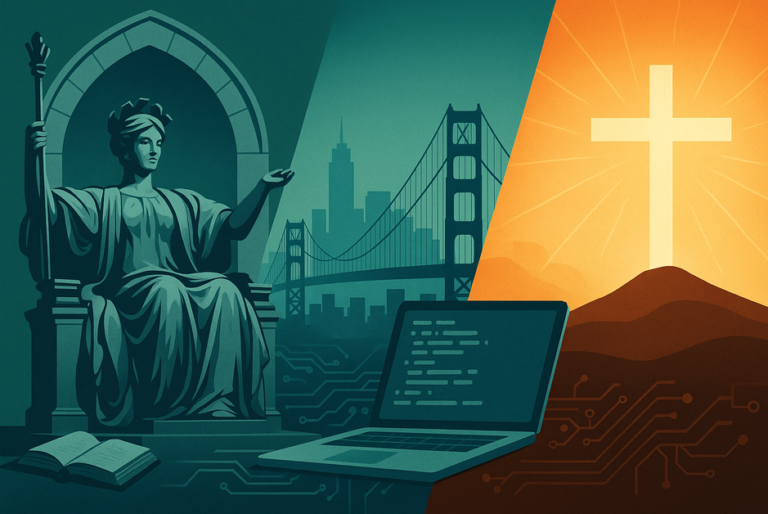
And at the center of my long and winding path, from Kentucky to the Ivy League, from Silicon Valley to the Cross, I found Christ: the answer to violence, the hope of forgiveness, and the foundation for our future.






;?>/smartquizbuilder/includes/images/sqb-registration-img.jpg)