This article is #5 of a weekly series highlighting the former memes of Bureaucrash, an organization once headed by my friends Pete Eyre and Jason Talley of the Motorhome Diaries. The memes were originally authored by Pete Eyre and Anja Hartleb-Parson, and were intended as means of communicating ideas about liberty in catchy and succinct ways.
—-
Capitalism is the only moral social system. Only a capitalist system allows you to act in your own interest, to keep what you have worked for and trade it with other willing individuals. For much of human history, wealth has been produced primarily by looting or enslaving others. Under capitalism wealth is created by serving others, by creating values for them. Individuals who produce the best goods and services are rewarded by making the most profit. Those who produce shoddy goods, mediocre services or try to defraud others are weeded out when exposed.
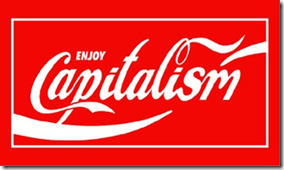 Capitalism is win-win. Producers only make profits on goods and services that consumers choose to buy. Competition among producers ensures that consumers have a variety of goods and services at different price ranges to choose from. Workers and employers come together based on mutual consent. Employers can choose to fire incompetent workers, and workers can choose to leave an employer for a better job. Competition among employers for qualified workers drives wages and benefits up. Whereas politics is a zero-sum game in which power and tax dollars are redistributed from one group to another, capitalism continuously creates more wealth, thereby growing the pie and increasing prosperity for all.
Capitalism is fair. Capitalism is predicated upon and respects individuals’ free choices. No one has to pay for what he does not want and derives no benefit from. Under capitalism, individuals and businesses cannot seek politically enforced advantages or handouts. For instance, in a capitalist system steel producers would not be able to obtain tariffs and subsidies in order to avoid being undersold or driven out of business by foreign competitors, and a workers’ union could not get government to force employers to provide higher wages, more benefits and greater job security. Unable to run to the government for help, these groups must prove themselves entirely based on the worth of the goods and services they produce. That is fair to consumers and competitors.
Capitalism empowers the consumer. The consumer votes for or against goods and services with his money. If companies do not offer the kinds of goods and services consumers want to buy, they fail — but their demise inspires the emergence of new markets, new products, new services, and new methods of production. In this way, capitalism promotes innovation and efficiency through a process of creative destruction. Capitalism also fosters the creation of mass communication tools such as the internet. Thus, consumers can make informed decisions about what to purchase and can let others know about the quality of that purchase. Many consumers united together can persuade a producer to lower prices or change his product or service for the better.
Capitalism reflects human nature. People have limited knowledge. State-planned economies fail because no bureaucrat or committee, no matter how well educated in economics, has the knowledge to coordinate the actions of millions of individuals. People are also motivated by different values. Under capitalism people can pursue their chosen values, provided of course that they do not violate the rights of others. Pursuing values and being allowed to keep, dispose of and profit from the results of that pursuit motivates people to take care of things, to produce, and to innovate. Further, by tapping into human beings’ competitive nature, capitalism makes everything better. Just compare the best car created under a capitalist system to the best car created under a socialist system, where competition is suppressed.
Capitalism fosters benevolence. When individuals are well-off, as would be the case for the bulk of individuals under capitalism (perhaps only those currently receiving special treatment from some government body would be the exception), they have time and money to take care of others. Further, if they have the right to keep what they have worked for and dispose of it in the way they choose, they are more likely to embrace helping people in need and give more than if their money is forcibly taken from them by the government via taxation. For instance, you might already donate money to your local homeless shelter, food pantry or to an organization working for a cause that is very important to you. But if you were not taxed as heavily as you are, you might be willing and able to donate more.
Capitalism makes everyone richer. Even the least well-off person in a developed country today lives a life of luxury beyond the wildest dreams of the richest kings centuries ago: consider televisions, computers, iPods, cell phones, microwaves, cars, washing machines, or air conditioning. Compare how poor people live in the United States today to how they lived in the US a hundred years ago, or to how they live in Third World countries today. In fact, capitalism is our best hope for alleviating and eventually eradicating poverty worldwide because it creates more wealth — for everyone — than any other social system.
Capitalism promotes peace. Capitalist countries are less likely than non-capitalist countries to initiate violence against their citizens or against other countries. Where people come together for mutually beneficial interaction such as trade, issues of race, religion, ethnicity, gender, or sexual orientation are less important. What matters is whether you can offer me the kinds of goods and services I want for the price I am willing to pay.