Archive for Edmund Opitz
Edmund Opitz – Minister to Liberty
Posted by: | CommentsThis article first appeared in Young American Revolution magazine in the March 2010 issue.
If a patron saint for the libertarian movement were to be chosen, at the top of the list would be Rev. Edmund A. Opitz, minister and theologian for liberty. He was a good friend of Murray Rothbard and many others in the freedom movement—he was present from the beginning and knew almost everyone. From the 1950s through the 1990s, Opitz called the church to an integrated understanding of religion, economics, and individual liberty. He passed away in 2006, creating a void yet to be filled but leaving this world much better than he had found it. Read More→
Please support LCC by sharing this post on your favorite social network.
Tags: christian libertarian, Christianity, Edmund Opitz, individualism, libertarian christian, philosophy, theology, YAL
Related Content:
The Liberating Arts
Posted by: | CommentsBy Edmund Opitz.
The recent movie called Out of Africa has acquainted millions of Americans with the name of a Danish Baroness Blixen, whose pen name was Isak Dinesen. The movie is based on Dinesen’s 1938 book, a semi-autobiographical work called Out of Africa. Four years earlier, in 1934, Isak Dinesen had published a work entitled Seven Gothic Tales, really seven short novels within the covers of a single book. One of these Gothic tales was set in the Paris of several generations ago and consisted mainly of the reminiscences of an old gentleman. There is a story within this larger story involving an Armenian organ grinder and his pet monkey. Some of you may recall seeing this type of street musician who would wander through city neighborhoods carrying, slung over his shoulder, a kind of music box the size of an accordion, a crank on its side. This contraption was set atop a pole, which supported the weight of the music machine when the man stopped to perform. The man would be dressed in a sort of gypsy costume, and as the entertainer cranked out his tunes his little capuchin monkey would pass through the crowd collecting coins, which he’d turn over to his master. This in itself was quite a stunt; but this little monkey was cleverer than most of his kind, because his master had taught him to perform a great variety of crowd-pleasing tricks, each one triggered by a word of command—in Armenian.
Please support LCC by sharing this post on your favorite social network.
Tags: Edmund Opitz, education
Related Content:
Constitutional Restraints on Power
Posted by: | CommentsBy Edmund Opitz.
American political institutions presuppose certain convictions about human nature, the worth and prerogatives of persons, the meaning of life, the distinction between right and wrong, and the destiny of the individual. The Colonists came to their understanding of these matters as heirs of the intellectual and religious heritage of Christendom—the culture whose shaping forces sprang from ancient Israel, Greece, and Rome.
Given the consensus of two centuries ago—which regarded man as a sovereign person under God—it was only logical to structure government so as to expand opportunities for the exercise of personal freedom. The Constitution is clearly designed to maximize each individual’s equal right to pursue his own peaceful goals and enjoy the benefits and responsibilities of ownership.
The Declaration of Independence put into words what nearly everyone was thinking, that personal rights and immunities are ours because we are created beings, that is, we manifest a major purpose and intent of this universe. This implies a firm rejection of the alternative, which is to assume that we are the mere end products of natural and social forces, adrift in a meaningless cosmos. For if the universe is meaningless, then no way of life is any more meaningful than any other; in which case Power has no limits.
Our forebears had firm convictions about the purpose of life, and knew that in order to achieve life’s transcendent end Power must be limited: “Resistance to tyrants is obedience to God,” they declared. If life is viewed in these terms, how shall we conceive the proper scope and competence of government? What is its role in society? What functions should we assign to it?
Government is the power structure of a society. This is the first and most important fact about the political agency, that it has the legal authority to coerce. The second thing is to inquire whether the power wielded by government is self-sprung, or delegated by a more comprehensive authority than the merely political. Does government rule autonomously or by divine right; or is the real power located elsewhere and merely loaned to government? The Constitution is clear on this point; the power is in the people to lay down the laws which Power must obey. They set it up; they tell it what to do.
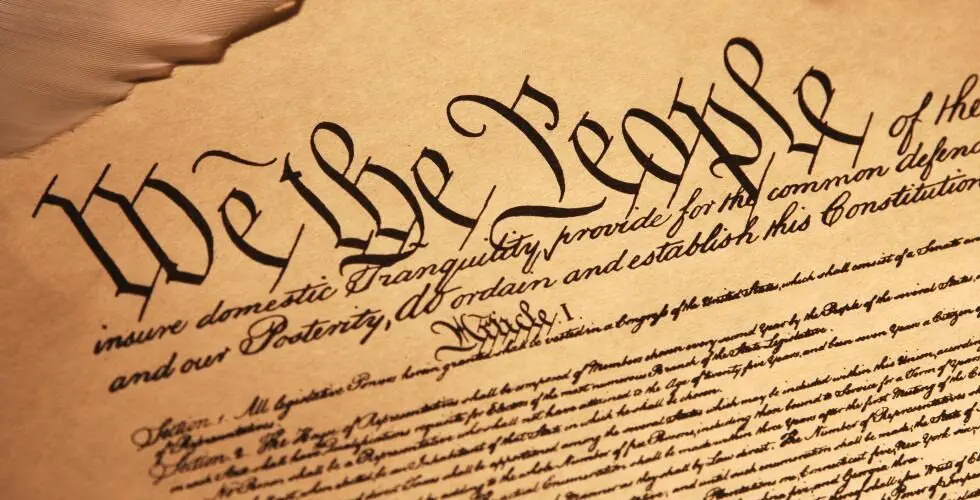
“We, the People of the United States,” reads the Preamble, “do ordain and establish this Constitution for the United States of America.”
Specific Limitations
The people empower an agency to do certain things for them as a nation, but if we isolate the provisions they laid down to limit government the prevailing intent or consensus which made the Constitution its political tool becomes clearer.
The powers not delegated to the United States by the Constitution, nor prohibited by it to the States, are reserved to the States respectively, or to the people. Amendment X
The people, furthermore, possess a body of rights by native endowment above and beyond those mentioned in the Constitution.
The enumeration in the Constitution of certain rights, shall not be construed to deny or disparage others retained by the people. Amendment IX
These sovereign people shall be free to worship, speak, and publish freely.
Congress shall make no law respecting an establishment of religion, or prohibiting the free exercise thereof. Amendment I
Congress shall make no law . . . abridging the freedom of speech. Amendment I
Congress shall make no law . . . abridging the freedom . . . of the press. Amendment I
Voluntary association is the corollary of individual liberty, and this is emphasized, as well as the right of petition.
Congress shall make no law . . . abridging . . . the right of the people peaceably to assemble. Amendment I
Congress shall make no law abridging . . . the right of the people . . . to petition the Government for a redress of grievances. Amendment I
The old world divisions of mankind into castes and orders of rank are to be no more.
No title of nobility shall be granted by the United States. Article I, 9
Every citizen shall have a right to participate in the processes by which the nation is governed; and, should he desire to run for public office he shall not be put to a creedal test.
The right of the citizens of the United States to vote shall not be denied or abridged. . . . Amendments’ XV and X1X
No religious test shall ever be required as a qualification to any office or public trust under the United States. Article VI
Freedom to Trade; No Special Privilege
Commerce makes for a free and prosperous people, so restraints on trade shall be removed.
No tax or duty shall be laid on articles exported from any State. . . . Article 1, 9
No preference shall be given by any regulation of commerce or revenue to the ports of one State over those of another. Article I, 9
Progressive taxation violates the principle of equal treatment under the law—penalizes ability, and lowers productivity, so it is forbidden.
No capitation, or other direct, tax shall be laid, unless in proportion to the census. . . . Article I, 9
The public treasury shall be inviolate; government shall not confer economic privilege on some at the expense of others.
No money shall be drawn from the Treasury, but in consequence of appropriations made by law. Article I, 9
Personal privacy shall be respected and jealously guarded.
The right of the people to be secure in their persons, houses, papers, and effects . . . shall not be violated. Amendment IV
Conflict is a built-in feature of human action, and when collisions of interest do occur in society, the rights of the individual must be maintained.
No person shall . . . be deprived of life, liberty, or property, without due process of law. Amendment V
Nor shall private property be taken for public use without just compensation. Amendment V
Strings on the Military
In some nations, the civilian life is a mere appendage to the military. This will not happen here because civilians control the purse strings.
No appropriation of money (to raise and support military and naval forces) shall be for a longer term than two years. Article 1, 8
As a further safeguard against any future militarization of this nation, the civilian sector must have the means for defending itself.
The right of the people to keep and bear arms, shall not be infringed. Amendment II
In some countries, criminal proceedings are used to entrap citizens, whose guilt is assumed; the burden of proof is on them to show their innocence. Here, the innocence of the accused is assumed, until his guilt is proved. The law shall not reach backward to designate as criminal an action which until then was innocent.
No . . . ex post facto law shall be passed. Article I, 9
There shall be no Star Chamber proceedings.
No person shall be held to answer for a capital, or otherwise infamous crime, unless on a presentment or indictment of a Grand Jury. Amendment V
Protecting the Accused
The accused is protected against illegal imprisonment, and must be informed of the charges against him.
The privilege of the writ of habeas corpus shall not be suspended. Article I, 9
Punishment shall fit the crime; it shall not mean extinction of civil rights, forfeiture of property, or penalties against kin.
No bill of attainder . . . shall be passed. Article 1, 9
The accused is entitled to be tried by his peers.
. . . the right of trial by jury shall be preserved. Amendment VII
There is to be no forced self-incrimination.
Nor shall [he] be compelled in any criminal case to be a witness against himself. Amendment V
The rights of the accused are summarized:
1. . . . . a speedy and public trial, by an impartial jury;
2. Within the district wherein the crime shall have been committed;
3. to be informed of the nature and cause of the accusation;
4. to be confronted with the witnesses against him;
5. to have compulsory process for obtaining witnesses in his favor;
6. and to have the assistance of counsel for his defense. Amendment VI
Even when found guilty, the accused is protected.
1. Excessive bail shall not be required;
2. Nor excessive fines imposed;
3. Nor creel and unusual punishments inflicted. Amendment VIII
Treason
Treason is a crime against the nation, so serious that it must be defined with special care.
Treason against the United States, shall consist only in levying war against them, or in adhering to their enemies, giving them aid and comfort. Article III, 3
The person judged guilty of treason is personally responsible for his crime, and therefore his family and kin shall not be punished.
No attainder of treason shall work corruption of blood. Article III, 3
Impeachment is a special case.
The Senate shall have the sole power to try all impeachments . . . and no person shall be convicted without the concurrence of two-thirds of the members present.
Judgment . . . shall not extend further than to removal from office, and disqualification to hold any office of honor, trust or profit under the United States. Article I, 3
A blind spot in the original Constitution is corrected.
Neither slavery, nor involuntary servitude, except as punishment for crime . . . Amendment XIII
No state shall . . . deny to any person within its jurisdiction the equal protection of the laws. Amendment XIV
The separate states are not wholly sovereign.
No state shall enter into any treaty . . . coin money . . . pass any law impairing the obligation of contracts. Article I, 10
The Method of Freedom
There is a strong penchant in human nature which impels people who feel strongly about something—a good cause, say—to group their forces and use the power of government to fasten their panacea on those they’ve been unable to persuade. The Constitution is a prime example of the limitations placed upon governmental power so that people with a cause to advance must resort to education, persuasion, and example only. This is the method of freedom, and a people committed to the method of freedom find the Constitution still an apt instrument for structuring a society which maximizes freedom and opportunity for all persons. It was designed to establish a national government internally controlled by checks and balances between the separate powers. And government was to be further limited by the Federal structure itself, in which the centripetal power of Washington was to be offset by the centrifugal powers of the separate states.
The Constitution was not a perfect document, but it carried the means of its own correction, and it did embody the consensus of the people for whom freedom was the prime political good. It was workable. And it will work again whenever a significant number of people have the force of intellect to comprehend sound ideas, and the force of character to make them prevail.
Originally published in The Freeman. This article originally appeared in the April 1978 Freeman and was reprinted in September 1987 to mark the 200th anniversary of the completion of the writing of the U.S. Constitution.
Read more from the Edmund Opitz Archive.
Please support LCC by sharing this post on your favorite social network.
Tags: constitution, Edmund Opitz, philosophy, power
Related Content:
Equal But Not the Same
Posted by: | CommentsBy Edmund Opitz.
The real American revolution of two hundred years ago took place in the minds of people; it was a philosophical revolution which evolved a new temper and state of mind. There were some dating assumptions about the nature of the human person, with his Creator-endowed rights, as set forth in the catalog of self-evident truths contained in the Declaration of Independence. The acceptance of these novel truths about the human person led logically to a new conception of government, a theory of right political action radically different from all previous theories of the purposes of government in human affairs.
Government, according to the Declaration, is instituted for one purpose only—to secure every person in his God-given rights. Period. No longer was the State to exercise the positive function of ordering, regulating, controlling, directing, or dominating the citizens. The new idea was to limit government to a negative role in society; government’s task is to protect life, liberty, and property by using lawful force against aggressive and criminal actions. Government would discipline the anti-social, but otherwise let people alone. The law was to apply equally to all; justice was to he impartial and even-handed.
Along with the words Life, Liberty, and Property, the word Equality has a prominent place in the political vocabulary of American thought.
Our Declaration of Independence reads: “We hold these truths to be self-evident, that all men are created equal.” Note well that the men who prepared this document did not say that all men are equal; they did not say that all men are born equal or should be equal, or are becoming equal. These several propositions are obviously untrue. The Declaration said: “created equal.” Now, the created part of a man is his soul or mind or psyche. Man’s body is compounded of the same chemical and physical elements which go into the makeup of the earth’s crust, but there is a mental and spiritual essence in man which sets him apart from the natural order. Man alone among the creatures of earth is created in God’s image—meaning that man has free will, the capacity to order his own actions, and so become the kind of person God intends him to be.
The political theory enunciated in the Declaration is based upon certain assumptions about human nature and destiny which were ingredients of the religion professed by our fore-bears. It was an article of faith in the religious tradition of Christendom — a culture compounded of Hebraic, Greek, and Roman elements – that man is a created being. To say that man is a created being is to affirm that man is a work of divine art and not a mere accidental by-product of physical and chemical forces. Man is God’s property, said John Locke, because He made us and the product belongs to the producer. As an owner, God cares for that which belongs to Him. Therefore, the soul of each person is precious in God’s sight, whatever the person’s outward circumstances. “God is no respecter of persons.” (Acts 10:34) He “. . . makes His sun to rise on good and bad alike, and sends the rain on the honest and dishonest.” (Matt. 5:45) Equality before the law is the practical application of this understanding of the nature of the human person. Equal justice means that a nation’s laws apply, across the board, to all sorts and conditions of men, regardless of race, creed, color, position, pedigree, income, or whatever. In the eyes of the law, all are alike.
But right there the likeness ends; human beings are different and unequal in every other way; they are male and female, in the first place—and they are tall and short, thick and thin, weak and strong, rich as well as poor, and so on. They are equal in one respect only; they are on the same footing before the law. Equality before the law is the same thing as political liberty viewed from a different perspective; it is also justice—a regime under which no man and no order of men is granted a political license issued by the State to use other men as their tools or have any other legal advantage over them. Given such a framework in a society, the economic order will automatically be free market, or capitalistic. (We are speaking now of the idea of equality in a political context. Later I shall deal with the opposing concept of economic equality, which is incompatible with limited government and the free market.)
Political Equality
Political equality is the system of liberty, and its leading features are set forth in Jefferson’s First Inaugural Address: “Equal and exact justice to all men, of whatever state or persuasion, religious or political; peace, commerce, and honest friendship with all nations,—entangling alliances with none . . . freedom of religion, freedom of the press; freedom of person under the protection of the habeas corpus” and so on.
The idea of political equality—equal justice before the law—is a relatively new one. It did not exist in the ancient world. Aristotle opened his famous work entitled Politics with an attempted justification of slavery, concluding his argument with these words: “It is clear, then, that some men are by nature free, and others slaves, and that for these latter slavery is both expedient and right.”
Plato conceived the vision of a society constructed like a pyramid. A few men are at the top wielding unlimited power; then descending levels of power—the men on each level being bossed by those above and bossing, in turn, those below. On the bottom are the slaves, who outnumber all the rest of society. Plato knew that those in the lower ranks would be discontented with their subservient position, so he proposed a myth to condition them with—in his words—a “noble lie,” or an “opportune falsehood.” “While all of you in the city are brothers, we will say in our tale, yet God in fashioning those of you who are fitted to hold rule mingled gold in their generation . . . but in the helpers silver, and iron and brass in the farmers and other craftsmen.” You know dam well that fraudulent theories of this sort are in vented by men who suspect gold in their own makeup!
Hinduism, with its system of castes, provides a contemporary example of a system of privilege. Men are born into a given caste, and that’s where they stay; that’s where their ancestors were, and that’s where their descend ents will be. There is no ladder leading from one level in this society to any of the others. Hinduism justifies these divisions between men by the doctrine of reincarnation, arguing that some are suffering now for misdemeanors committed during a previous existence, while others are being rewarded now for earlier virtue. This outlook breeds fatalism and social stagnation. The eminent Hindu philosopher and statesman, S. Radhakrishnan, defends the caste system with a metaphor. He likens society to a lamp and says, “When the wick is aglow at the tip the whole lamp is said to be burning.”
Politics—it must be emphasized—rests upon certain assumptions in basic philosophy. We of the West make different philosophical assumptions than do Greek and Hindu philosophers, for we have a different religious heritage than they. The fountain source of the religious heritage of Christendom is, of course, the Bible. The Bible was the textbook of liberty for our forebears, who loved to quote such texts as “Where the spirit of the Lord is, there is liberty,” (2 Cor. 3:17) and, “You shall know the truth, and the truth shall make you free.” (Jn. 8:32) And they turned often to the Old Testament prophets with their emphasis on justice and individual worth.
Let me quote a few lines from an unsigned editorial appearing in the magazine Fortune some years ago:
The United States is not Christian in any formal sense, its churches are not full on Sundays and its citizens transgress the precepts freely. But it is Christian in the sense of absorption. The basic teachings of Christianity are in its bloodstream. The central doctrine of our political system—the inviolability of the individual—is the doctrine inherited from 1900 years of Christian insistence upon the immortality of the soul.
It takes a while, centuries sometimes, for a new idea about man to seep into the habits, laws, and institutions of a people and shape their culture. It was not until the eighteenth century that Adam Smith came along and spelled out a system of economics premised on the freely choosing man. Smith referred to his system as “the liberal plan of equality, liberty and justice.” The European society of Smith’s day was, by contrast, a system of privilege; it was an aristocratic order.
The Rise of Aristocracy
England’s aristocratic order did not rise by accident; it was imposed by a conqueror. England’s social structure may be traced back to the battle of Hastings in 1066 and the Norman invasion of England. William of Normandy had a claim, of sorts, to the British throne, a claim which he validated by conquering the island. Having established his overlordship of England he parceled out pieces of the island to his followers as payment for their services. In the words of historian Arthur Bryant, “William the Conqueror kept a fifth of the land for himself and gave one-quarter to the Church. The remainder, save for an insignificant fraction, was given to 170 Norman and French followers—nearly half to ten men.” [1] In other words, 55 per cent of the territory of England was divided among 170 men, ten of whom got the lion’s share, or 27 per cent among them, while 160
men got the rest. This redistribution of England’s territory was, of course, at the expense of the Anglo-Saxon residents who were displaced to make room for the new owners. The new owners of England from William on down were the rulers of England; ownership was the complement of their rulership, and the wealth they accumulated sprang from their power and their feudal privileges and dues.
Norman overlordship was a system of privilege. That is to say, the Norman rulers did not obtain their wealth by satisfying consumer demand. Under the system of liberty, by contrast, where the economic arrangements are free market or capitalistic, the only way to make money is to please the customers. Under the various systems of privilege you make money by pleasing the politicians, those who hold power. Either that, or you wield power yourself.
This was a fine system—from the Norman viewpoint; but the Anglo-Saxon reduced to serfdom viewed the matter quite differently. It was obvious to the serf and the peasant that the reason why they had so little land was because the Normans had so much and, because wealth flowed from holdings of land, the Anglo-Saxons reasoned correctly that they were poor because the Normans were rich! It is always so under a system of privilege, where those who wield the political power use that power to enrich themselves economically, at the expense of other people. It makes little difference whether the outward trappings of privilege are monarchical, or democratic, or bear the earmarks of 1984; in a system of privilege, political power is a means of obtaining economic advantage.
When our forebears wrote that “all men are created equal,” they threw down a challenge to all systems of privilege. They believed that the law should keep the peace—as peacekeeping is spelled out in the old-fashioned Whig-Classical Liberal tradition, as liberty and justice for all. This preserves a free field and no favor—which is the real meaning of laissez faire—within which peaceful economic competition will occur. The term laissez faire never meant the absence of rules; it doesn’t imply a free-for-all. Government, under laissez faire, does not intervene positively to manage the affairs of men; it merely acts to deter and redress injury—as injury is spelled out in the laws. This is the system of liberty championed by present-day exponents of the freedom philosophy—whether they call themselves Libertarians, or Conservatives, or Whigs, or whatever.
The Wealth of Nations
Adam Smith’s “liberal plan of equality, liberty and justice” was never practiced fully in any nation, but what was the result of a partial application of the ideas of The Wealth of Nations? The results of abolishing political privilege in Europe and starting to organize a no-privilege society with political liberty and a market economy were so beneficial that even the enemies of liberty pause to pay tribute.
R. H. Tawney, one of the most gifted of the English Fabians, was an ardent socialist and egalitarian. His most famous work is Religion and the Rise of Capitalism, but in 1931 he wrote a book entitled Equality, arguing, in effect, that no one should have two cars as long as any man was unable to afford even one. He wished to take from those who have and give to those who have not, in order to achieve economic equality. But he acknowledged that there was an earlier idea of equality—equal treatment under the law. Here is what Tawney writes about the beneficial results of the movement toward political liberty and the free economy in the early decades of the nineteenth century, the movement known as Classical Liberalism:
Few principles have so splendid a record of humanitarian achievement . . . Slavery and serfdom had survived the exhortations of the Christian Church, the reforms of enlightened despots, and the protests of humanitarian philosophers from Seneca to Voltaire. Before the new spirit, and the practical exigencies of which it was the expression, they disappeared, except from dark backwaters, in three generations . . . . It turned [the peasant] from a beast of burden into a human being. It determined that, when science should be invoked to increase the output of the soil, its cultivator, not an absentee owner, should reap the fruits. The principle which released him he described as equality, the destruction of privilege. [2]
Smith’s “liberal plan of equality, liberty and justice”means the practice of political liberty. Now, when people are free politically and legally equal, there will still be economic inequalities. There will continue to be rich and poor, as there have been wealth differentials in every society since history began. But now there’s this difference: in the free economy the wealthy will be chosen by the daily balloting of their peers in the marketplace, and the wealthy won’t necessarily be the powerful, nor will the poor necessarily be the weak.
Variation is a fact of life; individuals differ one from another. Some are tall and some are short; some are swift and some are slow; some are bright and others are not so bright. The talents of some lie along musical lines, others are athletes, a few are mathematical wizards. Some people in every age are highly endowed with a knack for making money; whatever the circumstances, these people have more worldly goods than others.
Rich and poor are relative terms, but every society reveals a population distribution ranging from opulence to indigence. This occurs under monarchies, and it occurs in primitive tribes which measure a man’s wealth by cattle and wives; it occurs in communist states where, as Milovan Djilas pointed out in a famous book, a “new class” emerges out of the classless society, and the “new class” enjoys privileges denied the masses.
Under the system of liberty, the free market will reward men in differing degrees so that some men will make a great deal of money while others, such as teachers and preachers, have to get by on a very modest income. But under the system of liberty even those in lower income brackets enjoy a relatively high standard of living, and, furthermore, the practice of the Rule of Law guarantees that there’ll be no persecution for deviant intellectual and religious beliefs. The government does not try to manage the economy or control the lives of the citizens; it keeps out of people’s way—unless rights are violated.
Under conditions of political equality—which is the system of liberty, with the Rule of Law and the market economy—a man’s income depends upon his success at pleasing consumers, at which game some people are much more successful than others. A certain American entertainer earned millions of dollars last year by gyrating and howling in public places. He didn’t get any of my money, and except for the fact that I believe in liberty, I might have paid a substantial sum to keep him permanently tranquilized! On a somewhat higher level, there are talented people who are sensitive to consumer demand, and so they produce the kinds of goods or render the kinds of services that people will be able and willing to buy. They’ll make a bundle, in virtue of their ability to attract customers in free market competition.
Our own country’s past affords the best example of the enormous multiplication of wealth—broadly shared—which results from the release of human creativity under a system of liberty. But reintroduce a system of privilege, and dreams of prosperity fade.
Helping the Poor
The big domestic issue is poverty. Ever since New Deal days in the 1930s, governments have legislated various welfare schemes designed ostensibly to help “the poor,” spending trillions of dollars in these efforts. And the big issue is still poverty! it’s only the relative prosperity of the private sector, working against politically imposed obstructions, which has provided the funds to fuel the futile political programs touted as the remedy for economic distress. These are false remedies. The truth of the matter is that only economic action can produce the goods and services whose lack is indigence and destitution. Misguided political programs actually manufacture poverty by hampering productivity. Should we trust further government interventions to correct the very conditions government has caused by its earlier interventions?
Poverty may be measured in various ways, but whatever else it is, poverty means a lack of the things which sustain Fife at the basic level, or not enough of the things which make life pleasant and enjoyable. A genuinely poor person in the United States lives in a shabby room, dresses in hand-me-down clothing, and eats meals running heavily to starchy food, with little meat and fruit. A person who is this poor would be better off if he enjoyed a larger and finer house, had several extra suits, and ate tastier and more nourishing food. After improving the situation at the level of necessities he’d move ahead to the amenities: to recreation, a second car, air conditioning, and so on. The point to note is that people move away from poverty and toward prosperity only as they command more economic goods, more of the things which are manufactured, grown, transported, or otherwise produced.
Poverty is overcome by production, and in no other way. Therefore, if we are seriously concerned with the alleviation of poverty, our concern for increased production must be equally serious. This is simple logic. But look around us in this great land today and try to find anyone for whom increased productivity is a major goal. There are some able production men in industry, but many established businesses have learned to live comfortably with restrictive legislation, government contracts, the foreign aid program, and our international commitments. The competitive instinct burns low, and the entrepreneur who is willing to submit to the uncertainties of the market is a rare bird. And then there are the farmers. Agricultural production has taken a great leap forward in recent years, but no thanks to those farmers who latch onto the government’s farm program and accept payment for keeping land and equipment idle. Union leaders claim to work for the betterment of the membership, but no one has ever accused unions of a burning desire to be more productive on the job. Politicians are not interested in increased industrial or agricultural production, which is why government welfare programs manufacture poverty, and the economic well-being of the nation as a whole sinks below the level of prosperity a free market economy would achieve.
Confirmation of this point comes from a New York Times Magazine article by the celebrated economist, Thomas Sowell:
To be blunt, the poor are a gold mine. By the time they are studied, advised, experimented with and administered, the poor have helped many a middle class liberal to achieve affluence with government money. The total amount of money the government spends on its anti-poverty efforts is three times what would be required to lift every man, woman, and child in America above the poverty line by simply sending money to the poor.
An overall increase in the output of goods and services is the only way to upgrade the general welfare, but there is no clamor on behalf of increased productivity. The clamor is for redistribution, for political interventions which exact tribute from the haves and bestow largesse on the have-nots. Present-day politics is based on the redistributionist principle: taxes for all, subsidies for the few.
I’m arguing on behalf of a philosophy of government which understands the primary function of the Law as the defense of the life, liberty, and property of all persons alike. Such a political establishment leads to the kind of society in which bread and butter issues are handled by the market. So now, a few words about the nature of the market.
The market is not a magic instrumentality which comes up automatically with the fight answer for every sort of question. The market is a sort of popularity contest; the market tells us what people like well enough to buy; it’s an index of their preferences. Thus, the market provides a very valuable piece of information, but it’s far from the whole story. It’s important for a manufacturer to project an accurate guess as to where the hemline will be next season, or what people will look for when the new car models are unveiled. But a similar fingering of the popular pulse is an abomination in the intellectual and moral realms—unless one is a liberal intellectual! I refer to the proclivity of the current crop of liberal opinion molders to ask: “What’s going to be the fashion in ideas next season?” One glaring example of this—a former professor of mine was a leading clerical spokesman for involving the United States in World War II; but when the climate of opinion changed he became a co- chairman of SANE. This man has a good market in the intellectual realm, but of course he opposes the market in the economic realm!
The market is not some entity; the market is only a word describing people freely ex-changing goods and services in the absence of force and fraud. The market is the only device available for serving our creaturely needs while conserving scarce resources. But the market is no gauge of the validity of ideas. The market measures the popularity of an idea or a book or a system of thought, but not its truth or worth. Mises and Hayek are, for my money, far better thinkers and economists than Samuelson and Galbraith; but the market for the services of the latter pair is enormously greater than the popular demand for Mises and Hayek. Likewise in aesthetic questions. An entertainer’s popularity is no index of his musicianship, and a best-selling novel may fall far short of the category of literature.
The Market as Mirror
The market is simply a mirror of popular preferences and public taste; but if we don’t like what the mirror reveals we won’t improve the situation by throwing rocks at the glass! There is a great deal more to life than pleasing the customer, but if the integrity of the market is not respected, consumer choice is impaired and some people are given a license to foist their values on others. Permit this kind of poison to infect economic relationships and our ability to resist it elsewhere is seriously weakened.
We are throwing rocks at the mirror whenever we undertake programs of social leveling, aimed at economic equality. The government promises to aid the poor by redistributing the wealth. This, of course, is a power play, and it is the poor—generally the weakest members of a society—who are hurt first and most in any power struggle. Furthermore—and this is an important point—economic inequalities cannot be overcome by coercive redistribution without increasing political inequalities. Every form of political redistribution widens power differentials in society; officeholders have more power, citizens have less; political contests become more intense, because the control and dispersal of great amounts of wealth are at stake.
Every alternative to the market economy—call it socialism or communism or fascism or whatever—concentrates power over the life and livelihood of the many into the hands of the few who constitute the State. The principle of equality before the law is discarded—the Rule of Law is incompatible with any form of the planned economy—and, as in the George Orwell satire, some people become more equal than others. We head back toward the Old Regime—the system of privilege.
Those who have assumed Or seized power to take from the “haves” and give to the “have-nots” will eventually realize that they are operating a dumb racket. The “have-nots” who may be on the receiving end at the beginning are generally not society’s best and brightest, not the kind of people the power brokers like to hobnob with. The politically powerful who operate the transfer system will—when the light dawns—continue to plunder the “haves” but will then divvy up their take between themselves and the beautiful people who possess enough sensibility to realize the rightness of running a society for the benefit of such as they! The poor are squeezed out; they are worse off than before. And the nation is saddled with the “democratic despotism” predicted by Alexis de Tocqueville as far back as 1835.
Those of you who are fans of Lewis Carroll will remember his poem, “The Hunting of the Snark.” Hunters pursued this strange beast, but every time they thought they had their quarry the snark turned out to be a quite different beast—a boojum! Every time a determined group of people have concentrated power in a central government to carry out their program, the power they have set up gets out of hand. The classic example of this is the French Revolution, which turned and devoured those who had started it. It is not so much that power corrupts, as that power obeys its own laws. Our forebears in the old-fashioned Whig-Classical Liberal tradition were aware of this, so they sought to disperse and contain power. They chose liberty. They chose liberty in full awareness that in a free society the natural differences among human beings would show up in various ways; some would be economically better off than others. But in a free society there would be no political inequality; everyone would be equal before the law.
The alternative to the free economy is a servile state, where a ruling class enforces an equality of poverty on the masses, and lives at the expense of the producers. To embark on a program of economic leveling, then, is like trying to repeal the law of gravity; it’ll never work, and the energy we waste trying to make it work defeats our efforts to attain the reasonable goals which are within our capacity to achieve.
- – - – - – - – - –
1. Story of England, Arthur Bryant, Vol. I. p. 164.
2. Equality, R. H. Tawney, pp. 120-121.
Originally published in The Freeman, April 1988.
Read more from the Edmund Opitz Archive.
Please support LCC by sharing this post on your favorite social network.
Tags: Edmund Opitz, equality, philosophy
Related Content:
Human Nature and the Free Society
Posted by: | CommentsBy Edmund Opitz.
Is there anything in the basic makeup of the men and women we know, or those we read about in the press, or encounter in the pages of history texts, which encourages us to believe that the free society we strive for is a realistic possibility?
Edward Gibbon, the great historian of Rome’s decline and fall, offered, as his considered judgment, the opinion that “History is little more than a register of the crimes, follies, and misfortunes of mankind.” The bleakness of this assessment is redeemed somewhat by the inclusion of the words “little more.” Human nature does have its dark underside which pulls us down below the norm and produces the crimes, follies, and misfortunes recorded by historians.
But there is more to our story than this; there is also a record of the geniuses in every field—including heroes and saints—who demonstrate the realized potential of our common humanity. And then there are the multitudes who are just plain, ordinary, decent, hardworking folks, uplifted on occasion by the magnetism of those who rise above the average, and sometimes seized by a madness of sorts when the criminal and depraved acquire a kind of glamour.
Every society takes on its unique characteristics from the people who compose it; we are the basic ingredients of our society. The human story is a checkered affair; some ups, many downs. Does a realistic appraisal of our history on this planet provide any warrant for believing that we human beings are capable of approximating a truly free society with its market economy?
I propose to deal with four features of human nature and conduct which give me confidence that in the constitution of ordinary men and women are the characteristics which incline them to strive for a freer life with their fellows. I shall list these four points and then discuss them.
1. There is a strong instinct in all men and women to be free to pursue their personal goals.
2. There is a universal need in each of us to call something our very own; an instinct for property.
3. There is an upward thrust in human nature to live a life that is not simply more comfortable, but better in a moral sense. We really believe in fair play; we respond to the ideals of justice.
4. The market is everywhere; people in every part of the globe have sought to better their economic circumstances by barter and trade. The market is universal; but only occasionally does the market become institutionalized as the market economy.
First Point—Freedom
Every person has a deeply rooted urge to be free to pursue his chosen goals; it is impossible to imagine a person, who is determined to accomplish a certain task, inviting people to hinder or prevent him from getting his job done. Even a dictator as vicious as Stalin, one of whose aims was to extinguish personal freedom in a great nation, demanded complete freedom to pursue his evil goals. Anyone who tried to hinder him was shortly referred to in the past tense.
But despite the universal urge for full personal liberty, most people who have ever lived have been slaves, serfs, bondsmen, thralls, helots, Sudras, retainers, lackeys, vassals, liege men, and the like. Despite the fact that every person wants to be free to live on his own terms, most of the earth’s people have lived wholly or in part on terms laid down by someone else. There are more of them today than ever before. A powerful instinct for individual liberty animates virtually every man and woman, but this universal urge to be free has been fully institutionalized only once in history—in the theory and practice of old-fashioned Whiggery and Classical Liberalism, rising and falling during the period, approximately from the American Revolution to the early twentieth century.
Second Point—Property
The sense of personal identity is aroused in us early in infancy; it suddenly dawns on each of us that “I am me!” The seeds of our lifelong personal uniqueness are planted early. As soon as we learn to think “me” we begin to think its inevitable corollary, “mine.” Every child, early on, comes to regard certain toys as his own. Each of us grows into a property relationship with things in his environment long before he evolves a theory of property, that is, a theory of the correct relationship between ourselves and the things that belong to us. Your property is an extension of your self; no one can live his life to the full unless he owns the things on which his life depends, things which he may use and dispose of in any peaceful way he chooses. Justice demands that every person have a right to acquire property, for every person’s sense of self is powerfully linked to the things he owns.
Because property is right, theft is wrong. The belief that property is fight is so nearly universal that even thieves believe it. The pickpocket who steals your wallet does not intend his action as a symbolic gesture against the idea of private property; he may be a crook, but he’s no socialist! Every crook believes in the sanctity of private property—he doesn’t want people stealing from him! His attitude toward other folks’ property is, shall we say, somewhat liberated. And there’s the rub. “Me” and “mine” is a natural instinct; it’s the “thee” and “thine” that needs to be fortified by moral values, by manners, and by the law. Gradually, as we mature into moral beings, reciprocity—the idea of “do as you would be done by”-generates the belief that mutual respect for individual property rights is the cornerstone of the free society.
Since the dawn of history, getting hold of other people’s property by war, plunder, piracy, pillage, and looting has been a way of life for a large segment of mankind. “Robbery is perhaps the oldest of labor saving devices,” wrote Lewis Mumford fifty years ago, “and war vies with magic in its efforts to get something for nothing.” And Ludwig von Mises points out that “All ownership derives from occupation and violence.” (Socialism, p. 32. See also Human Action, p. 679.) English civilization emerged in the aftermath of the Norman Conquest; most modern nations have followed a similar pattern, including our own. A people or a tribe acquires its territory by successfully doing battle. It is only the slow progress of civilization and the development of the idea of The Rule of Law that generates the belief that every person’s property should be regarded as inviolate by every other person.
A corollary of this is the belief that the primary task of a just legal system is to secure every person’s right to that which is his own. We do this by stressing the sanctity of private property and, when moral deterrents to theft are not enough, we seek to discourage thievery by invoking a swift and sure justice designed to increase the risks of robbery and diminish any conceivable benefits.
Third Point—Justice
The practice of pillage is ancient, but so is mankind’s concern for justice. Some fifteen hundred years before Christ, a legislator of ancient Israel wrote: “You shall not pervert justice, either by favoring the poor or by subservience to the great. You shall judge your fellow countrymen with strict justice” (Lev. 19:15). Pericles, the Athenian statesman of the fifth century B.C., said in his great funeral oration, “If we look to the laws, they afford equal justice to all in their private differences.” And Cicero, one of the last of the old Romans, in the century before our era: “Of all these things respecting which learned men dispute there is none more important than clearly to understand that we are born for justice, and that right is founded not in opinion but in nature.”
Long before some unknown genius framed a theory of justice, men and women knew when they had been wronged, betrayed, let down, dealt with unfairly. The capacity to make moral judgments is built into human nature itself; and human nature is constituted as it is because our nature is derived from the ways things are in the universe.
We are “in play” with the universe as we try to keep in time with its music. We have, for example, categories of round and square because these shapes and others are found in the nature existing outside us. The concepts of long and short would be meaningless to us were length not one characteristic of the way-things-are. We have a sense of beauty because we have seen lovely things and listened to melodious sounds. And by the same token, the distinction that mankind universally makes between right and wrong or good and evil presupposes a moral dimension in this universe from which our personal categories derive.
As far back as we can trace man’s story we find him drawing ethical distinctions, employing the categories of right and wrong. Jeane Kirkpatrick speaks of “. . . the irreducible human concern with morality.” Obviously, we would not expect universal agreement as to which actions should be classified as right and which wrong; but the classification would stand—nearly everyone has agreed that some things are right and others are wrong. It is a long trail that leads from these primitive beginnings to the insights of the moral geniuses of the race—the Hebrew Prophets, Jesus, Confucius, St. Francis—and to the refinements of moral theory of the great philosophers of ethics—Aristotle, Marcus Aurelius, Aquinas, Spinoza, Adam Smith, to name a few.
At this point some timid folk may fear that we are treading on dangerous ground here. Start with the philosophical distinction between right and wrong, they point out, and the next step is to divide people into the multitudes who are wrong, and the few of us who are right. A third step seems to follow: We who are right are commissioned to correct the evil ways of the rest of you. Hence, crusaders against the infidel, suppression, prohibitions, and the like. A spoilsport like Carrie Nation goes around with her hatchet busting up saloons! Innocent pleasures and festive occasions come under attack. Reaction against such real or imagined sequences of events contributes to the widespread ethical relativism of our time. Right and wrong, we now hear it said, is a matter of taste, a matter of feeling; everyone is entitled to decide for himself what is right or wrong for him. In today’s vernacular, we are told: “Do your own thing.”
But when you discard ethical yardsticks, the weak doing their thing are at the mercy of the strong doing theirs, as the twentieth century attests. Ours is the age of ethical relativism and nihilism, and it’s no coincidence that “we live in an age unique for the unrestrained use of brute force in international relations.” The words are those of Pitirim Sorokin, from his four-volume study of war during the past 2,500 years. The most widespread, potent, evangelizing religion of our time is communism, and communist theory has no place for the traditional ethical yardsticks; in Marxist theory, right and wrong are whatever the party commands. In consequence, communist policy during the first seventy years after the Russian Revolution has exacted a toll of more than a hundred million lives, and what it has not destroyed it has damaged.
These horrors do not faze the liberals who, when their attention is called to the facts, like to refer to Lenin’s remark that you cannot make an omelet without breaking a few eggs. Human life is cheap in the twentieth century.
You can burn down the ham and get rid of the rats, and you can discard the idea of a moral order and get rid of the reformers. But at what price! If there are no ethical standards, moral relativism holds sway, right gives way to might, and disaster overtakes us in the ways made familiar in this century.
Traditional ethical theory maintains that right is right and wrong is wrong. Why? Because the universe has a built-in moral dimension, a moral law, often identified with God’s will. In any event, this moral law is anchored in something deeper and more fundamental than private feelings, majority opinion, party dictates, or the will of some despot. The moral law is an important facet of the nature of things, and it is binding on all men and women.
Every one of us is fallible; no one can be certain that he has correctly read some deliverance of the moral law. So we shouldn’t be surprised when some would-be reformer comes out of the woodwork and annoys us with his eccentric interpretations of the moral law. He may earnestly desire to do good, but he goes about it in the wrong way. But such a person is harmless, unless he comes to power. Moreover, if we solicit the counsel of the most ethically advanced men and women we find that they are unanimous in telling us that the right and the good can be advanced in three ways only: by reason, by persuasion, and above all by example.
Fourth Point—Economic Action
It is a fact of the human situation—regardless of the nature of the social order—that man does not find, ready-made in his natural environment, the wherewithal to feed, house, and clothe himself. There are only raw materials in nature, and most of these are not capable of satisfying human needs until someone works them over and transforms them into consumable goods.
Man has to work in order to survive. He learns to cooperate with nature, making use of natural forces to serve his ends. Work is built into the human situation; the things by which we live do not come into existence unless someone grows them, manufactures them, builds them, and moves them from place to place.
Work is irksome and things are scarce, so people must learn to economize and avoid waste. They invent labor-saving devices, they manufacture tools, they specialize and exchange the fruits of their specialization. They learn to get along with each other, our natural sociability reinforced by the discovery that the division of labor benefits all. Division of labor and voluntary exchange constitute the marketplace, which is the greatest labor-saving device of all.
“This division of labor, from which so many advantages are derived,” wrote Adam Smith, “is not originally the effect of any human wisdom which foresees and intends that general opulence to which it gives occasion. It is the necessary, though very slow and gradual, consequence of a certain propensity in human nature . . . the propensity to track, barter, and exchange one thing for another. . . . It is common to all men, and to be found in no other race of animals.”
It is natural for us human beings, as we seek to improve our circumstances, to bargain, swap, barter, and trade. This is the market in action: men and women trading goods and services in a noncoercive situation. The benefits of such activity are mutual and obvious, which is why the market is everywhere. The market has always existed, and it’s in operation today all over the world. Virtually no tribes are so primitive, and no collectivism so totalitarian as to prevent people from engaging in voluntary exchanges for mutual advantage. But only rarely has the market ever got itself institutionalized as the market economy—the thing called capitalism.
What does it mean to say that something has been institutionalized? When practices which heretofore have been informal and sporadic become formalized, regular, habitual, and customary they are said to be institutionalized. As institutions they operate by an established rule or principle; they draw support from the moral code and are buttressed by appropriate laws.
For example, education is institutionalized as the school; religion is institutionalized as the church. And the market—individuals trading, bartering, and swapping—is institutionalized as the market economy, or capitalism. This occurs when free-market practices are allied with appropriate moral, cultural, legal, and political structures. Has this ever happened? Yes, but probably only once, and in a few countries only, when free-market practices coalesced with the Whig social order in the eighteenth and nineteenth centuries. This was the social order Adam Smith referred to as his “liberal plan of equality, liberty and justice.”
I have briefly set forth four convictions of mine—which I would put into the category of self- evident truths. First, every person has an unquenchable urge to be free to pursue his personal goals—but seldom translates this into the idea of “equal freedom.” Second, every person has an instinct for private property—every “me” requires a “mine.” Third, every person has moral sense; he knows when he has been dealt with unfairly or treated unjustly. When we become mature persons we strive for equity; we try to treat others as we would like to be treated. In the fourth place, it is a fact of common observation that people of every culture, and at every level from the most primitive to the most civilized, engage in trade and barter; the market is ubiquitous.
A Fifth Point—Political Plunder
And now for the bad news: Whenever a society moves above the level of desperate poverty, and has generated even a modicum of prosperity, some citizens set up institutions which enable them to live on the fruits of others’ toil. The law, established to achieve justice between person and person, is perverted into an instrument of plunder. This is the central message of Frederic Bastiat’s The Law.
Citizens of our own nation have gone far in this direction. A recent news item reports that 66 million Americans receive 129 million checks each month from the Department of Health and Human Services. Tens of millions of additional Americans derive their incomes in part or in full from money taxed from productive working people. These 80 or 90 million people constitute what Leonard Read used to call a plunderbund.
We are now a nation where almost everyone is trying to live at the expense of everyone else. We have written a form of theft into our statutes. Why? Because there’s a little bit of larceny in our souls! Large chunks of the American electorate have discovered that living off government handouts is easier than working for a living and safer than stealing, so they create political parties in their own image; and they elect politicians who promise them an inside track to the public treasury.
Present-day Americans are not unique in this respect. The legal transfer of wealth from producers to beneficiaries goes on today in every nation, and something like this has occurred in virtually every society since the dawn of time.
The Roots of Plunder
How did this politico-economic pattern originate? The most plausible answer is that the system of plunder was installed in the aftermath of a conquest. A hardy band of warriors swoops down from the hills and overcomes the people of the plain. The victors enslave the vanquished, setting themselves up as a governing body over a permanent underclass. Time passes, intermarriage occurs, and gradually the former warriors go soft and a hardier tribe overcomes them, and history repeats itself.
Apart from whatever excitement some men feel in battle, and the gratification that some people get from being the boss and giving orders, there is an economic motive behind the conquest and the subsequent system of rule. There is a natural drive in human beings to live better while working less; or, better yet, to live well without working at all.
Now, no one can get something for nothing unless he wields political power or is a friend of those in power. If you have such power you don’t have to go into the marketplace and try to woo customers; you take what you want. This is not considered theft because the legal system has been set up to facilitate this transfer of property from those who produced it to those in power.
Such is the political pattern exhibited by most nations known to history. This pattern can be viewed as an effort to answer three questions:
1. Who shall wield power?
2. For whose benefit shall this power be wielded?
3. At whose expense shall this power be wielded?
What we are describing here is the well-nigh universal arrangement by which nations have been governed over the centuries by kings, presidents, and potentates; by emperors and mikados; by shahs, czars, maharajas, and pooh-bahs of all kinds. Their institution is usually called “government.” The word “govern” is derived from the Latin Guber-nare, to steer. So when a group of people is elevated above the generality of citizens — as a result of conquest, usually — to ride herd on them, rule them, regulate them, control them, and exact tribute from them, they are “governing.”
This was the modus operandi in the governance of nations, everywhere, and in every century. Then came the Whig breakthrough in the eighteenth century. It was the polar opposite of “rule” in the old sense; it was a new vision of a society which aspired to achieve liberty and justice for all. It was the novel idea of a government that did not “govern,” but sought instead to protect the life, liberty, and property of all persons alike. The keynote of Whiggery was the ideal of equality before the bar of justice: The Rule of Law.
It is an idea familiar to everyone that the same instrument may he put to radically different uses. The knife you use to slice the roast may be used to kill someone. The hand that now caresses may, next hour, deal someone a mortal blow. And the law, as Bastiat points out, may serve justice, or it may violate justice when it is employed as an instrument of plunder.
The law serves justice when it acts to restore the peace, broken when someone’s rights were violated. But the law may misuse the power entrusted to it by itself violating someone’s rights, for its own ends or to further the purposes of a third party.
The Whigs used the word “government” but gave it a radically new meaning; from now on its role was to be limited to the actions required to maintain justice between person and person. Government was no longer to intervene positively in people’s lives to rule them, regulate them, or interfere with the peaceful actions of anyone.
Confusion is sown when two radically different functions are tagged with the same label; the agency designed to serve the ends of justice by securing each person’s rights to life, liberty, and property may rightfully be called “government.” But the institution set up to impair people’s rights to the life, liberty, and property ought to bear some other name. Albert Jay Nock suggested that the law, when perverted into an instrument of plunder, be called The State. The functional distinction between the two institutions—government and state—is clear.
It is in the nature of government, we might say, to use lawful force against aggressors for the protection of peaceful people. Government does not initiate action; government is triggered into “re-action” by earlier criminal conduct which causes personal injury to innocent people or otherwise disrupts the peace of the community. The state, on the other hand, initiates action. The state initiates legalized violence against peaceful people in order to advantage some people at the expense of others, or to further some grandiose national plan, or to promote some impossible dream. To paste the same label on two such radically different actions is to promote misunderstanding.
The problem is ancient, as witness the testimony of St. Augustine, dating back to the fifth century A.D.:
Without justice, what are kingdoms but great robber bands? For what are robber bands themselves, but little kingdoms. The band itself is made up of men; it is ruled by the authority of a prince; it is knit together by the pact of the confederacy; the booty is divided by the law agreed on. If, by the admittance of abandoned men, this evil increases to such a degree that it holds places, fixes abodes, takes possession of cities, and subdues people, it assumes the more plainly the name of a kingdom.
The Whig Idea
The Whigs got the point. Whiggery was the eighteenth-century creed of such men as Edmund Burke and Adam Smith; on these shores it was embraced by the likes of Thomas Jefferson and James Madison. Whiggism became Liberalism after 1832, and this noble creed projected a pattern for the lawful ordering of a society which was radically different from every political pattern known to history prior to the eighteenth century. Since the eighteenth century many nations have gone from monarchy to republicanism to democracy to socialism, but this is merely to rearrange the furniture while the political plundering continues much as before.
Whiggism is a difficult philosophy to grasp, for old ways of thinking stand in the way—and so does the ingrained reluctance of many to give up the ages-old political racket which operates whenever the law is perverted into an instrument of plunder.
Jefferson and his friends had a solid grasp of the old Whig idea when they wrote that “all men are created equal,” and that they are “endowed by their Creator with certain unalienable rights,” and that governments have no other reason for being than to secure people in their God-given rights.
The Whig idea filtered down into the popular mentality and came out as a piece of folk wisdom wrongly attributed to Jefferson: “That government governs best which governs least.” Close, but no cigar. Thoreau did better with his play on words: “That government governs best which ‘governs’ not at all,” perhaps having in mind Aesop’s fable about King Log versus King Stork.
The Whig idea, the American idea as voiced in the Declaration of Independence, viewed “government” as an instrument of justice, set up to interpret—and enforce when necessary—the previously agreed upon rules without which a free society cannot function. “Government,” then, would be analogous to the umpire in the game of baseball. The umpire does not direct the game, nor does he side with either team; the umpire acts as an impartial arbiter who decides whether it’s a strike or a ball, whether or not the runner is safe at first, and so on. In the nature of the case these decisions cannot be made by the players or by the fans; the game of baseball needs an independent functionary who sees to it that the game is played within the rules. Every society, likewise, needs a nonpartisan agency to act when there is a violation of the rules on which that society’s very existence depends.
The uniquely Whig and American political breakthrough was the conception of a government that did not “govern,” an umpire government limited to insuring that the rules upon which a society of free people is premised are maintained—and with the authority to penalize anyone who violates those rules.
We have moved a long distance away from a truly free society; and we’re even further from the theory or philosophy which gave rise to the free society. The restoration of that philosophy begins with a candid exploration of the issues.
However, no clarification of the issues is sufficient by itself to rehabilitate the old ideals of freedom and justice. The next step must be adequate educational attention to the matters in question; and from there on we rely on informed moral choice.
Originally published in The Freeman, October 1987.
Read more from the Edmund Opitz Archive.
Please support LCC by sharing this post on your favorite social network.
Tags: Edmund Opitz, free society, history
Related Content: