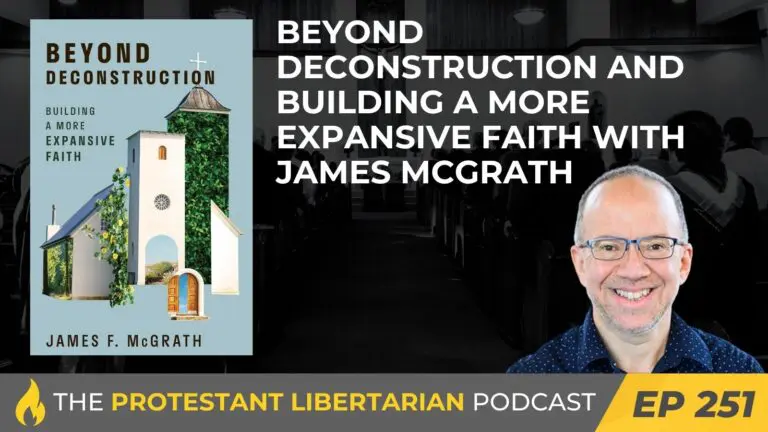
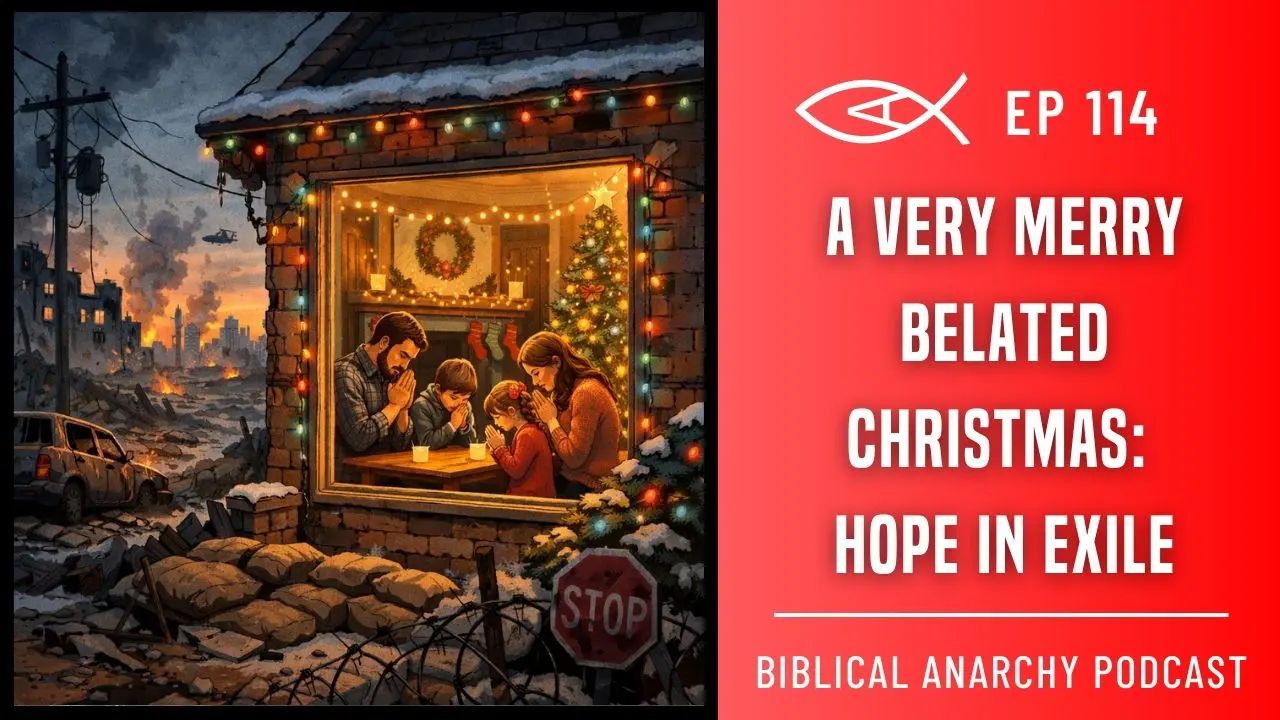
Ep. 114: O Come Emmanuel — Why Christmas Is About Exile Before Celebration
Christmas is not primarily a celebration. It is a cry. Before it is Joy to the World, it is O Come Emmanuel — a song of longing from people who live under occupation, under silence, under the crushing weight of a world that has not yet been set right. That is the message buried in this ancient hymn, and it is a message the modern church tends to skip straight past.
This episode revisits one of the most theologically loaded songs in the Christian tradition and makes the case that O Come Emmanuel is not just a Christmas carol but a theological statement about exile, covenant, and the already-and-not-yet kingdom of Christ. The birth of Jesus is not the end of the story. It is the setup — the first act of a redemption narrative that will not be fully resolved until Christ returns.
What follows is a walk through the hymn’s layers: its Second Temple Jewish context, its biblical roots, its covenant theology, and its direct challenge to Christians today who are tempted to end their exile on their own terms.
O Come Emmanuel and the Exile Christmas Forgets
1. O Come Emmanuel Was Never Just a Christmas Song
Most Christmas hymns look forward or backward — they celebrate the birth or anticipate the joy. O Come Emmanuel does something different. It mourns. It longs. It sits in the tension between promise and fulfillment. The tone of the song itself is unlike anything else in the Christmas canon, and that dissonance is not accidental. The hymn was written to capture a spiritual condition, not a holiday mood.
2. Second Temple Judaism and the Weight of Prophetic Silence
To understand O Come Emmanuel, you have to understand what the Jewish people were living through at the time of Christ’s birth. After the prophet Malachi, there were roughly four hundred years of prophetic silence — no word from God. Add to that the grinding reality of Roman occupation, and the messianic longing in first-century Judea makes complete sense. This was not just political frustration. It was a deep spiritual ache for God to show up again.
3. The Pharisees Were Trying to End the Exile Too
One of the more overlooked aspects of the Pharisaic movement is that many of them were not simply power-hungry or hypocritical. Many were sincere. They believed that Israel’s obedience to the law was the condition for the Messiah’s arrival — that if they could just get the people to follow Torah faithfully enough, God would act. The irony is that this produced exactly the kind of rigid, anxious religion that Jesus kept confronting. The effort to end exile through human effort, even religious effort, keeps producing the wrong kind of kingdom.
4. Emmanuel Means God Himself, Not Just a Better King
The name Emmanuel — God with us — comes from Isaiah 7:14 and is echoed in Matthew 1:23. What Israel was asking for in this song was not merely a new Davidic ruler who would expel Rome. They were asking for God to dwell among his people. In the old covenant, God was present in the tabernacle and temple, behind the veil, accessible only to the high priest. The longing in O Come Emmanuel is a longing for that separation to end, for the exile that began not in Babylon but in the garden.
5. Ransom Captive Israel Points to the Human Condition
The line “ransom captive Israel” draws on Isaiah 61, Isaiah 52, and Exodus imagery. Israel is portrayed as enslaved and unable to free itself. But the deeper point is that this captivity is not just political — it mirrors the universal human condition. Even in a perfectly free society with limited government and full protection of rights, every person would still be born into bondage to sin. Political liberation is real and worth pursuing. But it cannot solve the problem O Come Emmanuel is actually about.
6. “Mourns in Lonely Exile” Is Not Ancient History
Psalm 137, Lamentations, and 1 Peter 2 all contribute to this phrase. What makes it theologically significant is the argument from Romans and Galatians that the true Israel is not defined by ethnic lineage but by the covenant promise. Those who are in Christ — Jew and Gentile alike — are grafted into Abraham’s family and inherit the covenant. That means the exile of ancient Israel is not just their story. It is ours. Medieval Christians who sang this hymn understood that. The church has largely forgotten it.
7. O Come Emmanuel and the Already-and-Not-Yet Kingdom
Christ has ascended. He sits at the right hand of the Father. He has conquered sin and death. And yet the world continues to resist his kingship, to call good evil, to distort justice, to oppress the vulnerable. This is the tension that gives O Come Emmanuel its power. The kingdom is real, it is present, and it is not yet fully realized. Christians live in that gap — between the first and second appearances of Christ — and the hymn holds that tension without resolving it cheaply.
8. Christmas Is the Prequel, Not the Point
The incarnation and the virgin birth are not insignificant — they are essential. But if the story of Christ ended at Bethlehem, there would be no gospel. The good news comes through his life, death, resurrection, and ascension. Christmas sets the stage. The birth of Jesus is the opening act of a drama whose climax is the cross and whose final act is still coming. Treating Christmas as the destination rather than the beginning strips it of most of its theological weight.
9. The Temptation to End Exile on Our Own Terms
This is where O Come Emmanuel speaks most directly to the present moment. Christians who are uncomfortable with exile — who cannot live in the tension of a broken world without trying to fix it through power — will always be tempted toward false gospels. Some look to political strongmen. Some look to the state as the engine of Christian cultural renewal. Some simply abandon theology altogether and baptize whatever strategy seems to work. The Pharisees made the same mistake. Obedience to the law, or wielding the right kind of power, was going to force God’s hand.
10. The Civil Magistrate Cannot Cure the Human Condition
At its best, civil government can restrain the worst forms of human aggression. It can stop violent people from preying on the innocent. That is a real and limited good. But the state cannot preach the gospel. It cannot regenerate the human heart. It cannot end exile. The idea that Christians should harness political power to fix the world’s brokenness at a deeper level is not just strategically misguided — it misunderstands what the problem actually is.
11. You Were Once the Enemy of Christ
One of the sharpest lines in this episode is a simple reminder: you were once the enemy of God, and he did not condemn you. Christ took on death and sin on your behalf. If that is how God treated his enemies, it has implications for how Christians are supposed to treat theirs. The logic of wielding power against enemies — of keeping yourself safe by making your enemies afraid — runs directly counter to the logic of the incarnation. God did not come in power to crush. He came in weakness to ransom.
12. Comfort in Exile Is Not Passivity
Living in exile does not mean doing nothing. It means being honest about what you can and cannot accomplish. Christians can and should work to make the world better — not by bending fallen kingdoms to their purposes, but by preaching the word, living as witnesses to Christ’s kingdom, and shining light into darkness. The sword cannot do what the gospel can. Restraining evildoers is the state’s calling. Bearing witness to the king is the church’s.
Conclusion: O Come Emmanuel — The Cry That Still Stands
O Come Emmanuel is a Christmas song the way Lamentations is a love letter. Technically accurate, but the category misses the point. This hymn captures something that most of Christmas worship does not: the cost of waiting, the weight of a world that refuses the king who has already won, and the spiritual discipline required to keep hoping without seizing control.
The birth of Christ did not end the exile. It announced that the exile would end. The ransom has been paid. The captive is being freed. But we are still in the middle of the story, and the temptation to rush the ending — to grab power, to build the kingdom by force, to trade the patience of faith for the efficiency of coercion — is as old as the Pharisees who thought that if they could just get obedience right, God would show up.
He already showed up. In a manger. On a cross. From an empty tomb. The question is whether Christians will trust what he did or keep trying to do it themselves. O Come Emmanuel is the prayer of those who have stopped trying to end their own exile and are waiting, watchfully and actively, for the king who is already here and not yet fully come.
Additional Resources
Biblical Anarchy Podcast
External Reads








;?>/smartquizbuilder/includes/images/sqb-registration-img.jpg)