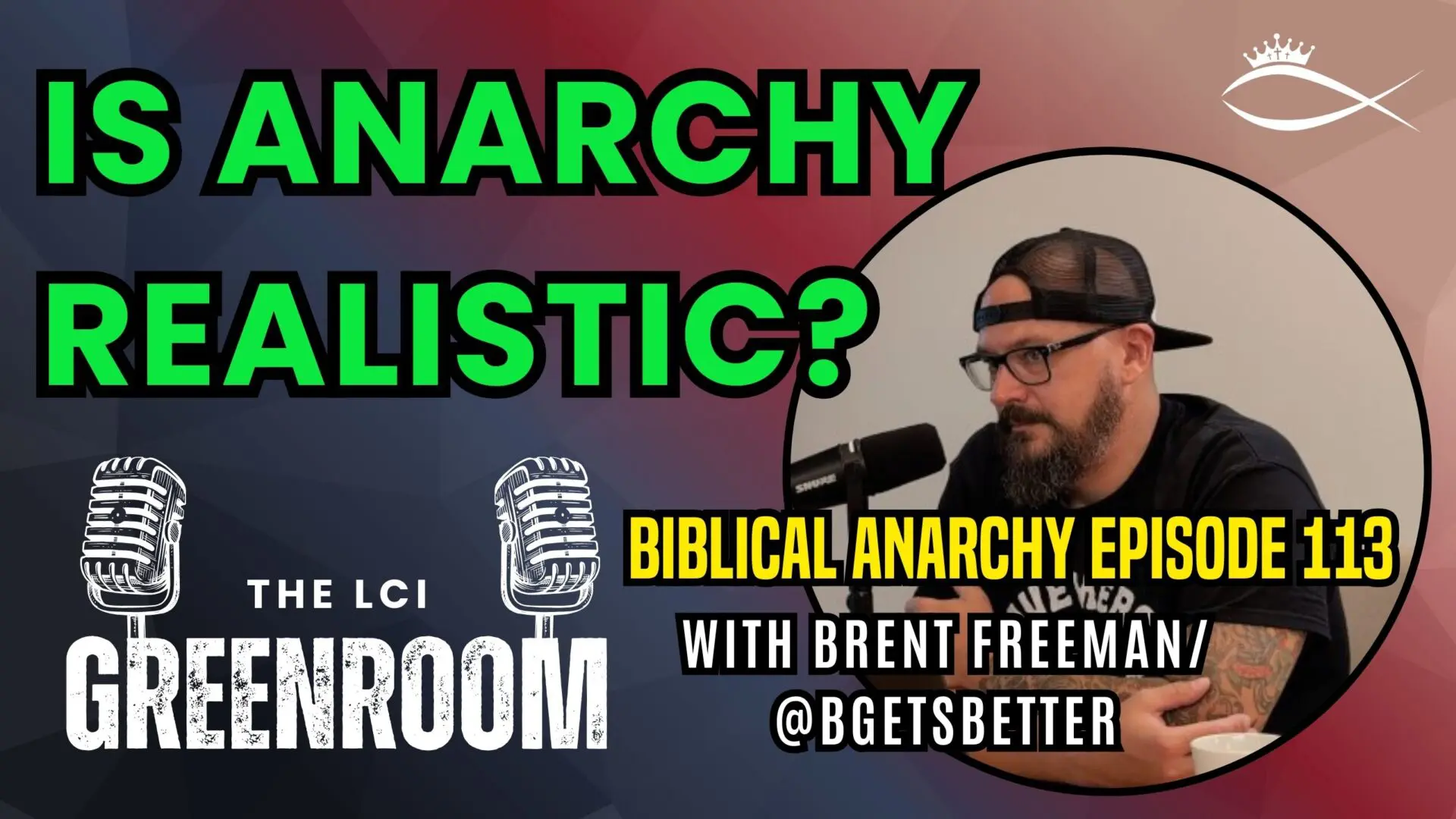
What is Freedom? Exploring Anarchy, Health, and Personal Sovereignty with Brent Freeman
What is freedom, really? Not the bumper sticker version, not the political slogan — but the kind of freedom that actually changes how you live, how you build, and how you relate to other people. That question sits at the center of this conversation with Brent Freeman, host of the Aiming Up Podcast, who brings a wide lens: liberty philosophy, health and mindset, agorism, and a refreshingly honest agnosticism that makes the dialogue between faith and freedom genuinely worthwhile.
This isn’t an episode about converting anyone. It’s about what a free society actually requires — not just the right theory, but the right kind of people, the right habits, the right communities. Jacob and Brent cover the NAP debate between Dave Smith and Liquid Zulu, the history of stateless societies, why the liberty movement keeps eating itself, and where Christianity fits into the broader human need for meaning and shared narrative.
The conversation moves across philosophy, culture, and practical life in a way that’s hard to neatly categorize. That’s the point. Freedom isn’t a single idea — it’s a direction. Here’s how the episode gets there.
What is Freedom? Working Through the Questions
1. The NAP Debate Missed the Real Point
The Dave Smith vs. Liquid Zulu debate generated a lot of heat, but the underlying confusion was philosophical. The Non-Aggression Principle is a diagnostic tool — it identifies whether aggression has occurred. It doesn’t tell you what to do about it. When Smith pressed Zulu on trolley-problem style hypotheticals, both sides were arguing past the actual function of the NAP. Freedom philosophy needs to distinguish between identifying a transgression and deciding how to respond to it.
2. Minarchism Is a Contradiction in Terms
Every government action, no matter how minimal, begins with a gun pointed at someone to extract funding without consent. You cannot enforce the NAP using the very aggression it prohibits. Minarchism may be a useful stepping stone for people working their way toward consistent liberty, but calling it a stable endpoint is a contradiction. A government that taxes involuntarily is not enforcing the NAP — it’s violating it from the first line item of the budget.
3. Is Anarchy Actually Possible?
The question isn’t unreasonable. Ancient Ireland, Medieval Iceland, Caspian societies, Frisia, the American frontier, and the Zomia highlands of Southeast Asia all show that stateless or near-stateless civil order has existed across history, culture, and scale. The objection that “it’s never been done” is historically illiterate. The better question is whether it can work in a modern, technologically complex society — and there, the honest answer is that private dispute resolution already handles the majority of civil cases, blockchain enables decentralized contracts, and private competition in services like security and policing is entirely conceivable.
4. Anarchy Means No Unjust Hierarchies, Not No Hierarchies
One of the most persistent misconceptions about what is freedom in anarchist terms is that it means flattening all hierarchy. It doesn’t. Natural hierarchies emerge wherever there is quality, preference, and human choice — music, markets, community standing. What anarchism opposes is hierarchy by coercion: the kind that can only be maintained at gunpoint. As Brent puts it, everything anarchic produces a Pareto distribution. The best things rise. Forcing equality is the inverse — it requires violence and produces uniform mediocrity.
5. Anarchy Is a Relationship, Not a Location
The Michael Malice framing is exactly right: anarchy means “you don’t speak for me.” It’s not a utopian territory that has to be declared and defended — it’s a posture toward power. You don’t consent to having your money extracted to bomb people halfway around the world. You don’t recognize that a vote by someone else constitutes your endorsement of whatever they decided. This reframing matters because it makes what is freedom a livable ethic rather than a distant political goal.
6. The Liberty Movement’s Real Problem Is Inversion
Too many libertarians spend all their energy trying to fix the macro — the government, the party, the movement — while doing almost nothing to free themselves at the personal level. Agorism isn’t just a philosophy; it’s a practice. Building trade networks with like-minded people, developing self-sufficiency, creating counter-institutions — these are the actual building blocks of a free society. The purity spiraling and infighting that define so much of the liberty movement are symptoms of a people who have outsourced their personal freedom to the political arena.
7. Gatekeeping Libertarianism Serves No One
Declaring that only anarchists are real libertarians, or that minarchists don’t belong in the movement, accomplishes nothing except shrinking the coalition. People take different on-ramps. Ron Paul brought millions of people into the liberty conversation who stayed at the constitutional level — and some of them kept going. The function of the movement is to be a direction, not a gate. What is freedom for the person just discovering the NAP is different from what it means for someone who has spent years in the philosophy. Both matter.
8. Technology Has Changed the Calculus for Stateless Order
The historic critique of anarchism — that complex, dense, modern societies can’t self-organize without a state — runs into the reality of what technology now makes possible. Private policing with surveillance that citizens voluntarily opt into. Smart contracts via blockchain for dispute resolution. Competitive security providers replacing the monopoly model. The structural problems that states evolved to solve are increasingly solvable through voluntary, market-based mechanisms. The argument that we need a state to coordinate modern society is getting weaker every decade.
9. The NAP Has a Letter and a Spirit
Applying the Non-Aggression Principle like a code of law, with no regard for why it exists, produces the libertarian version of Pharisaism. The letter of the NAP identifies aggression. The spirit of it is peace and voluntary social cooperation. If a commitment to the NAP doesn’t lead someone toward being a more peaceful, gracious, cooperative person, something has gone wrong. What is freedom, at its best, is not a syllogism to win arguments — it’s a framework for loving your neighbor without coercion.
10. Why Secular Humanism Can’t Carry the Weight Christianity Can
Rationalism alone hasn’t provided the moral and social cohesion that human communities need. The early church grew not through violence or state power but through a countercultural identity that crossed ethnic, class, and national lines — unified by a shared narrative and a shared Lord. That’s what gave it coherence and staying power. Secular humanism and libertarian philosophy don’t have an equivalent narrative. The NAP tells you what not to do. It doesn’t tell you who you are, what you’re for, or why any of it matters. Christianity answers those questions in a way that scales across cultures and generations.
11. Shared Narrative Is What Moves People
Dave Smith’s persuasive power comes not from syllogisms but from embedding liberty in a story — deconstructing the state’s narrative and rebuilding it with truth. That’s why people are drawn to him. Philosophy alone doesn’t move crowds. What moves people is truth married to narrative. The liberty movement’s comparative weakness here is real. Christianity has the whale and the prophet, the resurrection, the wine at the wedding. The state has Paul Revere and the Fourth of July. What does the liberty movement have that captures the imagination of someone who isn’t already a committed philosophy reader?
12. Freedom Starts With You, Not the Government
The most underasked question in the liberty movement is: what can I do to improve myself? Not the country, not the party, not the movement — yourself. Start with the concentric circles. Get yourself right. Then your family. Then your community. The macro will not be fixed by people who haven’t done the personal work first. This is one of the oldest insights in both libertarianism and Christianity, and it keeps getting buried under the noise of political commentary and internet arguments.
Conclusion: What is Freedom? It’s a Direction, Not a Destination
Freedom is not a place you arrive at when the state has been abolished. It’s a direction you orient your life toward — starting today, with the choices in front of you. This episode pushes back against the tendency to make libertarianism a religion unto itself, a set of purity tests to apply to others while doing nothing to actually build a freer life. That’s not what is freedom. That’s a performance of freedom.
The harder, more worthwhile question is how to live it. How to build trade relationships, develop self-sufficiency, raise children who understand personal responsibility, and engage your neighbors with grace and intellectual honesty. Christianity provides a framework for that kind of grounded, embodied freedom — not because it should be imposed on anyone, but because it answers the questions that pure legal philosophy cannot.
A viewer came into this stream skeptical of anarchism and left more open to it. That’s what good conversation does. No conversion required — just a direction, a posture, and the courage to start with yourself.
Additional Resources
Biblical Anarchy Podcast
Ep. 105: How Anarchy Works — 4 Reasons Private Law Is Better Than the State The deep-dive companion to this episode — Kerry Baldwin and Jacob tackle whether stateless civil governance is actually plausible and why sinful humans make worse arguments for the state than against it.
Ep. 1: What Is Biblical Anarchy? The pilot episode that sets the foundation — what anarchy actually means, what it doesn’t mean, and the biblical case for rejecting centralized state power.
Objectivism vs. Christianity: Comparing Different Foundations for a Libertarian Society Jacob and Michael Leibowitz debate whether reason alone or Christian faith provides the stronger foundation for a free society — the exact tension Brent raises throughout this conversation.
LCI Greenroom
Stephen Wolfe & Alex Bernardo: Christian Nationalism & Christian Libertarianism A structured look at how theological commitments shape political philosophy — relevant to the episode’s discussion of whether Christianity and liberty are complementary or in conflict.
External Reads
Murray Rothbard, Anatomy of the State — The foundational text behind the Michael Malice line that anarchy means “you don’t speak for me.” Free at the Mises Institute: mises.org/library/anatomy-state
Hans-Hermann Hoppe, The Private Production of Defense — The economic and philosophical case for competitive, private security provision that Jacob references in the episode. Free at Mises: mises.org/library/private-production-defense
Robert Murphy, Chaos Theory — Murphy’s accessible model of how courts, law, and dispute resolution could function in a stateless society. Free at Mises: mises.org/library/chaos-theory
James C. Scott, The Art of Not Being Governed — The scholarly study of Zomia (Zamiya), the stateless highland civilization in Southeast Asia that Jacob and Brent reference as a real-world example of large-scale anarchic order. Available via Yale University Press








;?>/smartquizbuilder/includes/images/sqb-registration-img.jpg)