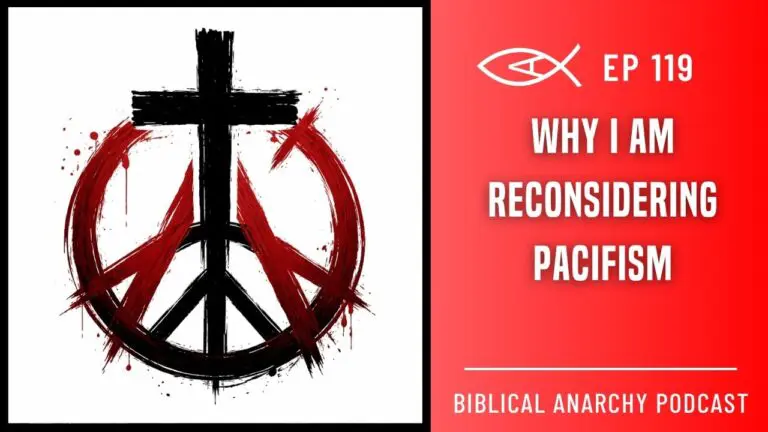
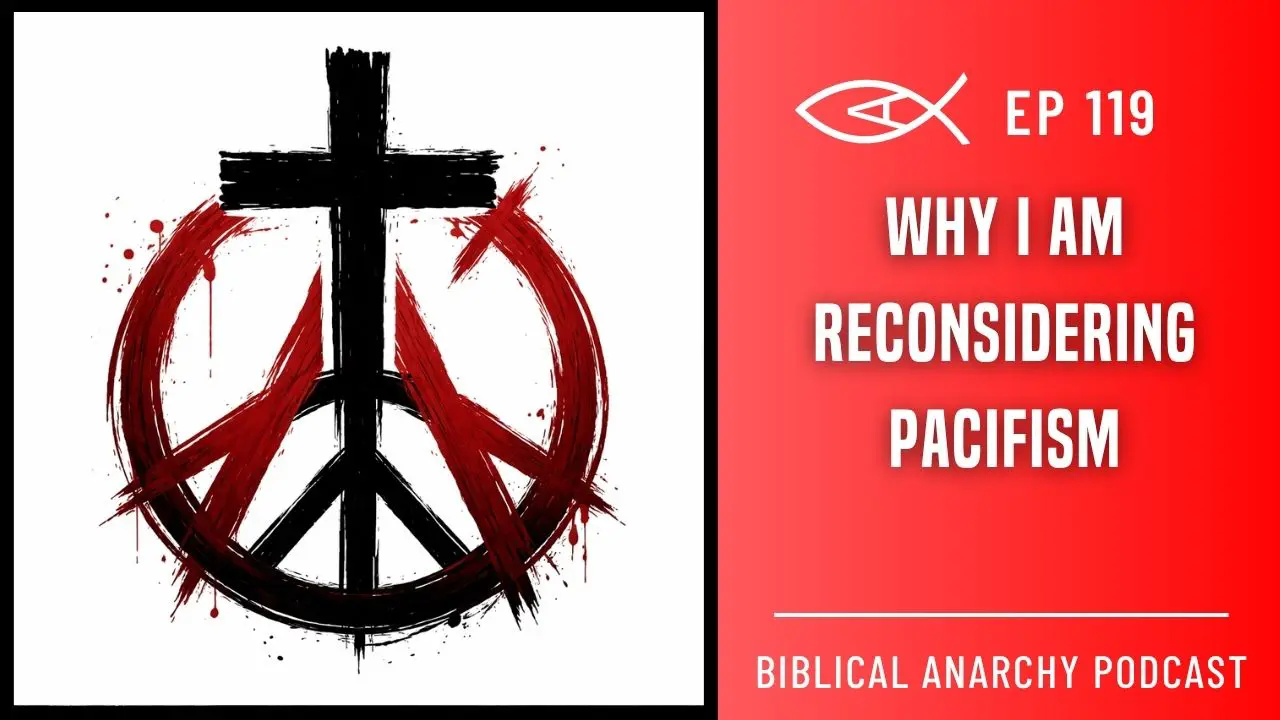
Christian Pacifism: How One Verse Made Me Rethink Violence
In this episode of the Biblical Anarchy Podcast, host Jacob Winograd examines Christian Pacifism and whether legal justification is a sufficient stopping point for Christian ethics on violence. Anchoring the discussion in 1 Corinthians 6:12 — “all things are lawful, but not all things are helpful” — Jacob distinguishes between principled pacifism, which he rejects on biblical grounds, and practical pacifism, a posture that treats lethal force as a genuine last resort rather than a celebrated option.
Drawing on parallels from free market theory and noncoercive parenting, he argues that when violence is taken off the table as a default, better solutions emerge. The episode also critiques the “I wish a MFer would” ethos in Christian gun culture, revisits the early church’s refusal to meet Roman persecution with defensive force, and challenges the binary framing that dominates both foreign policy and personal ethics debates among Christians. The conclusion: permissible is the floor, commendable is the target, and the church has been too quick to stop asking which one it is actually pursuing.
Christian Pacifism and the Question the Church Stopped Asking
Most Christians have made their peace with violence. Self-defense is legally permissible, our legal framework accounts for it, and the Second Amendment crowd has made it a point of cultural pride. Libertarians, including Christian libertarians, tend to also take a black and white stance on the subject. The conversation, for many, ends at the conclusion that defensive violence is “justified.” This episode argues that for Christians, however, it shouldn’t.
The anchor is 1 Corinthians 6:12. “All things are lawful for me, but not all things are helpful.” Paul wrote it in the context of food and sexual immorality, but the principle reaches further than most Christians apply it. When it comes to violence, the church has largely stopped asking whether something is beneficial once it has established that it is permissible. That stopping point is the problem.
What follows is not a case for principled pacifism. The Bible doesn’t teach that Christians must never use force, and the Sermon on the Mount is not a nonviolence manifesto. But there is a strong case for what might be called practical pacifism — a posture that takes legal justification as a floor, not a ceiling, and pushes Christians to ask harder questions about when and why they reach for violence.
Permissible Is Not the Same as Commendable
The libertarian legal framework is useful and largely correct. When someone initiates force against you, retaliatory or defensive force — including lethal force — is legally justified. That much is not in dispute here. The question is whether legal justification is where moral reasoning ends for a Christian.
Paul’s answer in 1 Corinthians 6:12 is clearly no. The permissible/beneficial distinction is not a footnote. Rather, it is a framework. Christians are not called to maximize what they can get away with. They are called to ask what is commendable, what reflects the character of the kingdom, what the Holy Spirit would have them do rather than what the law permits them to do.
The Free Market Analogy Nobody Applies to Violence
There is a well-worn argument in libertarian circles that when you take coercion off the table, human creativity fills the gap. The slavery abolition example makes this concrete: when forced labor was removed, industrialization accelerated. The constraint produced innovation. People found better solutions precisely because the easy, coercive solution was no longer available.
The same logic applies to parenting without corporal punishment. When spanking is removed as an option, parents are pushed toward prevention, preparation, and creative discipline that actually works better. The constraint is generative.
Christian pacifism, or at least a practical version of it, applies this same logic to violence. When lethal force is treated as a genuine last resort rather than a rhetorically acknowledged one, other solutions surface. Solutions that were always there but never reached for because the violent option was too easy and too culturally celebrated.
Gun Culture and the Heart Problem
There is something in Second Amendment culture — and libertarianism is not immune to it — that does more than affirm the right of self-defense. It relishes the hypothetical. The “I wish a MF would” posture treats the opportunity to use lethal force as something to anticipate rather than something to dread.
That posture is spiritually wrong, regardless of its legal standing. Taking a human life, even in justified self-defense, is not a moment to celebrate or fantasize about. Christian pacifism begins here — not with a legal argument but with a reckoning about what it means to treat human life as sacred. If we actually believed that, the dominant tone in Christian gun culture would look very different.
Where Principled Pacifism Goes Too Far
None of this means the principled pacifist position is correct. The argument that no lethal force is ever morally permissible breaks down quickly in practice. What counts as lethal? Is intent the measure, or the means? When a woman’s life is in immediate danger, is she morally prohibited from using whatever force ends the threat?
The answer is no. There is a legitimate moral allowance for defensive force when life is genuinely at stake. The problem is not that Christians affirm this. The problem is that many treat it as the end of the conversation rather than the beginning of a harder one. The problem is also that we tend to extrapolate these extreme and edge cases to all situations where the stakes and dynamics aren’t necessarily the same.
Paul Wasn’t Killed, and That Was the Point
The early church offers the most striking case study. Paul was, before his conversion, actively rounding up and killing Christians. By any libertarian legal standard, someone would have been justified in stopping him by force. The world’s solution was available. The early Christians didn’t take it.
What followed was not a failure of nerve — it was a kingdom strategy. Paul’s radical conversion produced half the New Testament. The restraint of the early church under Roman persecution, their refusal to meet violence with violence, was not passivity. It was a theological wager that God’s solutions operate on a different register than the world’s, and that register was worth trusting.
That doesn’t translate into a universal rule against defensive force. But it is a serious challenge to the assumption that the world’s solutions and kingdom solutions are interchangeable.
The Third Way the Church Keeps Missing
Foreign policy debates among Christians tend to collapse into a binary: intervention or isolation, strike or do nothing. The same pattern shows up in personal ethics around violence: use lethal force or be a victim. Christian pacifism, even in its practical form, is a refusal of that binary.
The church’s job is not to pick the least bad option between two statist framings. It is to ask whether there is a third way — one that takes the image of God in every person seriously enough to make violence feel like a tragedy even when it is technically justified.
Conclusion: Christian Pacifism Is a Posture, Not Just a Position
Christian pacifism, properly understood, is not a claim that violence is always wrong. It is a claim that Christians have consistently underestimated the cost of violence and overestimated its value — and that 1 Corinthians 6:12 gives us a framework for doing better.
Permissible is the floor. Commendable is the target. The early church understood this. The Second Amendment right to defend yourself is real. The Christian call to treat human life as sacred enough to make violence feel weighty, slow, and genuinely last-resort is also real. Those two things are not in conflict — but the church tends to honor only one of them.
The practical pacifist doesn’t disarm. He prepares differently, thinks ahead, and refuses to let the availability of lethal force become a substitute for wisdom. That is not weakness. That is the application of 1 Corinthians 6:12 to the part of our lives we have been most reluctant to examine.
Additional Resources
Biblical Anarchy Podcast
Christians for Liberty Network
External Reads
- The Anarchist Anabaptist by Cody Cook — The book behind this episode’s conversation partner; Cook makes the case that Anabaptism and libertarian anarchism converge on a vision of voluntary, noncoercive Christian community.
- Kerry Baldwin at MereLiberty.com — Baldwin’s ongoing research on Reformed libertarianism, self-ownership, and parental rights, referenced in this episode as refining the edges of libertarian legal theory.








;?>/smartquizbuilder/includes/images/sqb-registration-img.jpg)