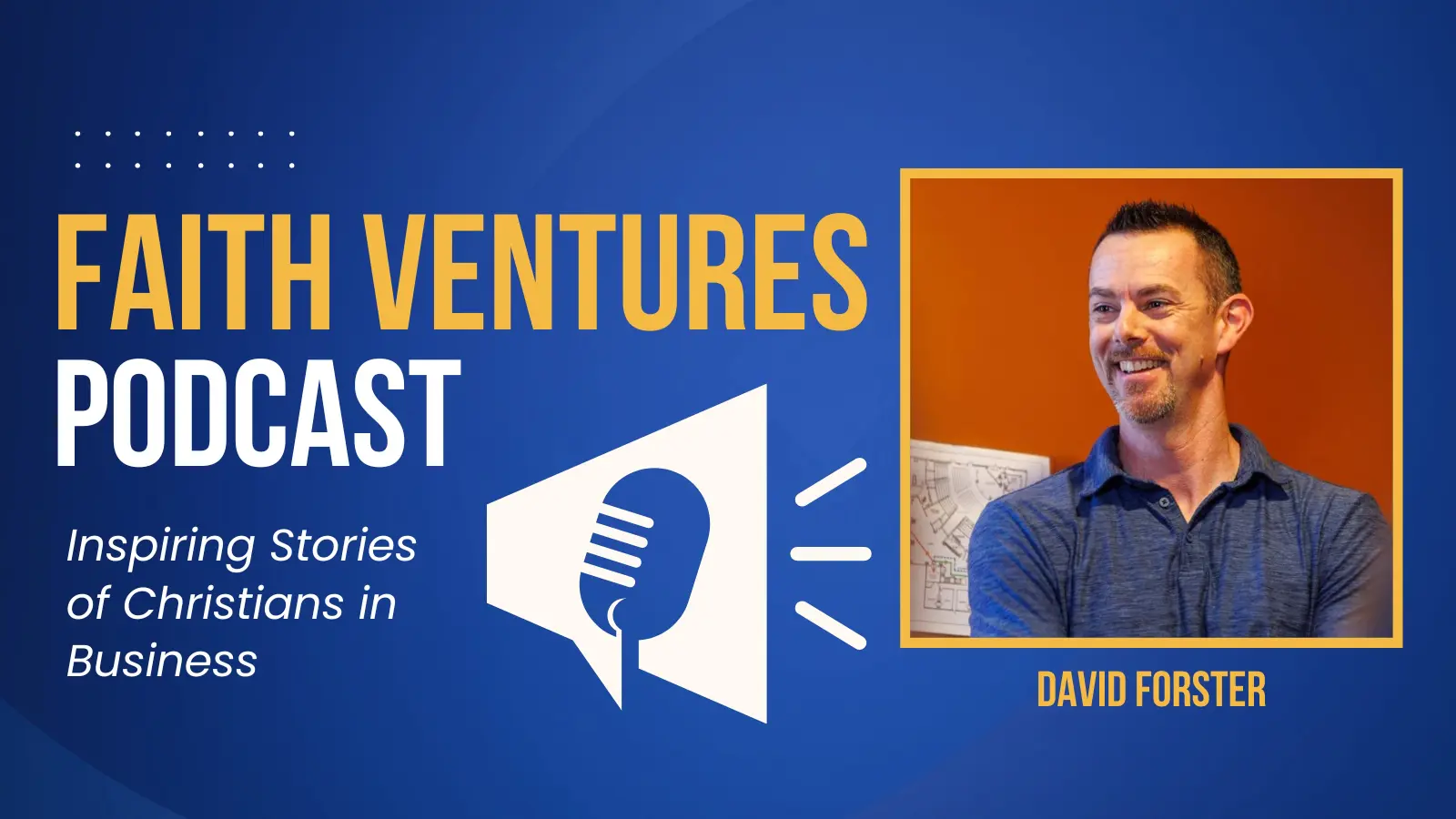
David Forster has put God in his org chart. Not as a brand statement. Not as the kind of thing you put on your website and forget about. Structurally — in the owner’s seat of the accountability chart he actually runs his businesses by. He’s the CEO. God is the owner. And the accountability question that follows from that isn’t abstract: if Jesus came back today and asked for the keys, would the P&L reflect faithful stewardship?
That’s the parable of the talents read as a performance review. It’s uncomfortable, and David knows it. He says so. But it’s also, in his account, the framework that has made him a clearer thinker, a better operator, and a more honest steward of what God has entrusted to him.
This episode of Faith Ventures is about how he got there — through hamsters, landscape businesses, a bicycle shop, a dream he felt called to abandon, and a single ride that changed everything.
The Dream He Put Down
The first landscape business David built came to an end through a process that had nothing to do with market conditions or strategic pivots. He had a dream. He prayed. He felt clearly that God was telling him to sell it. So he did.
He describes it as one of the best testimonies of his married life — not because obedience was easy, but because of what it produced. A season of closeness with his wife. A deepened capacity to hear God’s voice in high-stakes moments. And the hard-won knowledge that Christian business stewardship isn’t only about what you build. It’s about being willing to hand it back when the owner asks.
That posture — active, attentive, genuinely willing to receive a word that costs something — is what distinguishes Christian stewardship from Christian branding. David learned it the first time by obeying when it was hard. He’s been practicing it ever since.
The Ride That Built a Business
The Bike It Out story starts with David’s wife issuing an ultimatum about an expensive bike hanging unused on the wall. He went for a ride. An hour later, the accumulated stress of running a landscape business — the client calls, the crew questions, the decisions that never stopped — had simply fallen off. His head was clear. He could pray. He could think. He described it as the first time in years his mind had actually felt clean.
He understood why. His kinesiology background gave him the biology: movement metabolizes cortisol, oxygenates the brain, creates the neurological conditions for clear thinking and good decision-making. He had known that academically. The ride made it real. And the implications for every high-capacity entrepreneur he knew — most of whom were sitting in exactly the kind of cognitive fog he had just ridden out of — were immediate.
That’s what Bike It Out is: a conviction, built on both biology and experience, that movement is the most underused tool in the entrepreneur’s toolkit. And for a Christian entrepreneur trying to hear God clearly in the middle of a demanding business life, it may also be the most spiritually practical.
The Structural Distinction That Changes Everything
The episode’s sharpest theological contribution comes in the second half, when David draws the distinction between stewardship and ownership. Most Christian business owners, he argues, collapse these categories in ways that limit both their business and their theology.
An actual owner, structurally speaking, has zero day-to-day role. No job description. No operational obligations. The owner is an investor and a visionary — guiding direction from outside. Every other function — CEO, COO, operations, sales, technical work — belongs in the org chart with defined responsibilities. When a business owner insists on performing every role and calling it ownership, they’ve confused the position with the functions. That confusion creates a ceiling on growth and a fog around identity.
Once David understood the distinction, the theological move was clean. God goes in the owner’s seat. He takes the CEO role. The business belongs to God; David just runs it. And the accountability that follows is no longer a vague spiritual aspiration but a concrete operational reality: is he doing with this business what a faithful steward would do with something that belongs to someone else?
The Parable of the Talents as a Performance Review
David invokes the parable of the talents not as an illustration but as a live accountability framework. He describes the question he sits with: if Jesus came back today and asked for the keys to the front door, would David be excited to hand them over? Would the P&L show faithful multiplication of what was entrusted? Or would there be scrambling and explaining?
Norman’s response in the moment is worth noting: he flags the connection to LCI’s broader thesis — that the marketplace is the primary means of human flourishing outside the church itself, and that God used the economic metaphor of the talents for a reason. The parable isn’t incidentally about money. It’s about the responsibility that comes with being entrusted with capacity, time, and resources in a world where what you do with them has eternal stakes.
David’s org chart is a way of keeping that question live, every day, in the structure of how he actually works.
Conclusion: Christian Business Stewardship — It’s God’s Company and You’re the CEO
The body needs to move. The mind needs clarity. The business needs a real owner and a real operator who understand the difference. And the Christian entrepreneur needs a framework that holds all of it together — not as a motivational poster but as a working structure for how they actually run things.
David Forster’s contribution to that framework is specific and useful: put God in the owner’s seat, take the CEO role, and ask yourself regularly whether the keys you’ll hand back reflect what faithful stewardship looks like. Whatever is fogging your thinking or weighing down your decisions — go bike it out. Your body knows what to do. So does the one who actually owns the company.
Systems Over Sweat — Operations consulting for entrepreneurs building businesses that run on systems, not personal heroics.
External Reads
Frédéric Bastiat, The Law — The foundational argument that voluntary exchange produces value rather than extracting it; essential background for Norman’s marketplace thesis.