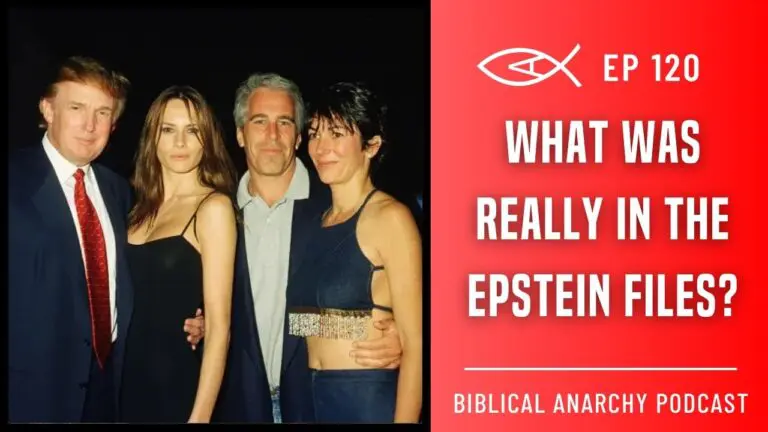
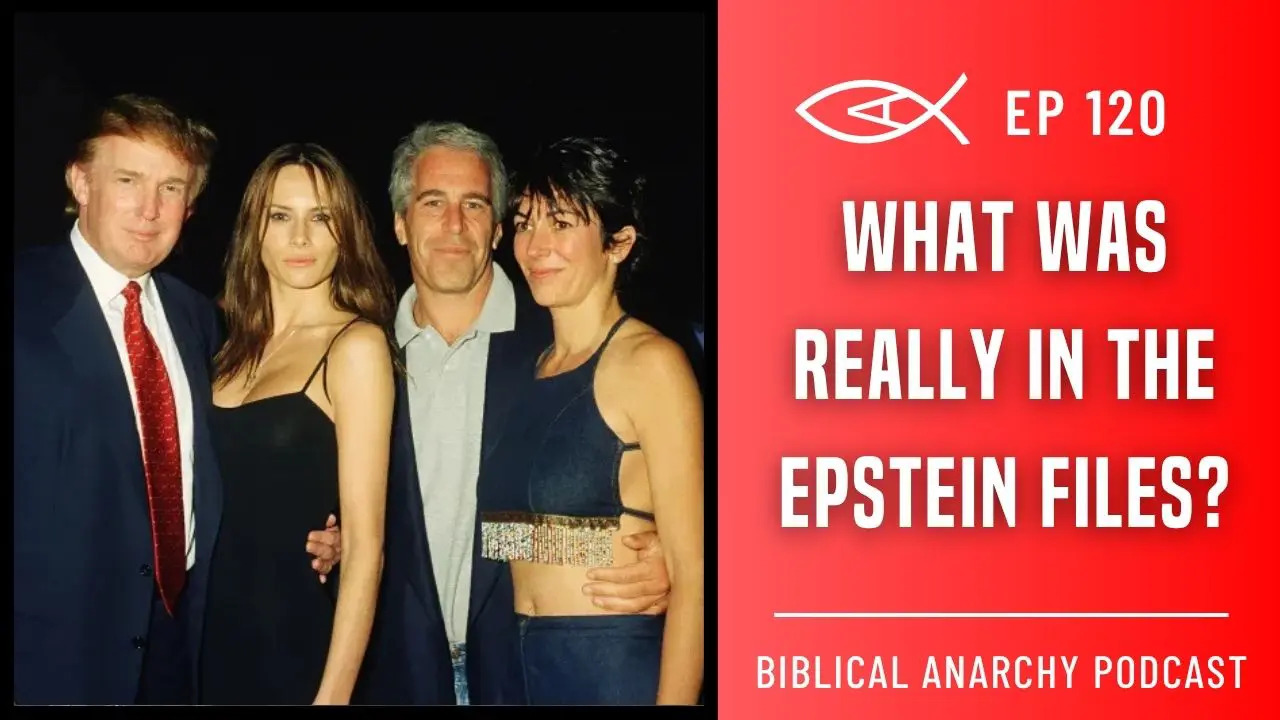
In Episode 120 of the Biblical Anarchy Podcast, Jacob Winograd examines what happened when Congress passed the Epstein Files Transparency Act — and the DOJ simply ignored it. Drawing on the Massie hearings, the Epstein conspiracy pattern, elite theory, and the prophetic tradition of Scripture, Jacob argues that the cover-up reveals something more disturbing than any name in the files: that American Christians have drifted into worshiping the system itself, and that faithfulness to Christ demands we stop.
The Epstein Files Transparency Act and the Question No One Wants to Ask
The Epstein Files Transparency Act was supposed to be simple. Congress passed a law. The DOJ had thirty days to comply. The deadline passed. What was released came in partial dumps, riddled with redactions, with some documents reportedly removed after posting and further releases pushed indefinitely into the future.
Before we even get to who is named in the files, there is a more basic question sitting in the room: what do we call it when the executive branch ignores a clear statutory mandate without consequence? If that question makes you uncomfortable, it should. Because the answer forces a conclusion many Americans — including many Christians — are not prepared to sit with.
The Epstein files saga is not just a scandal about a dead sex trafficker and his powerful friends. It is a stress test for whether the rule of law still applies to those who wield power in this country. This episode works through what the evidence actually shows, what it means, and why Christians have a specific responsibility to engage it rather than look away.
The Pattern That Built the Epstein Conspiracy
Jeffrey Epstein was not a mystery. He was a convicted sex offender who served thirteen months in county jail under a plea agreement widely described as a sweetheart deal, walked out with work release privileges, and then reentered the same elite circles as if nothing had happened. He hosted gatherings. He made introductions. He cultivated relationships with billionaires, academics, heads of state, and royalty. And he apparently did all of this under the radar of a justice system that had already convicted him once.
When he was finally arrested on federal charges in 2019, he died in federal custody within weeks. The official ruling was suicide. The cameras malfunctioned. The guards were asleep. He had been taken off suicide watch. None of that is speculation — those are the documented facts. The reason the Epstein conspiracy theory has legs is not because conspiracy theorists are imaginative. It is because the facts themselves, taken together, resist innocent explanation.
The episode walks through several specific overlaps that generate legitimate suspicion: Donald Barr, an intelligence-connected figure, hired the twenty-year-old college dropout Epstein for his first professional job. Donald Barr’s son William Barr later served as Attorney General — the same role he occupied during Epstein’s arrest, detention, and death. Former federal prosecutor Alex Acosta reportedly told associates that he was instructed Epstein belonged to intelligence, though no country was named. Former Israeli Prime Minister Ehud Barak, who previously led Israeli military intelligence, maintained a well-documented relationship with Epstein and received financial backing from him.
None of this is proof of a coordinated conspiracy. But the same networks, the same institutions, and in some cases the same families keep appearing at key moments. At a certain point, the simpler explanation is not coincidence.
The episode is careful to distinguish between legal proof and private judgment. Courts require evidence that can survive cross-examination. Human beings also make probabilistic assessments outside of courtrooms, weighing cumulative patterns. The call here is not to convict anyone. It is to acknowledge that where there is this much smoke, the question of fire is reasonable — and that demanding transparency rather than demanding trust is the rational, and the Christian, response. That’s why the Epstein Files Transparency Act is not just a political matter, but a moral one.
What the Massie Hearings Actually Revealed
When Thomas Massie and Ro Khanna arrived to view the unredacted files at the DOJ, they found that seventy to eighty percent of the documents were still blacked out. When this was brought up during the hearings regarding the Epstein Files Transparency Act, the explanation offered was clerical, bureaucratic, a function of the volume of materials. But within two hours, Massie had identified six men whose names were redacted specifically in places where they were labeled as co-conspirators. Not general redactions. Targeted ones.
Massie also raised the case of Les Wexner, the billionaire founder of L Brands and Epstein’s primary financial patron for years — the man who granted Epstein power of attorney over his finances. When Massie flagged publicly that a well-known retired CEO appeared to be labeled a co-conspirator in a trafficking document with his name redacted, the DOJ unredacted it. The defense was that his name appeared thousands of times elsewhere in the files. But that misses the point entirely. The question was not whether Wexner’s name was present in the broader file set. It was whether his name was specifically redacted in the one location where he was labeled a co-conspirator.
Redactions that are precise when protecting alleged co-conspirators and sloppy when protecting victims are not clerical noise. They are a pattern pointing in one direction. The Epstein Files Transparency Act set strict provisions and mandates, and they are not only being ignored, but being inverted.
Then Pam Bondi was asked a simple question: how many of Epstein’s co-conspirators have been indicted? Instead of a number, she delivered a campaign speech about the stock market and Trump derangement syndrome. The DOJ has stated there are no additional co-conspirators being pursued, no ongoing investigations, no further prosecutions planned, and no more document releases coming. If that is true, then there is no privilege claim that can justify continued redactions.
You cannot simultaneously say the case is closed and invoke active-investigation protections. These claims directly contradict each other. And when the survivors themselves testified through raised hands that they had reached out to the DOJ offering testimony and evidence — and every single one had been ignored — what we are looking at is not incompetence. It is a decision.
Elite Theory, Scripture, and the Theology of Power
The political sociology term for what is happening is elite capture — the tendency of wealth, influence, and institutional access to concentrate over time in ways that insulate a small class from the accountability that applies to everyone else. The Epstein files are not an anomaly in this framework. They are its illustration.
But Scripture was saying the same thing long before political scientists named it. Isaiah condemned rulers who used legal mechanisms to entrench their own interests at the expense of the vulnerable. Micah called out leaders who knew the law and invoked it selectively. James was scathing toward those who used accumulated wealth to escape consequences that ordinary people could not escape. And Paul reminds us in Ephesians 6 that our struggle is not against flesh and blood but against rulers and authorities operating in dark places — language that is not accidental and is not limited to demonic principalities in some purely spiritual sense. Evil organizes. It concentrates. It institutionalizes. This is what fallen human nature does at scale.
What makes the Epstein conspiracy and the broader pattern disturbing is not the darkness of the worst-case theories. It is that every plausible explanation — foreign intelligence leverage, domestic prosecutorial corruption, mutual elite blackmail, or simple institutional cowardice — tells the same story. The powerful are not subject to the same justice system as everyone else. The fallout of the Epstein Files Transparency Act makes this crystal clear. And a country that cannot hold the wealthy accountable for crimes against the most vulnerable among us has a problem that goes far deeper than any one case.
America Worship Is the Real Scandal
Here is the harder point, and the one that cuts closest for Christians. The Epstein Files Transparency Act has revealed problems in our society that are not primarily political. It is because too many believers have allowed their Christian identity to be filtered through their American one — and have ended up defending the system more reflexively than they defend the truth.
The abolitionists faced this same temptation. They were not primarily fighting atheists or progressives. They were confronting churches — believers who preferred institutional stability to moral clarity, national unity to repentance. William Lloyd Garrison said the church had become the bulwark of slavery, not because it loved slavery, but because it refused to disturb the system that sustained it. The parallel is not exact, but the pattern is the same: every generation faces the temptation to confuse faithfulness with quietism, and to tell itself that staying comfortable is the same as staying holy.
The Epstein Files Transparency Act was ignored. Survivors were ignored. The law was treated as optional by the agencies it was meant to bind. And the response from much of conservative Christian media was to defend the administration, mock the questioners, and pivot to economic metrics as if the Dow index settles questions of elite accountability. This is not patriotism. It is the cult of America worship — the theological error of treating American institutions as divinely guaranteed, American exceptionalism as a form of Providence, and criticism of the nation as a betrayal of it.
America is not covenant Israel. Its institutions carry no divine guarantee. Its elites are no more inherently virtuous than the kings of Israel, many of whom used their position to exploit, to silence, and to take what was not theirs. The prophet Nathan did not storm the palace. He told a story and looked the king in the eye and said: you are the man. That is what prophetic faithfulness looked like then. Naming what is true to those who do not want to hear it — not for the sake of being provocative, but because obedience in a broken world comes with friction.
Conclusion: The Epstein Files Transparency Act and the Cost of Faithfulness
The Epstein Files Transparency Act revealed something beyond redactions and missed deadlines. It revealed that when transparency becomes politically costly, institutions protect themselves — and that many Christians will defend the institution rather than demand the transparency.
The response to all of this is not despair and it is not rebellion. It is something closer to what Ephesians 5 calls exposing the unfruitful works of darkness. It is refusing to rationalize corruption because the market is up. It is refusing to treat proximity to power as a substitute for righteousness. It is refusing to let the cult of America worship quietly replace the kingdom of God as the object of our primary allegiance.
Our hope is not in these institutions. It never was. We look forward to a better country — one whose builder and maker is God. In the meantime, faithfulness means telling the truth about this one.
Additional Resources
Biblical Anarchy Podcast
Ep. 102: Is America the Bad Guy? Exploring the Myth of American Exceptionalism — Jacob traces U.S. foreign policy from the Spanish-American War through the present, asking whether the language of liberty and Christianity has been weaponized to justify empire. Essential companion to this episode’s critique of American exceptionalism.
How Conspiracy Theories and Propaganda Fueled the Rise of the Radical Right — Jacob analyzes the tension Christians face between principled skepticism and conspiratorial thinking, using the Dave Smith vs. Seth Dillon exchange as a case study. Directly addresses the discernment questions raised in this episode.
Ep. 85: Is the State Evil, Incompetent, or Both? — Jacob applies the incompetence-vs-malice framework to state institutions, which sits at the heart of how to read the Epstein files compliance failures.
Libertarian Christian Podcast
Ep. 393: Biblical Anarchy Now: REDUX, with Jacob Winograd — Cody Cook and Jacob revisit Romans 12-13, Judges-era governance, and what allegiance to Christ’s kingdom actually demands — the theological foundation underneath this episode’s call to prophetic witness.
External Reads
The Church Committee (U.S. Senate Historical Overview) — The definitive overview of the 1975 congressional investigation that uncovered COINTELPRO, assassination plots, and illegal domestic surveillance by the CIA, FBI, and NSA. The historical precedent the episode invokes when explaining why intelligence-adjacent patterns around Epstein are not unreasonable to scrutinize.
Frank Church and the Church Committee — Levin Center for Oversight and Democracy. A thorough account of the 16-month investigation, including Church’s warning that the capacity for tyranny already existed and required strict legal oversight to prevent.
Frederick Douglass, Narrative of the Life of Frederick Douglass — Project Gutenberg. Free. The source of the Douglass quote distinguishing the Christianity of Christ from the Christianity of America. Essential for understanding the abolitionist tradition the episode invokes as a model for Christian prophetic witness.








;?>/smartquizbuilder/includes/images/sqb-registration-img.jpg)