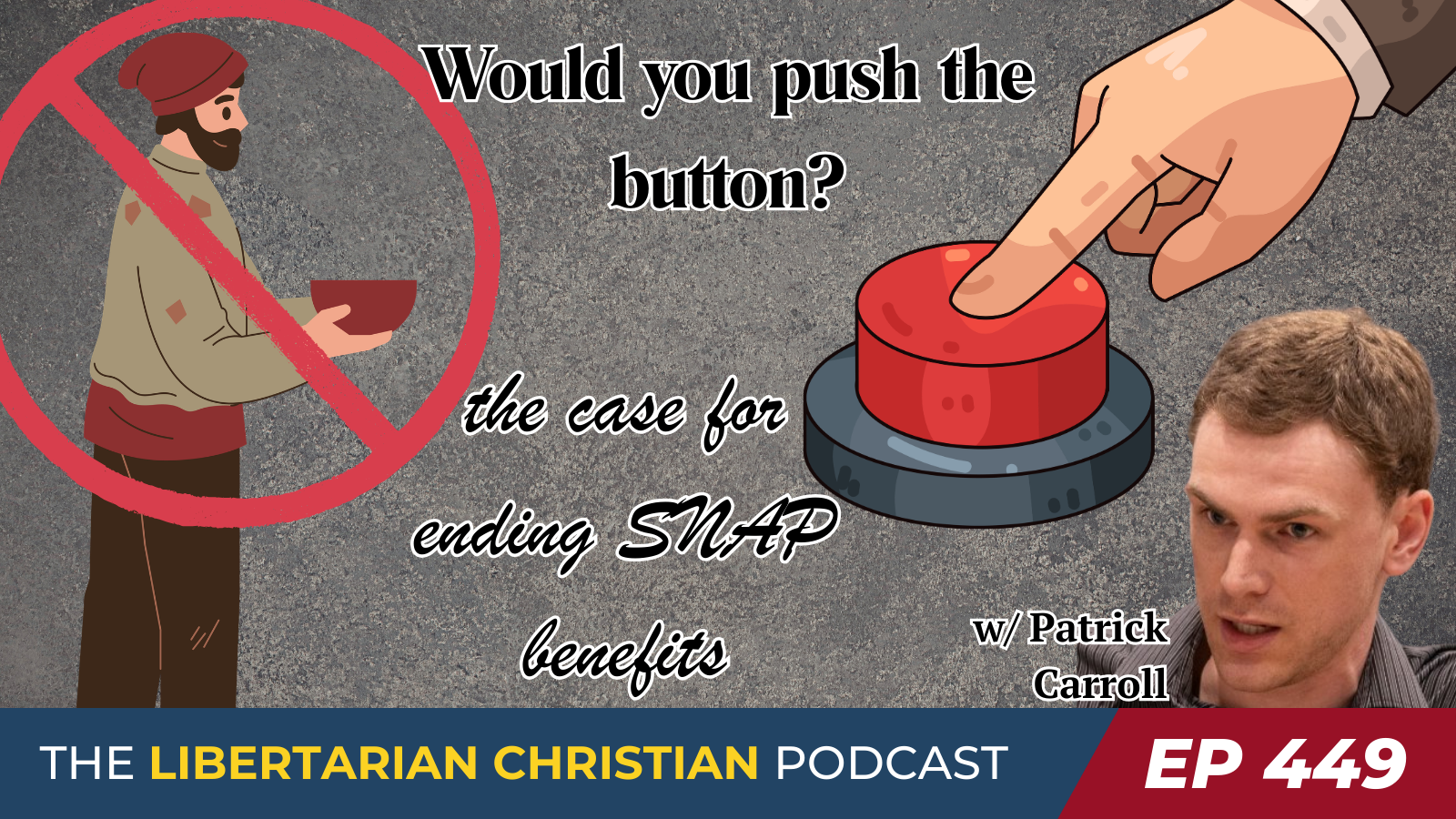
Host Cody Cook sits down with Patrick Carroll, a sharp libertarian opinion journalist based near Toronto whose writing appears in outlets like the Mises Institute, Libertarian Institute, AIER, and FEE (where he once served as managing editor). Carroll’s Substack, Against the Left, regularly dismantles progressive arguments from a free-market vantage point—and this conversation dives deep into one of his most provocative pieces: “Why SNAP Spending Should Be Cut Even If Charity Doesn’t Replace It.”
The episode centers on the dramatic events of late 2025, when a record-breaking U.S. government shutdown stretched into its second month. By early November, the Supplemental Nutrition Assistance Program (SNAP, formerly food stamps) faced a funding lapse. The Department of Agriculture announced that the roughly $100 billion annual program—serving about 42 million Americans, or one in eight—would not issue full November benefits. Chaos ensued: food banks reported overwhelming demand, long lines formed, and media stories highlighted desperate families suddenly without their usual grocery support.
Left-leaning commentator Carl Beijer seized on the crisis in a Jacobin piece, declaring it definitive proof that private charity cannot substitute for state welfare. Overwhelmed pantries and panicked recipients, he argued, exposed the fantasy of market-based solutions replacing government safety nets.
Carroll pushes back hard. He concedes the short-term strain on food banks but argues the episode reveals more about SNAP’s overreach than charity’s inadequacy. With little advance certainty (the shutdown’s duration remained a day-to-day uncertainty), private organizations had scant time to scale. Yet many still responded impressively—businesses like DoorDash offered free meals, churches and local groups rallied, and some food banks pivoted quickly. Had there been months of clear notice, Carroll contends, the charitable response would have been far stronger.
More controversially, he challenges the scale of need SNAP addresses. Citing a 2021 USDA study, he notes that 39% of recipients are obese, 26% overweight, 33% normal weight, and only 3% underweight. This, he says, shatters the media stereotype of widespread starvation and suggests the program subsidizes far beyond genuine hardship—often enabling poor lifestyle choices rather than preventing famine.
Carroll proposes an initial 50% cut, returning spending to roughly 2007 levels after years of ballooning budgets. He acknowledges “food insecurity” statistics (around 13% of Americans) but critiques their definitions, which can include anyone who occasionally buys cheaper groceries or skips a preferred item—hardly a crisis justifying $100 billion annually.
The discussion turns philosophical and theological. Carroll invokes the “negative contact hypothesis”: while meeting marginalized groups often reduces prejudice, direct exposure to many in poverty can erode naive sympathy when observers see patterns of self-inflicted hardship—addiction, unwise relationships, financial irresponsibility. Anecdotes from YouTuber Caleb Hammer’s Financial Audit series reinforce this, as do studies showing that more well-off people’s support for redistribution weakens after real contact with the poor.
From a Christian libertarian perspective, Carroll emphasizes voluntary generosity over state coercion. Jesus warned against lording authority over others (Matthew 20); early Christians practiced communal sharing without petitioning Caesar for taxes. He praises historical mutual-aid societies and modern examples like Mormon welfare systems as superior, more personal, and non-coercive alternatives to centralized bureaucracy.
Addressing bleeding-heart objections, Carroll entertains the sequencing argument: enact free-market reforms (deregulation, free trade, ending occupational licensing and minimum wage barriers) first to boost opportunity and reduce poverty, then phase out welfare. He’s sympathetic but rejects indefinite delay—some cuts can and should happen now without catastrophe, especially given SNAP’s questionable targeting.
This episode is bold, data-driven, and unapologetically challenging. It refuses easy compassion narratives, forces listeners to grapple with uncomfortable stats, and calls Christians to prioritize peaceful, voluntary charity over state redistribution. Whether you bristle or cheer, it’s a thought-provoking case for rethinking welfare in a free and faithful society.
Links:
Patrick’s Substack
Patrick’s piece Why SNAP Spending Should Be Cut Even If Charity Doesn’t Replace It
Patrick’s Twitter/X: https://x.com/PatrickC1995
David Beito’s book From Mutual Aid to the Welfare State: Fraternal Societies and Social Services, 1890-1967
Watch on YouTube:
https://www.youtube.com/watch?v=elUkkkW8qX8








;?>/smartquizbuilder/includes/images/sqb-registration-img.jpg)