American Hegemony — Do We Have a Right to Run the World?
Madeleine Albright once declared that America is the indispensable nation — that we stand tall and see further into the future than other countries. It’s a claim that has animated American foreign policy for decades. And it’s a claim that American hegemony has now thoroughly discredited. The wars that never ended, the trillions in debt, the millions of lives destroyed, the moral credibility of the Christian church burned through by leaders who said they were acting in defense of life and liberty — none of that was seen. Empires keep mistaking ambition for prophecy.
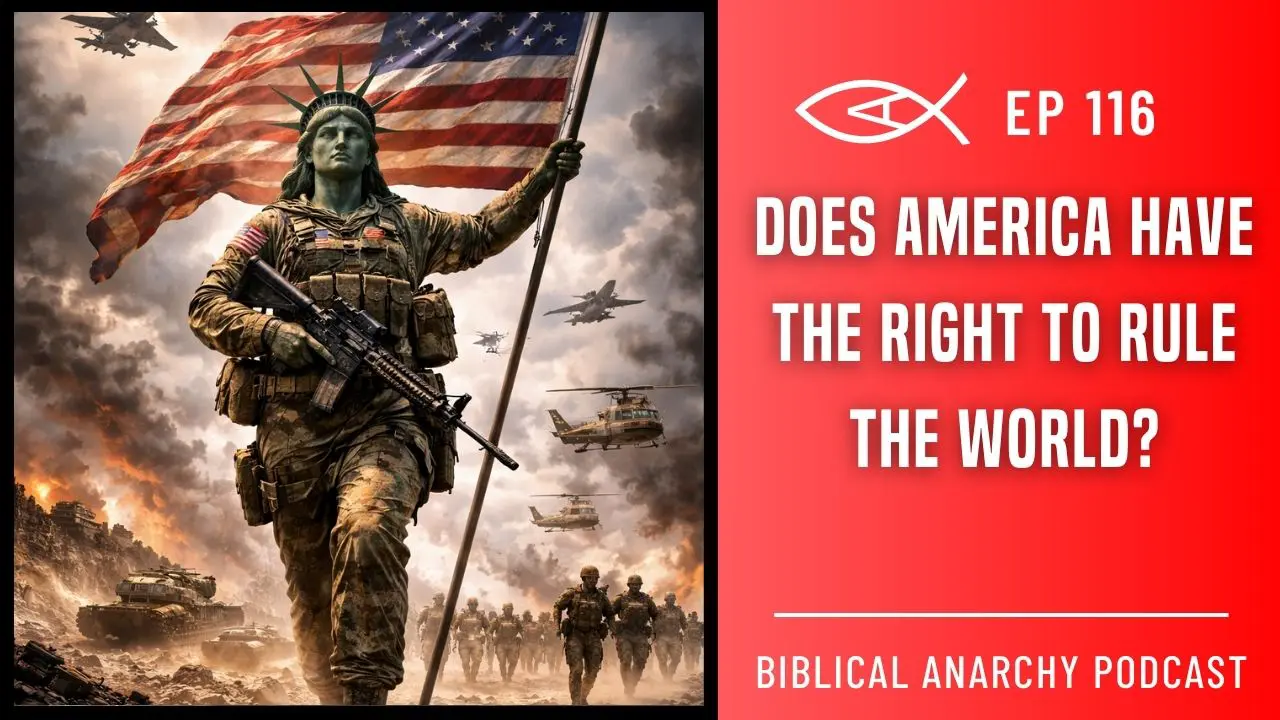
This first episode of 2026 from the Biblical Anarchy Podcast is a reckoning. Jacob Winograd returns from the holidays with remorse over his 2024 Trump vote — not because his single vote changed anything, but because the regression he has watched on the right represents something deeper than one election. After decades of failed foreign policy, after a presidential campaign that seemed to finally absorb the Ron Paul lesson about empire and blowback, we are somehow back at the beginning. American hegemony is being repackaged and re-sold, this time under the banner of America First.
What follows is the case against that repackaging — on strategic grounds, on historical grounds, and most importantly, on Christian grounds.
American Hegemony and the Lie of the Indispensable Nation
1. American Hegemony Has Already Proven It Cannot See the Future
The Albright doctrine rested on a single, audacious claim: that American power is uniquely wise and therefore uniquely justified. The last thirty years demolished that claim. The wars didn’t end. The debt compounded. The regimes we toppled became failed states, breeding grounds for the next generation of adversaries we would then have to fight. Bin Laden was a creature of American foreign policy before he became its most famous target. ISIS emerged from the vacuum American intervention created in Iraq. The Taliban reclaimed Afghanistan the moment we left.
Claiming to see further into the future while producing this track record is not a foreign policy doctrine. It’s a delusion.
2. The Ron Paul Lesson Was Almost Learned — Then Abandoned
The 2024 election cycle felt different. Presidential candidates felt genuine pressure to reckon with the libertarian critique of empire. Voices like Tulsi Gabbard, Tucker Carlson, and Vivek Ramaswamy were citing Ron Paul, calling for a humble foreign policy, sound money, and an end to forever wars. It looked, briefly, like the decades of work by people like Murray Rothbard, Hans-Hermann Hoppe, and Harry Browne had finally broken through to the mainstream right.
A year into Trump’s second term, that window has closed. The same foreign policy apparatus is back in the driver’s seat, now wearing America First branding. Marco Rubio, Ben Shapiro, and others who once positioned themselves as skeptics of neoconservatism are back to selling war and empire — just with different marketing.
3. Venezuela Is the Test Case — and the Trap
Venezuela is presented as a clean case: a bad leader, a plausible operation, a potential win. And for the sake of argument, assume the best. Assume minimal casualties, real benefits to Venezuelans, even economic upside for Americans through restored oil production. Even granting all of that, the question this episode presses is not whether a particular operation might produce short-term goods. The question is what principle is being established.
If a successful Venezuela operation becomes proof that American hegemony was never the problem — that the last thirty years were just bad execution rather than a flawed premise — then mission creep isn’t a risk. It’s a guarantee. Every future intervention will be sold as the one that finally gets it right.
4. The Broken Legs Analogy Still Applies
There is a classic libertarian observation that applies here with full force: the government breaks your legs and then hands you crutches, then claims you couldn’t walk without them. Most of what looks like a silver lining in American foreign policy follows this exact logic. We created Bin Laden and then stopped him. We destabilized Iraq and then surged to fight the groups that filled the vacuum. We armed the mujahideen against the Soviets and then spent the next two decades fighting the blowback.
Any honest accounting of American hegemony has to include the full ledger — not just the crutches, but the broken legs that made them necessary.
5. The Pro-Life Argument Has a Empire Problem
One of the sharpest points in this episode is also the one that should sting the most for evangelical Christians. The moral foundation of the pro-life movement is that every human life is precious — that innocent children, wherever they are, cannot be sacrificed for convenience or political calculation. Madeleine Albright was asked about 500,000 dead Iraqi children as a result of sanctions in the 1990s and said the price was worth it.
It wasn’t. And Christians who saw the hypocrisy of claiming to defend innocent life while cheering drone strikes in Syria, sanctions in Iraq, and bombs over Yemen drew the obvious conclusion. Nothing did more to accelerate the cultural collapse of Christian conservative influence in the 2000s and 2010s than the gap between what was preached on Sunday and what was cheered on Monday. American hegemony cost the church its credibility with an entire generation.
6. Special Pleading Doesn’t Become a Doctrine Just Because America Does It
The logic of American hegemony requires a kind of special pleading that doesn’t survive scrutiny. If the American government has the right to look around the world, identify illegitimate leaders, and use military force to remove them, then that principle either applies universally or it is not a principle — it is just power dressed up as morality.
Half the politically active population in America has called Donald Trump a fascist. By the logic of American hegemony, a foreign government that believed that assessment would have the right to intervene here. Nobody on the pro-intervention right would accept that conclusion. Which means they are not arguing from principle. They are arguing from dominance.
7. The Old Testament Does Not Justify American Hegemony
There will be those who reach for the Mosaic covenant — Israel’s wars, Israel’s statecraft, the commands given to Joshua and David — as theological cover for American military action. This argument fails on its own terms. Old Covenant Israel was a typological covenantal theocracy, a specific arrangement in a specific geography and time, designed to prepare the ground for the coming of the Messiah. The book of Hebrews is explicit: that covenant has passed away and been made obsolete.
More pointedly: does President Trump have a direct line to God the way Moses and Joshua did? Is he receiving divine commands to take Venezuela? If not, the Old Testament analogy isn’t just weak — it’s a category error. Theology matters for exactly this reason. When the covenant structure changes, so does the application.
8. The Religion of American Exceptionalism Is Not Christianity
What the hegemony advocates are actually practicing is not Christianity. It is a civil religion — one that wraps American power in the language of divine mandate while borrowing none of Christianity’s actual content. Blessed are the peacemakers. The last shall be first. Love your neighbor and your enemy. Vengeance belongs to the Lord. Leadership is servanthood. Jesus came not to be served but to serve.
None of these teachings survive contact with the logic of American hegemony. The right wing critique of socialism — that it subordinates the individual to the collective — applies with equal force to the claim that American interests justify military action anywhere on the globe. “American interests” is not a moral standard. It is a blank check written to whoever holds power.
9. Total Depravity Is an Argument Against Concentrated Power
The theological doctrine of total depravity — that human beings apart from God are fallen, self-interested, and capable of profound evil — is not just a soteriological claim. It is a political one. Anyone who genuinely understands their own sinfulness, who knows they need redemption rather than applause, should be deeply suspicious of concentrating the kind of power American hegemony requires in the hands of any person or institution.
J.R.R. Tolkien put it plainly: his political beliefs leaned toward anarchy — not bombs and chaos, but voluntary order and self-government — because no one has the right to rule over his fellow man, least of all the one who seeks it. That is not a radical position. It is the logical conclusion of taking human depravity seriously.
Conclusion: American Hegemony — The Question That Needs an Answer
The challenge this episode leaves on the table is a simple one: show the Christian argument for American hegemony. Not the Monroe Doctrine. Not force projection theory. Not the claim that this is simply how nation-states operate. A Christian argument — one that accounts for the sanctity of human life, the limits of human knowledge, the warnings against pride and empire in scripture, and the teaching of Jesus about power and servanthood.
That argument has not been made. What has been made, repeatedly, is the argument from dominance — that America is powerful enough to intervene, and that power is its own justification. That is exactly the logic Jesus rejected when he told his disciples not to seek to rule like the Gentile kings who lord authority over others.
The Biblical Anarchy Podcast exists to make the case that these are not separate questions — that what the Bible says about power, war, money, and human authority has direct implications for how Christians should think about foreign policy. In 2026, that work is as urgent as it has ever been.
Additional Resources
Biblical Anarchy Podcast
LCI Greenroom
External Reads
- “When Will We Learn?” by Harry Browne (2001) — Written immediately after September 11, this essay made the blowback case before most Americans were willing to hear it. Available at the Mises Institute.
- Costs of War Project — Referenced in the episode for casualty estimates from the post-9/11 wars. Academic research tracking the human cost of American military interventions since 2001. Available at Brown University.
- “The Monroe Doctrine” — Referenced as the historical basis pro-intervention voices are citing for hemisphere dominance. Background at Avalon Project, Yale Law School.








;?>/smartquizbuilder/includes/images/sqb-registration-img.jpg)