3 Important Bible Stories That Reframe the Immigration Question
We read many of these Bible stories as children, but we have failed to apply them to the issues of our time, including immigration. The immigration debate in America has no shortage of voices. What it has a shortage of is honest theological reckoning. Christians on both sides reach for proof texts, swap policy talking points, and rarely stop to ask the harder question: what kind of people are we becoming when fear is setting the agenda? That question sits at the center of this conversation between Jacob Winograd and pastor and author Benj Giffone — and the bible stories they work through don’t resolve the policy debate so much as they reframe it entirely.
Giffone, author of A House Divided: Technology, Worship, and Healing the Church After COVID, brings a pastoral and exegetical lens to a conversation that most Christians are having badly. The episode isn’t a simple open-versus-closed-borders debate. It’s a deeper interrogation of what scripture actually teaches about foreigners, neighbors, and enemies — and what it reveals about the church when those teachings get buried under partisan fear.
What follows is a breakdown of the theological arguments, the historical examples, and the pastoral challenge this episode puts before every Christian trying to think faithfully about one of the most contested issues of our moment.
Bible Stories and the Immigration Question: What Scripture Actually Says
1. Rahab the Canaanite Blows Up the Ethnic Exclusion Argument
One of the most important bible stories for this conversation is also one that gets skipped in most immigration debates. Rahab is a Canaanite — a member of a people group the Israelites were commanded to dispossess. And the first thing Israel does upon entering the land is make a covenant with her. The text treats this not as a compromise but as a triumph. Rahab joins the people of God because she professes genuine faith in the God of Israel. Ethnicity was never the point. It was never the criterion.
The same pattern holds throughout the Old Testament. Ruth is a Moabite. Uriah is a Hittite. Caleb, the leader of the tribe of Judah, is identified in Numbers 32 as a Kenizzite. The commands against intermarriage with surrounding peoples were always about excluding pagan beliefs and practices, not bloodlines. Anyone reading the Pentateuch as a mandate for ethnic or cultural exclusion is reading a different book than the one that’s actually there.
2. The Good Samaritan Defines the Neighbor You Can’t Ignore
When Jesus is asked who qualifies as a neighbor, he doesn’t answer with a census category. He tells a story — one of the most familiar bible stories in the canon — where the hero is a Samaritan, a member of a group that faithful Jews of Jesus’s day despised on ethnic and religious grounds. The Jewish man bleeding on the road is the Samaritan’s neighbor not because they share a tribe, culture, or nation, but because he is the one the Samaritan found.
That’s the logic Jesus is working with. Your neighbor is the person in front of you. The obligation to love doesn’t wait for shared heritage. And as Giffone points out in this episode, the Samaritan didn’t travel somewhere to find a worthy recipient of his compassion. He served the man who crossed his path. That framing has direct implications for how Christians think about the immigrants, refugees, and foreigners who cross their paths — whether in their city, their church, or their country.
3. The Sermon on the Mount Draws the Line at Tribalism
Jesus’s words in Matthew 5 are pointed in a way that gets softened in most retellings. He doesn’t just say love your neighbor. He says that loving those who love you back is nothing — even tax collectors do that. Even the Gentiles greet their own brothers. The standard Jesus sets is love for enemies, prayer for persecutors, and active care that extends beyond the tribe.
This is one of the bible stories that strikes hardest at the cultural preservation argument some Christians make for immigration restriction. The argument — that Western culture, shaped by Christianity, is worth protecting from dilution by outsiders with different values — contains a real kernel. But as Giffone notes, Jesus is not saying tribal love is wrong. He’s saying it’s insufficient. It’s the floor, not the ceiling. Christians who stop at loving their own and treat that as a completed obedience have misread the Sermon on the Mount.
4. The Old Testament Warned Against Oppressing Foreigners — Repeatedly
The law in Exodus 22, Leviticus, and Deuteronomy returns again and again to the same command: do not oppress the foreigner, because you were foreigners in Egypt. The memory of slavery is invoked not as a historical footnote but as the moral ground for how Israel was to treat outsiders. You know what displacement feels like. That knowledge creates obligation.
The episode takes care not to flatten Old Testament law onto modern immigration policy — ancient Israel was a covenantal theocracy in a specific geography and time, not a template for the U.S. Department of Homeland Security. But the moral logic underneath the law doesn’t expire with the covenant. The posture scripture calls for toward the foreigner is one of active welcome, not suspicion as a default.
5. Paul’s Theology of Identity Undoes the Ethnic Hierarchy
Romans 2 and Romans 9 together make a case that should reshape how Christians think about national and ethnic identity. Paul argues that true membership in the people of God has never been a matter of bloodline. It has always been a covenant of faith, not a covenant of descent. He is not a Jew who is one outwardly. He is a Jew who is one inwardly, by circumcision of the heart.
This framework doesn’t just apply to Jewish identity. It applies to every attempt to rank Christian solidarity below national or ethnic solidarity. The episode makes the point directly: a Christian in Pakistan, Mexico, or China shares something with you that no secular atheist of European descent shares, regardless of what passport they hold. Colossians 3 and 4 reinforce the same point. The new humanity in Christ transcends the categories the nations use to sort people. Christians who rank shared ethnicity above shared faith are not just making a policy argument. They are making a theological error.
6. The Milton Friedman Problem Is Real — and Doesn’t Justify Tribalism
The episode takes seriously the libertarian case for immigration restriction, particularly the argument most associated with Milton Friedman: open borders and a welfare state are not compatible. When the state subsidizes arrival and incentivizes dependency, the natural market and voluntary signals that would otherwise govern migration get distorted. This is a genuine tension, and the episode doesn’t wave it away.
But the Friedman problem is a critique of the welfare state, not a mandate for ethnic or cultural protectionism. The solution to a broken immigration system is to fix the system — reduce the welfare incentives, streamline legal pathways, enforce actual criminal law — not to treat every foreigner as a threat by default. The black market analogy is instructive here: crack down on legal immigration without fixing the underlying system, and you self-select for the people most willing to bypass the rules entirely.
7. The Enforcement Crisis Is a Failure of Categories, Not Just Policy
One of the sharpest observations in this episode is that much of what passes for the immigration debate is really a confusion about what the church is supposed to do versus what the state is supposed to do. When Christians outsource their moral obligations toward foreigners to the government and then call the result compassion, something has gone wrong at the level of categories, not just policy.
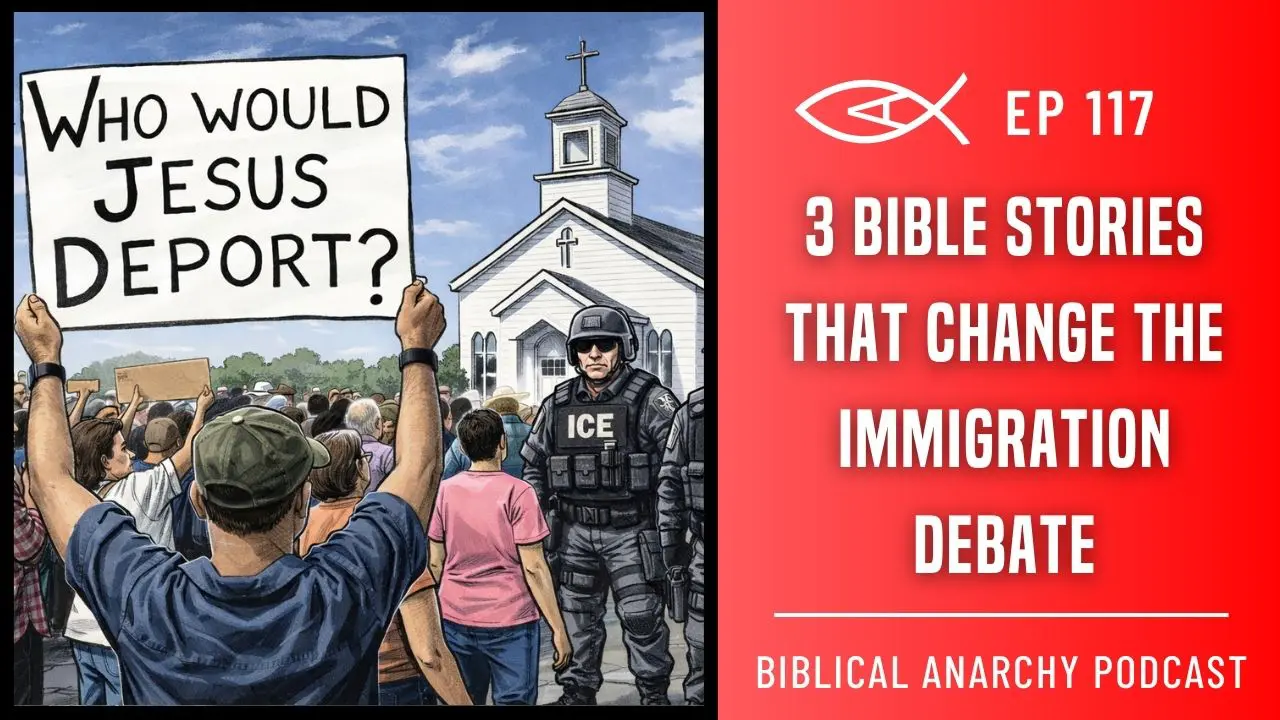
The ICE enforcement situation illustrates the problem. Most people across the political spectrum agree that violent offenders who are here illegally should face consequences. Where the system breaks down is when sanctuary policies refuse to hand over violent offenders, forcing ICE into broad enforcement operations that then produce the very confrontations and abuses that inflame the debate further. The solution isn’t to cheer every enforcement action as righteous or to obstruct every enforcement action as tyranny. It’s to insist on due process, proportionality, and a clear-eyed distinction between criminal behavior and mere presence.
8. Fear Is Not a Christian Immigration Policy
The episode returns repeatedly to the same diagnosis: fear has replaced faith as the operating principle for too many Christians engaging the immigration question. The threat narratives — cultural dilution, violent crime, Islamic infiltration, demographic replacement — are not all imaginary. Some of them contain real concerns. But when fear sets the moral agenda, it tends to produce exactly the kind of tribalism that the bible stories above were designed to challenge.
Giffone draws on Adam Smith’s Theory of Moral Sentiments to make the point that it is natural to care more about what is close to us. That instinct is not wrong. But Christianity has always called people beyond the natural. The whole arc of biblical revelation — from the inclusion of Rahab and Ruth in the Old Testament to the breaking down of the dividing wall in Ephesians 2 — is the story of God expanding the circle of neighbor beyond what tribalism would allow.
9. The Church Cannot Heal What It Keeps Handing to Caesar
The pastoral close of this episode is the part that should sit with Christians longest. Jacob’s framing is direct: when we ask the state to do our moral work for us — to protect our culture, preserve our values, enforce our vision of virtue — we shouldn’t be surprised when the tools of coercion corrupt the outcome. The church that outsources compassion to government programs and outsources justice to enforcement agencies has already ceded the ground it was called to hold.
Giffone’s three practical steps for Christians are worth taking seriously: maintain genuine empathy for those who suffer, serve the neighbor who crosses your path, and organize proactively to help those who are different from you. None of those require a policy position on deportation rates. All of them require actually being the church — the kind of community that government cannot replicate and that no amount of legislation can substitute for.
Conclusion: Bible Stories and the Immigration Debate — What Fear Costs the Church
The bible stories at the center of this episode — Rahab, the Good Samaritan, the Sermon on the Mount — don’t tell Christians what to think about border enforcement. What they do is harder: they tell Christians who to be. They draw a picture of a people who cannot reduce the image of God in the foreigner to a threat category, who cannot love only those who look and vote and worship like them, and who cannot hand their moral imagination over to the state and call the result faithfulness.
The immigration debate will continue. The policy questions are genuinely hard, and the episode doesn’t pretend otherwise. But the theological questions underneath them have clearer answers than most of the debate suggests. Christians who start with the bible stories — really start there, rather than using them as decoration for conclusions already reached — will find that the framework they need is already present. It just requires the courage to follow it past the point where it stops being comfortable.
Fear is a poor shepherd. Christ is a better one.
Additional Resources
Biblical Anarchy Podcast
LCI Greenroom
Books by Benj Giffone
- A House Divided: Technology, Worship, and Healing the Church After COVID — Available at housedividedbook.com. The book this conversation grew out of; essential for churches trying to recover a clear sense of mission after the COVID years.
- My Salvation Is Close at Hand: Isaiah 56–66 for the Church After Christendom — Available at salvationcloseathandbook.com. Giffone’s second book, which includes direct treatment of what Isaiah’s vision of the nations means for Christians thinking about immigration and empire today.
External Reads
- The Myth of the Rational Voter by Bryan Caplan — Referenced in the episode for Caplan’s research on the natural cognitive bias against immigrants and what it means for honest policy analysis. Overview at EconLib.
- The Theory of Moral Sentiments by Adam Smith — Giffone draws on Smith’s earthquake analogy to explain why globalized news distorts our moral priorities. Available free at EconLib.








;?>/smartquizbuilder/includes/images/sqb-registration-img.jpg)