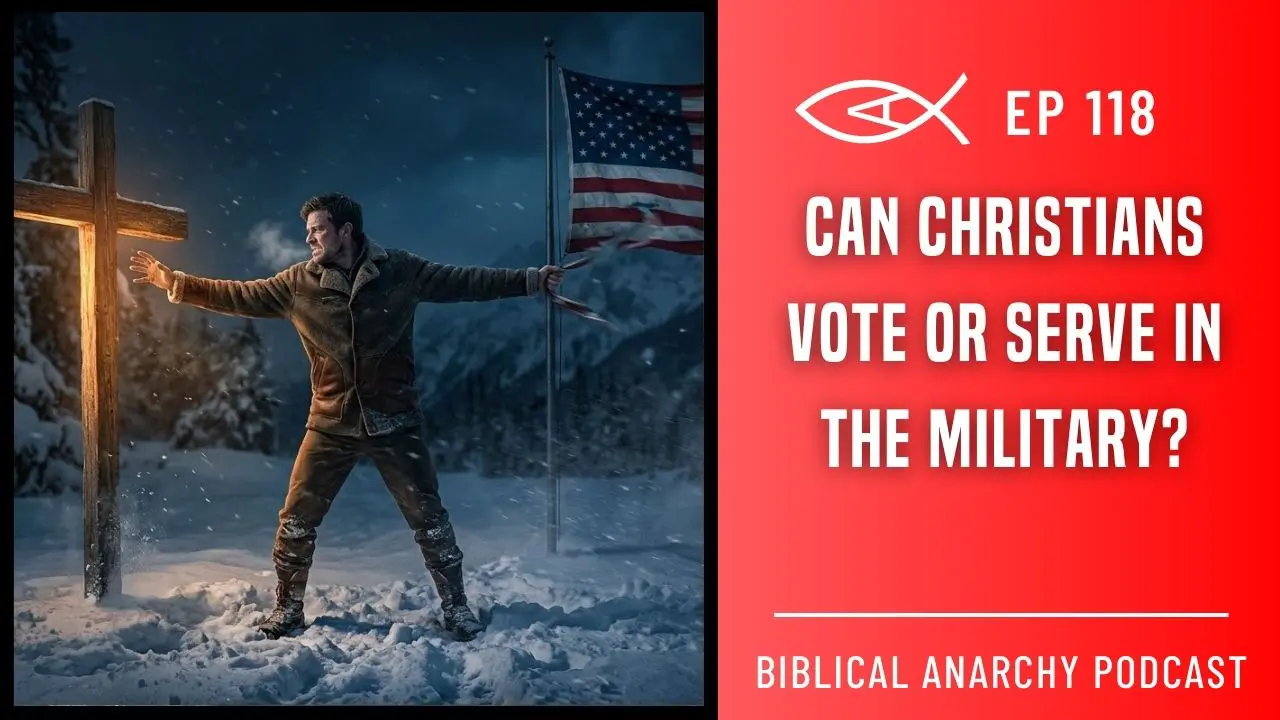
2 Hard Questions for Christians: Can We Vote or Serve in the Military?
Two questions for Christians keep surfacing in conversations about faith and political life: should believers serve in the military, and should they vote? They sound like separate questions, but they share the same root problem. Both involve handing over some measure of moral authority to a system that does not answer to Christ. Both carry real costs that Christians tend to underestimate. And both deserve more than a casual answer.
This episode revisits two questions submitted by a listener named Ethan, originally answered on the Faith Seeking Freedom podcast and now expanded here. The episode draws on Faith Seeking Freedom (the LCI book) and two-plus years of additional reflection, including an honest account of voting for Donald Trump in 2024 and what that decision looks like in hindsight.
Question 1: Should Christians Serve in the Military?
What Is a Conscientious Objector, Exactly?
A conscientious objector is someone who refuses military service on grounds of conscience, religion, or deeply held moral belief. The military has formal processes for this — the 1-O form (full discharge) and the 1-A-O form (reassignment to non-combatant duties). Notably, the government excludes “political, philosophical, or sociological” beliefs from qualifying. That exclusion is worth pushing back on. Philosophy is the study of ethics. Political convictions can be moral convictions. The line the government draws is convenient for the government, not coherent on its own terms.
Military Service Is a Moral Decision, Not Just a Career Decision
Faith Seeking Freedom frames military enlistment the way any major moral decision should be framed: weigh all the costs, not just the obvious ones. Skill development, leadership training, and educational benefits are real. So are PTSD, physical injury, and the possibility of death. But the costs that get underweighted are the moral ones. Does this path oblige me to kill on command? Does it build habits that run against Christian character? Does it make conscientious objection structurally impossible?
The Questions for Christians Go Deeper Than Use of Force
This is not primarily a question about whether Christians can ever use defensive force. Most Christians — including libertarian ones — are not pacifists. The harder question is what it means to enlist in a state military. A foot soldier is not making independent moral judgments in the field. He is executing orders from a chain of command that runs up to the president. That chain of command is not accountable to Scripture. The moral authority the soldier delegates when he enlists is not a small thing.
First-Century Christians Refused To Serve
Roman soldiers who converted to Christianity frequently left military service. The early church’s near-universal rejection of Christian participation in the Roman military was not squeamishness. It was a considered conclusion that the call to renounce violence was incompatible with what the empire required of soldiers. That example doesn’t automatically mean they are right, we shouldn’t just follow everything the early church did unquestioningly. Nevertheless, their conviction is one we need to also consider.
Just War Criteria Require More Than Good Intentions
If Christians are going to apply just war theory to military service decisions, they have to apply the whole framework. A just war requires a just cause, right authority, right intention, proportionality, and a reasonable chance of success. The original constitutional design tried to build something like that check into American government: Congress had to formally declare war, which meant making a public case before the nation that the conflict was justified, the objectives were defined, and the force was warranted. That check is gone. The War Powers Act, executive overreach, and decades of undeclared conflicts have dissolved it. A Christian soldier today may be sent to fight in a war that has never passed any meaningful just war test, by any branch of government.
The Moral Compromise Risk Is Built Into the Institution
Even in a theoretically just conflict, the military’s function is to suppress independent moral reasoning. That is not a cynical reading — it is how the institution works. Split-second combat decisions require trained reflexes, not ethical deliberation. The problem is that the same conditioning that works in genuine defensive situations also works in unjust ones. Soldiers who later object to illegal or immoral orders frequently struggle to be heard. The institution defaults to trusting seniority over conscience.
These Questions for Christians Apply to Government Service Too
Everything said about military service applies, in a softer form, to government employment and political office. Working within the state means working within a hierarchy that will eventually ask you to carry out something you disagree with. The question is not whether that moment will come. It will. The question is whether you have drawn your lines clearly enough, in advance, to hold them when it does.
Question 2: Should Christians Vote or Hold Political Office?
Politics Is Broader Than Voting
Faith Seeking Freedom opens by defining politics as any advocacy that affects how human beings relate to each other with respect to force and power. By that definition, hosting a podcast is a political act. So is listening to one. So is preaching. Christians are already political whether they think they are or not. That reframe matters for the voting question because it removes the false binary between “engage by voting” and “disengage entirely.” There is a wide field of legitimate political action that does not require casting a ballot.
Voting Is Not Self-Evidently a Christian Duty
The standard democratic argument for voting is that it is the peaceful mechanism for consent-based governance. The libertarian counterargument is that majority rule is not obviously peaceful — it is the organized enforcement of one group’s preferences on another. If the state is fundamentally an instrument of coercion, then voting for its rulers is not a neutral act. It may be participation in something Christians should be skeptical of. That is not a reason for automatic abstention, but it is a reason to stop treating civic participation as an obvious Christian obligation.
Some Votes Are More Defensible Than Others
Not all voting is the same. Voting against a tax increase is categorically different from voting for an executive who commands a military. Protest votes — third-party candidates running on decentralization platforms, write-ins, or blank ballots — are different from strategic partisan votes. Direct policy referendums are different from candidate elections. These distinctions matter. Christians who want to vote with integrity should make them explicitly.
The “Lesser Evil” Argument Deserves More Scrutiny Than It Gets
The lesser-of-two-evils framework is usually deployed to end the conversation, not start it. It treats the two major candidates as the only real options and then asks which one does less damage. But that framing already concedes the ground that libertarian Christians should be contesting. Voting for a lesser evil is still voting for an evil. The question Christians have to answer is whether they are doing so in a way that compromises their witness, their allegiance, or their ability to speak prophetically from outside the system.
The Trump Vote as a Case Study
Voting for Trump in 2024 looked defensible at the time on specific grounds: promises made to libertarians, the possibility of real concessions, Ross Ulbricht’s freedom as a concrete and credible commitment. Some of those promises were kept. Most were not. The administration has governed in ways that are, on balance, bad — on immigration, on spending, on foreign policy. Looking back, the calculus is murkier than it seemed. That is not a reason for despair or excessive self-recrimination. It is an honest account of what strategic voting actually looks like when the results come in.
One Unexpected Benefit of That Vote
There is one thing the Trump vote produced that was not part of the original calculation: credibility as a critic. Objecting to an administration from inside the coalition that voted it into power carries different weight than objecting from outside it. That dynamic grew the platform and opened doors that would not otherwise have been open. That does not justify the vote. It does complicate any simple accounting of whether it was a mistake.
Dogmatism in Either Direction Is a Problem
Christians who think voting is always wrong and Christians who think voting is always obligatory have both stopped thinking. These questions for Christians — military service, voting, political participation — do not resolve cleanly. They require ongoing judgment, honest self-examination, and a willingness to update based on evidence. The goal is not to find the answer that lets you stop wrestling. The goal is to wrestle well, with the right things at stake.
Conclusion: Questions for Christians That Don’t Have Easy Answers
These two hard questions for Christians resist the clean answers that most Christian political discourse prefers. That discomfort is not a flaw in the questions. It is a feature. The tension between being in the world and not of it is not resolved by picking a side. It is lived, carefully, with clear eyes and clear lines.
What can be said clearly: the prophetic witness of the church matters more than partisan positioning. Christians are not called to retreat from political life, but they are called to refuse the terms that political life usually offers. Draw your lines before you need them — specifically, not abstractly — because the pressure to cross them will come in a context designed to make the crossing feel reasonable, even necessary.
When the world says go left or go right, stop and look up first.
Additional Resources
Biblical Anarchy Podcast
Faith Seeking Freedom Podcast
Libertarian Christian Podcast
External Reads
- Faith Seeking Freedom (LCI) — The Q&A book this episode draws from directly; Question 64 addresses whether Christians can serve in the military. Available at libertarianchristians.com/faith-seeking-freedom.
- Augustine, City of God — Classic treatment of earthly kingdoms and the limits of their moral authority; the argument that states without justice are merely organized robbery sits directly behind LCI’s critique of modern military adventurism. Freely available via New Advent.








;?>/smartquizbuilder/includes/images/sqb-registration-img.jpg)