Archive for religious freedom

By Edmund Opitz, author of The Libertarian Theology of Freedom and Religion and Capitalism: Allies, Not Enemies. This essay was originally published in the February 1964 edition of The Freeman.

I am going to discuss individual liberty… eventually; but I’m go­ing to begin at the other end with liberty’s opposite—tyranny. If this roundabout method needs a defense, I’ll refer you to the proce­dure employed down on the farm to get a pig back into his pen. One’s first thought is to aim the pig at the pen door, get hold of him, and pull. The pig resists. So then you get around back and push. Still no go. The expert solves the problem easily; he heads the pig in the direction he wants him to go, then pulls his tail in the op­posite direction. If you want the pig to head northeast, pull his tail toward the southwest!

So I propose that we work our way around to liberty by starting with an all too common affliction of human society—namely, tyranny or unlimited government. "The history of liberty," as Woodrow Wilson said in New York in 1912, "is the history of the limitations placed upon governmental power." So, if we start with a picture of unlimited government in our minds, and then—step by step—apply the proper limitations to governmental power, we should end up—if we have done our work right—with a pretty clear idea of what a free society looks like.

Visualize two rectangles. One represents government; the other, society. Now let us superimpose the government rectangle on the society rectangle. To all intents and purposes, we now have but one rectangle: Government has swallowed up society and the two form a single, organic whole. This I shall call the 1984 pattern, tak­ing my cue from the famous novel of that name by the late George Orwell.

The novel is set in England. It is an England where a diabolically clever officialdom has succeeded in reducing the citizenry to a bunch of robots, controlled from the top, twenty-four hours a day. There is no private sector in the society of 1984, no sphere for per­sonal action which belongs to in­dividuals as a matter of right. The society is operated by the govern­ment as if the country were a vast, automated factory. Such is the intention, and such the theory.

Now in actual practice, the the­ory limps a little. There are loop­holes in even the most tightly or­ganized, totalitarian society. The governmental machinery breaks down occasionally; officialdom is inefficient and occasionally cor­rupt. And so it is in 1984. The dictator of this society is called Big Brother. Big Brother’s pic­ture is everywhere, and the eyes of the portrait are designed so that as you look into them they seem to follow you. The universal slogan is: "Big Brother Is Watch­ing You." His agents mingle with the populace to spy on people, and in every dwelling there is a two-way television set which keeps the home under surveillance.

The novel has a hero named Winston, who works in what is called the Ministry of Truth. Winston’s apartment has the usu­al television set, but by an acci­dent of construction one corner of Winston’s room is out of range of Big Brother’s seeing eye. Win­ston has a tiny sliver of privacy, but only because the Master Plan leaked at this point; the design is total political control of society, and the consequent extinction of personal freedom. Such a society is called totalitarian. The princi­pal feature of such a society is that no limitations are set to the exercise of governmental power over people; the government is coextensive with society. As a re­sult, this is a society without free­dom—regardless of the authority invoked to sanction governmental invasions of the various sectors of life. That authority may pro­ceed from the will of one man, or it may rest on the will of a major­ity. No matter. Controls are con­trols, and unlimited government by definition denies individual lib­erty, whatever the reason or the authority for the controls. Every­body in 1984 loved Big Brother; the regime was a total tyranny because it had the support of the whole people.

Unlimited Power

But that’s fiction, you say, and in real life things are different. Well, there is many a slip between intention and action, or the hu­man race would never have sur­vived; but let’s stick with intentions for a bit. The first of the modern dictators was Lenin, who wrote: "The scientific concept, dictatorship, means neither more nor less than unlimited power, resting directly on force, not lim­ited by anything, not restricted by any laws or any absolute rules. Nothing else but that." One of the men who learned from Lenin was Mussolini. "The State em­braces everything," he wrote. "Nothing against the State; noth­ing outside the State; everything for the State." This is the 1984 design as exemplified in the blood brothers, communism and fascism—for the state to consolidate the society, and for the combination to engulf the individual person. There is an inherent tendency in the state to move in this direction — unless a significant number of men in the society succeed in mo­bilizing the right counterforce.

Go back again to our two rec­tangles. When government is su­perimposed on society, it means that all the various activities of people are controlled, directed, or commanded; that individual initi­ative is everywhere stifled, thwarted, or conditioned. Let me cite a quotation from Plato on this point, not as necessarily re­flecting the mind of Plato or the actual conditions anywhere in Greece, but as revealing the des­tination of an ageless line of thought: "The principle is this—that no man, and no woman, be ever suffered to live without an officer set over them, and no soul of man to learn the trick of doing one single thing of its own sole motion, in play or in earnest; but, in peace as in war, ever to live with the commander in sight, to follow his leading, and take its motions from him to the least de­tail…. In a word, to teach one’s soul the habit of never so much as thinking to do one single act apart from one’s fellows, of mak­ing life, to the very uttermost, an unbroken consort, society, and community of all with all."

It Can’t Happen Here?

What was advanced by Plato merely as a speculative idea, something to play with, has been actualized in our day. Listen to the words of one of the foremost experts on the Soviet Union, Ber­tram Wolfe. Speaking of Russia, Wolfe says: "The state continues to direct and control all aspects of life. A single party continues to dominate and rule the state, and to act as the core of all organiza­tions."

Well, you say, Russia is a long way off, America has a tradition of freedom, and the communists are no longer influential here. Be­sides, Americans are a good-na­tured people, and we wouldn’t do this to each other… would we? There are people who would do this to us, with the noblest of mo­tives. Many instances occur to you, but let me offer just two. The first is from the pen of Senator Clark of Pennsylvania. Applauding the "liberalism" of American colleges, he writes: "Spiritually and eco­nomically youth is conditioned to respond to a liberal program of orderly policing of our society by government." The second state­ment is from a recent article by the eminent theologian, Reinhold Niebuhr. He is advocating liber­alism of the Americans for Demo­cratic Action type, and says, "… liberalism connotes a desire to use all the instruments and au­thority of the political state for the attainment of (social) justice. This means the welfare state, the politics of the New Deal, and the… Administration’s current in­tegration program…."

The trend is obvious. The coun­try, under prodding such as this, moves toward a centralized soci­ety run from the top down. The national government commands each year an increasing portion of the people’s earnings, and its power grows accordingly; its functions are extended and ac­celerated year by year. In other words, we are witnessing and liv­ing in the midst of the natural drift of a state reverting to type.

And a state reverts to type when­ever counter forces are lacking. I propose in this paper to describe these counter forces in the hope of reactivating them.

History does not move in a straight line—there are ups and downs; there are periods of en­lightenment, and ages that are dark. Liberty, too, comes and goes. It is lost and then found again. People experience the tyranny of a despotic ruler, endure it just so long, and then something inside them revolts. They frame a phi­losophy which provides the ra­tionale for establishing sectors of individual immunity against gov­ernmental power, and they fight in various ways to achieve their goals. This is the pattern for the recurring struggle of men to be free in society, and it hinges on the success with which the func­tions of government are limited to curbing aggression and main­taining the peace of society. If men are to attain freedom in so­ciety, they cannot do so on any old terms, but only on the terms laid down by liberty itself.

Seven Major Concerns of Man

As we look back over human history, we note several major concerns which in every age have engaged the minds and hearts of men. These divide society into seven sectors. One of the great human enterprises is Economics. Man has to eat. He has to protect himself from the inclemencies of the weather; and he covers his body for warmth and adornment. It is by economic activity that men satisfy their bodily needs for food, clothing, and shelter. Work is involved here, and man has a natural inclination to avoid work. That is why he invents la­bor-saving devices. One of the first labor-saving devices, as some cynic pointed out, was robbery. Now, a person produces for his own use and enjoyment and nat­urally he resents the thief; so, to curb thievery the police power comes into being. This is the seed­bed of government, and whether we like it or not, politics has al­ways been one of the major pre­occupations of mankind.

Then there is Education. The adults of every society seek to in­troduce the young to the intellec­tual heritage of their culture and to imitate them into the world of the grown-ups. Schooling is part of education, and so is science.

The fourth sector is Art—the world of painting, sculpture, ar­chitecture, and literature. Art is a perennial concern of man and should occupy a realm of its own in society. So should Ethics. Men evaluate their own conduct and the conduct of others in terms of good and bad, right and wrong.

These are moral judgments, and they stake out the ethical realm in human affairs. People strive to be better; they seek the good life—the kind of living appro­priate to our nature.

Moral effort takes us into the domain of Religion. Almost every person has, at some time or other, sat back and wondered what it’s all about. Does the universe, that scheme of things of which we are a part, have any meaning, any purpose? What is the significance, the aim and object of human life? What am I here for? Nobody above the moron level can avoid asking questions of this sort, which is what William James had in mind when he observed that "mankind is incurably religious." Undeni­ably, every society has exhibited some interest in this dimension of our lives, however varied the rituals and the theology which express this interest.

The seventh sector of human life is reserved for the free play of Voluntary Groups. Obviously, there is some overlapping here with the previously mentioned en­terprises. A factory is a volun­tary association; so is a church, in our society. And there are other voluntary groups designed to further the ends of education, ethics, and art. Nevertheless, we need this category in order to include the groups men form for sport, recreation, and just plain fun. These are the seven major areas of social life.

Assume that we start with a society whose government is un­limited, politics being deep into every human concern. Our task is to stake out the major human enterprises I have listed, to guar­antee the integrity and relative autonomy of each by showing that—except for government, the realm of law—politics is foreign to it. When we have done this, the police power—or government—is painted into a corner where it be­longs, exercising its rightful func­tion of curbing destructive and criminal behavior and providing for the defense of the society against domestic and foreign enemies. When government is thus limited, the creative and productive actions of men are un­hampered. Given this situation in a society, men would be free—as they are free today in one major realm, that of religion.

Separation of Church and State

There is one important princi­ple on which most Americans are agreed—the principle of the sep­aration of Church and State. We take this principle of separation for granted, hardly realizing how unique it is in history and how strange it still sounds to non-American ears. England, and most countries of Europe, have national churches. A number of the American colonies had tax supported churches lasting, in my own state of Massachusetts, until 1833. Religious dissenters fared ill in many of the early colonies, but by 1779 the state of Virginia passed a Bill for Establishing Re­ligious Freedom which was penned by the hand of Thomas Jefferson. "Well aware that Al­mighty God bath created the mind free," Jefferson begins, and then goes on to say "that to com­pel a man to furnish contribu­tions of money for the propaga­tion of opinions which he disbe­lieves, is sinful and tyrannical." Nor was any man to suffer civil disabilities because of his reli­gious beliefs. He was to be free in this area to believe or not, to align himself with a church or not. In any case, his rights as a citizen were not impaired. The law would touch him only when a crime had been committed, and then—before the bar of justice—the believer and the nonbeliever would be on equal terms. The First Amendment to the Consti­tution merely guaranteed that Congress would not overturn the religious arrangements the states had worked out for themselves.

The principle of separating Church and State is frequently confused with something that sounds a little like it but is, in fact, altogether different—the separation of religion from so­ciety, the elimination of a spir­itual dimension from social mat­ters. Jefferson who, in the Dec­laration of Independence, wrote that men derive their rights from the Creator, and who elsewhere wrote, "The God who gave us life gave us liberty at the same time," did not favor a nonreligious, secu­lar society. He opposed a reli­gious establishment and did favor government neutrality toward the churches. Why? In order that re­ligion itself could play its proper role in the affairs of men. What is this role?

The Old Testament View

Compare our situation with that of the ancient world. Man, Aristotle said, is a political ani­mal. Aristotle was not merely call­ing attention to the obvious fact that men live in social organiza­tions as their natural habitat; by calling man a political animal Aristotle was saying that man is the kind of a creature who may find complete fulfillment within the Greek city-state. The Greek polis was Church and State in one; its politics, one might say, was salvational. Our idea of rele­gating the state to the modest role of an umpire, keeping the peace by merely enforcing the agreed upon rules, would have been largely incomprehensible to men of the ancient world. The head of the ancient state was also its religious leader; Julius Cae­sar, you recall, was also Pontifex Maximus, the chief priest. The individual, in this kind of a set­up, was really locked into society—body and soul. Then, along came a new religion which transformed the ancient world by teaching that only part of man is social, that man’s essence belongs to God.

This idea is part of our heri­tage from the Old Testament, with its stress on God’s tran­scendence. The common opinion in the ancient world was that a god was useful to have around to sanction social practices, to guar­antee prosperity, and to insure victory in war. If a tribe lost a battle, this would be accepted as signifying the superiority of the god or gods of the victors; if a crop failed, the particular god who fouled up that situation was sacked. Some such idea of God is still widely held by our contem­poraries. The Victorian novelist, Samuel Butler, satirized this no­tion when he said: "To love God is to have good health, good looks, good luck, and a fair balance of cash in the bank." But the ancient Israelites, although they lapsed now and again, discarded the no­tion of a god kept on tap to bestow prosperity and victory. They believed in a God of right­eousness and truth, and they saw the workings of God even in their own poverty and defeat. They for­bade all graven images, as well as any attempt to represent God in concept or word. The holy name was never pronounced or spelled. God was wholly other; he trans­cended human affairs, and yet—as the Creator and Sustainer of life—he was involved in them.

This idea became part of Chris­tian doctrine and it made a big difference to the politics of the West; it undercut the totalitarian idea which ruled the ancient world. Here is the way a British political scientist, J. B. Morrall, states the new political develop­ment which occurred after the fall of Rome: "The State as we should understand it today did not exist in the barbarian dark ages. Chris­tianity alone was left with the task of providing the West with a social unity across its new bar­barian frontiers. It did so by ap­pealing not to a primarily politi­cal sense of obligation, but to a basis of divinely inspired and commonly shared spiritual fellow­ship. Medieval Europe offers for the first time in history the some­what paradoxical spectacle of a society trying to organize itself politically on the basis of a spir­itual framework (which gives to political life merely a relative value). By so doing western European thought about politics was propelled along lines which were to be sharply different from those of any other human so­ciety."

A Neglected Premise

Political theory in our tradi­tion is based on the assumption that men must be free in society because each person has a destiny beyond society which he can work out only under conditions of lib­erty. In other words, the inner and spiritual liberty of man im­plies the outer and social freedom needed for its completion. Loyal to these premises, the peoples of the West began their long and painful ascent toward the ideal of political liberty. By the time the West had attained a large meas­ure of liberty—in the eighteenth century—the premises had been forgotten. They are neglected to­day, but at least we do accept the principle that government should keep out of ecclesiastical affairs. Religion is to be free from politi­cal interference, just as we hope the other areas of life shall some day be free.

The spiritual underpinnings of our institutions have suffered ero­sion, and we careen toward the pre-Christian idea of the state as the universal caretaker promising to feed, clothe, house, train, and guide its minions. By its very label, the welfare state advertises its self-assumed benevolence; and by the same token it cloaks the power inherent in all political ac­tion. So successful is the disguise that it has even generated a spe­cious religious support.

To sum up: Man is not a politi­cal animal, in Judeo-Christian thought. He necessarily lives in societies and his societies require government. But the government must be limited to keeping the peace and administering justice, in order that individuals may have sufficient latitude to fulfill the law of their being, here and hereafter.

Ethical Values

This brings us to the domain of ethics. Every high religion is con­cerned with righteousness and the practice of virtue. As our reli­gious values have eroded, there has been a decline of standards in ethics and a worsening of con­duct. The figures on crime tell part of the story. Between 1958 and 1962 our population increased by 7 per cent, but crime increased by 27 per cent. Bank robberies have tripled in six years; em­bezzlement has doubled since 1956; there is an automobile stolen every 90 seconds. We in America steal more cars each year than there are cars manu­factured in Russia! Other forms of violence are on the increase. Harder to measure are losses in integrity, the casual going back on one’s word, the lack of moral indignation. And, of course, the trend is rationalized. Ethical rela­tivism is a widely held, but largely unexamined, theory. People of different cultures, we are told, have come to differing conclusions as to what is good and what bad; and this, we are told, means rela­tivism in morals—no right or wrong as such. People of differ­ent cultures have likewise come to differing conclusions as to what is true and what false. If the ethical relativists were consistent, they would have to say that this proves all truth is relative. Very few do.

Some people embrace ethical relativism on humane grounds, because—they say—people who think X is better than Y will try to force X onto other people. This is bad logic and bad history. There have been annoying re­formers who have sought to legis­late morals, a misguided effort. But the great crusades, persecu­tions, and massacres of history have not been efforts to improve wayward conduct; they have been attempts to correct error, false be­lief. If one adopts relativism on humane grounds, he should be con­sistent and deny any distinction between truth and error, on the grounds that people who believe they have The Truth might perse­cute on its behalf, as communists persecute ideological deviates.

The philosophy of the free so­ciety needs firm ethical support, and it is not getting it. As ethical standards decline, some people seek to correct the situation by passing laws to control behavior. Government is, in fact, a system of controls; but we ought to con­sider carefully the kinds of acts we decide to control by law. Crimes should be punished; on that point we all agree. But peo­ple cannot be made good by law; they can only be made less free, and that is bad. Anglican Bishop William Connor Magee made a fa­mous speech in the House of Lords in 1868 opposing a law which would have prohibited al­coholic beverages: "I’d rather the English should be free than that England should be compulsorily sober," he said. Now it is only fair to assume that this church­man favored sobriety; but if he were forced to choose between so­briety and freedom, he would choose freedom as the higher good. The dictum, "You cannot legislate morals," is sound doc­trine. But paradoxically, in a pe­riod when moral sentiments are weak, we have moved into the welfare state, which is a gigantic effort to legislate morals on a na­tional scale. When men go peace­fully about their creative and productive tasks, minding their own business, government should mind its business and let them alone. It cannot make them good, and it should not try. It can, how­ever, curb destructive and crimi­nal actions, and doing so is its proper job.

Importance of Education

It is one function of the edu­cator to be the gadfly of the state, but he cannot be a gadfly if he is on the state’s payroll. When the state begins its bid for total power, it must at some stage seize control of the country’s educa­tional system; it must establish a Ministry of Truth, as in 1984. Every culture devises ways of easing its young people into adult­hood, by imparting to them the heritage of that culture so that the patterns and values cher­ished by the citizenry may endure. But when there is a breakdown in the culture, there is a contest to determine what values and what information will be imparted to the young, and by whom. This gives the state an opening wedge for starting a vast conditioning process by which the young will be adjusted to their place in so­ciety and be kept ignorant of the fact that there is any higher order of majesty than that of state. We have made some headway in this direction, but those who would take us down this road know that the time is not yet ripe to advocate controlled education—as they openly advocate a con­trolled economy—and so, although they want government schools and urge federal aid to education, they assure us that this will not mean federal control. Despite their as­surances, subsidy must lead to control, and control means nation­alized education—a contradiction in terms.

Freedom in the Arts

Now we come to the realm of art. The writers, composers, and painters of Russia do not create for an independent public; they work for the commissars. They do not seek primarily to embody such values as truth and beauty in literature and music; their work is designed to further the pro­letariat revolution. An official statement reads: "The aim of Soviet art today must be to form the consciousness of the people." American artists are in a tizzy these days on the question of the role of government in the arts. Some opera singers and actors have come out in favor of federal subsidy for the arts, and there is now a Federal Advisory Art Coun­cil. But many American painters, sculptors, and writers are vigor­ously opposed to government in­terference and the Council of American Artist Societies is on record in favor of freedom in the arts. We don’t want an official art any more than we want an official religion. The real artist is necessarily a free spirit; it is only the routine writers and deco­rators who would go on the public payroll. So in the interests of art itself, we must keep politics and government out of this realm.

Art associations are just one type of innumerable voluntary as­sociations in our society. Political clubs and discussion groups are other types. Then there are ath­letic clubs, camera clubs, fan clubs, and a whole host of groups drawn together because the mem­bers share a common interest. The totalitarian state must seek to destroy all lesser loyalties within it, just as it seeks to destroy re­ligious loyalties above it; but in a free society, voluntary associations of all sorts flourish.

Economic Freedom

Finally, we come to the econ­omic sector of our society, the realm of business, industry, and trade. This is the place where nearly everyone devoutly pro­claims his dedication to free en­terprise and the free market while simultaneously calling for more controls and regulations. This is a critical area of our life, because it is presently the prime target of those who prefer collectivism to a free society. Freedom cannot be won or retained on economic grounds alone, but it can be and is being lost on the economic battlefront.

Economic activity is funda­mental to human existence. A Robinson Crusoe could get along without politicking, but if he did not work, he would die of hunger and exposure. Out of economic ac­tivity emerge the concepts of rights to property and claims to service around which many politi­cal battles are fought. Economics, on the surface, deals with prices, production, and the operations of the market as determined by our buying habits. Fundamentally, however, economics is concerned with the conservation and stew­ardship of the earth’s scarce goods: human energy, time, ma­terial resources, and natural forces. These goods-in-short-sup­ply are our birthright as creatures of this planet.

The strict limitation of govern­ment provides for an area of free­dom in society within which men take care of their material needs by a system of bargaining, con­tract, and free exchange. "The market" is simply a label for the system which uses free choice in buying and selling as a means of making economic decisions; it is the tactic of liberty applied to the workaday world. Within the network of market arrangements each man is rewarded according to the value his fellows place upon his offerings of goods and ser­vices. This reward is his "wage." Human nature being what it is, every man will tend to feel that his own wage is too low, whereas other folks’ prices are too high. Most people develop a reality sense on this point; others never do.

Every collectivist ideology—from the welfare state idea to totalitarian communism—is strung on a framework of eco­nomic error. People are prisoners of their beliefs, and so long as they cherish a wrong understand­ing of economics, they will be ap­pealed to by one form of collec­tivism or another. But when peo­ple embrace sound economics, col­lectivism will cease to be the men­ace it is today.

Parts of the Whole

Freedom is all of a piece, and economic freedom—within the proper moral and legal framework—is fundamental to the free so­ciety. Do we believe in religious liberty? Then unless there is pri­vate ownership of houses of wor­ship, and private means for paying salaries, printing books, and holding meetings, religion cannot be free. Do we believe in a free press? But if newsprint is a gov­ernment monopoly and all printing presses are government owned, how can newspapers be free? It is possible to have a Daily Worker in a capitalist country, but a Daily Capitalist in a communist country is inconceivable. Do we endorse academic freedom? But if government owns the schools and appoints the teachers, then free­dom vanishes.

The restoration of freedom is a difficult job. It’s one that will re­quire every bit of ingenuity and determination we possess. More­over, we ourselves are right in the middle of the picture. We cannot work from outside society, pre­tending that we are like gods fash­ioning a culture piece by piece; we are within society, and any improvements we might make have to be an inside job. Our situation reminds one of the story about a town council in Ireland. The town needed a new jail, so the council passed a four-point resolution: (1) The town will build a new jail to replace the old one; (2) To save labor costs the work will be performed by prison­ers; (3) To save material costs, the new jail will be built with bricks and boards obtained by tearing down the old jail; (4) The prisoners will live in the old jail until the new jail is completed!

Welfare Statists and Their Delusion

Not many Americans favor a dictatorship, but many Americans do favor the adoption of practices which will eventually lead to au­thoritarian rule. They believe in the welfare state, at the core of which lies a delusion. The welfare state is founded on the delusion that government—the power structure in society—after using its power to divest citizens of a portion of their earnings via tax­ation, will dispense the riches thus accumulated at the bidding of the powerless. It cannot be; power will respond to power. The poor and weak in our society employ no lobbyists, and the welfare state spends its billions at the behest of its upper bracket favorites.

Many of those who advocate the welfare state believe that society must be run by experts—given the current state of technology and the critical times we are in. But how do we know who is an expert, and who is not? At this point many intellectuals cast mod­esty aside and admit that they have themselves in mind. This simplifies matters for the rest of us, until we note that these ex­perts disagree among themselves as to who is really an expert and who is not. But one thing these experts favor, and that is the trend which is making our na­tional government ever richer and ever more powerful. They ap­plaud this, because they visualize themselves at the helm using the money and power accumulated in Washington to carry out vast pro­grams of their own devising. But if history teaches anything about politics, it is this: The intellec­tuals and the idealists may dream up blueprints for a heaven on earth, but political power is never wielded by intellectuals and ideal­ists—or not for long.

The welfare state operates on an evil principle: somebody’s pro­gram at everybody’s expense. The intellectuals want a powerful gov­ernment so that they can carry out their program, but this hope of theirs is doomed to continuous frustration—someone else always beats them to the punch. It will take a while before the intellec­tuals catch on to the futility of building for someone else’s take­over, and by that time we’ll prob­ably have gotten ourselves squared away in the fields of economics, religion, ethics, art, and educa­tion. When this is accomplished, we’ll have painted government in­to a corner, and men will be free.

Tags: , , , , , , ,
Categories : Articles
Comments (3)

From the great friend of LCC David Theroux comes a review of the recent movie “For Greater Glory,” which seems of particular value for all of us Christian libertarians out there. I’m excited to see it when it arrives in Austin. Here is what David had to say about it:

——

Of special interest to all freedom lovers is the sweeping, new, epic, independent film directed by Dean Wright, written by Michael Love and starring Andy Garcia, For Greater Glory: The True Story of Cristiada, that has just been released in theaters across the U.S. This story is one with particular interest to Garcia, the Academy Award-nominated, Havana-born actor, director, and producer, who has produced two major films depicting the terror and oppression of communist rule in Cuba (For Love or Country: The Arturo Sandoval Story and The Lost City). For his brilliant and courageous work in defending liberty, the Independent Institute presented him with its Alexis de Tocquevile Award at A Gala for Liberty in 2008. (Here are the presentations by Senior Fellow Alvaro Vargas Llosa and Andy Garcia at the event.)

Headlining a superb cast in For Greater Glory that includes Eva Longoria, Peter O’Toole, Santiago Cabrera, Eduardo Verástegui, Catalina Sandino Moreno, Rubén Blades, Oscar Isaac, and Bruce Greenwood, Garcia portrays Enrique Gorostieta Velarde, the retired army general who from 1927 to 1929 transformed an unorganized, minimally armed, indigenous insurgency into The Cristeros, a powerful, country-wide rebellion against the government of Mexico that had embarked on a campaign to rid the country of Christianity (Law for Reforming the Penal Code) beginning with the persecution of Catholics and ban of public religious practice (including all worship ceremonies, baptisms, weddings and funerals). Priests and religious sisters were denied the right to vote, fined for wearing religious attire, and imprisoned for exercising the right to free speech. When widespread peaceful protest, petitioning of the government, and an economic boycott resulted in 1926, the militant Marxist (i.e., atheist) Mexican president Plutarco Elías Calles denounced the dissent as treasonous and responded brutally with repression, torture, hangings, firing squads, and mass murder by federal troops. In 1927 the National League for the Defense of Religious Liberty recruited Gorostieta to lead the Cristeros against the government forces of Calles, who incidentally was publicly supported in the U.S. by the Ku Klux Klan.

This conflict is actually rooted in the imposed secularization of the Mexican Reforma (1855-1861) which in turn led to the Mexican Revolution of 1910 and the subsequent Mexican Constitution of 1917 and sought to impose a secular, socialist state over the entire country, at the same time the Bolsheviks were doing so in Russia. In imposing a system of compulsory government education, this Constitution reads, “Education services should be secular, and, therefore, free of any religious orientation. . . . The educational services shall be based on scientific progress and shall fight against ignorance, ignorances’s effects, servitudes, fanaticism, and prejudice.”

In my article “Secular Theocracy,” I note how in the modern world secularism has hypocritically been the driving force for intolerance and the creation of nation states, collectivism/statism on a gigantic scale and massive and invasive wars, and the Mexican government is Exhibit A. As Wikipedia correctly notes, to this day and in keeping with its own “secular theocracy”:

The Mexican constitution prohibits outdoor worship, which is only allowed in exceptional circumstances, generally requiring governmental permission. Religious organizations are not permitted to own print or electronic media outlets, governmental permission is required to broadcast religious ceremonies, and ministers are prohibited from being political candidates or holding public office.

And as part of this secular censorship, propaganda, and repression of religious freedom, there is virtually no mention of the Cristero War in the history books, films, and other media of Mexico, the U.S. or elsewhere. Indeed, both most Mexicans and Americans have been utterly unaware of this story in which between 90,000 and 200,000 people were killed (out of only a population of 15 million), and only now with the film with Andy Garcia are they able to learn vital lessons of their own history with more than obvious relevance for us all today. In this regard, the solution to the problem of church-state power is to de-socialize and privatize the public square, not seek to “take it over” and erect yet another theocracy.

Addendum: One aspect of the full story that unfortunately does not get presented in the film is that after the U.S. brokered a flawed peace agreement in 1929, during the following five years and as a secular theocracy the Mexican government broke the agreement by hunting down all of the surviving Cristeros leaders after they were disarmed and massacred them.

Tags: , , , , , ,
Categories : Articles
Comments (2)
Jun
15

Winner Take All

Posted by: | (0)

By Edmund Opitz, author of The Libertarian Theology of Freedom and Religion and Capitalism: Allies, Not Enemies. This article originally appeared in the March 1965 issue of The Freeman.

The census of 1960 turned up one hundred and ninety million souls living in these United States. Of this number, roughly one hundred and eight million qualify to regis­ter as voters. This is 56 per cent of the nation, and this body of people constitutes the electorate of the United States. But, of the number of persons eligible to register, only eighty-one million have actually done so; twenty-seven million have not, for rea­sons ranging from indifference to intimidation. The total vote cast in the 1964 Presidential sweep­stakes was roughly sixty-nine mil­lion. This is 64 per cent of the electorate, but it is only 36 per cent of the population. The 1964 election was won by a candidate who garnered forty-two million votes. This figure translates into 60 per cent of the votes cast, 51 per cent of the registered voters, 38 per cent of the electorate, and only 22 per cent of the population. This is "the majority" which, in the eyes of some political theor­ists, confers a mandate on the victorious party to impose its pro­gram on the reluctant "minority" of the nation, that is, on the other 78 per cent!

This is the theory of majori­tarianism, ardently espoused by some articulate intellectuals. Here, for example, is Professor James McGregor Burns of Williams Col­lege. Dr. Burns declares that "… as a liberal I believe in majority rule and majority rule is a ques­tion of adding up ‘bodies’ (or, I hope, adding up minds)." Profes­sor Burns believes that men who embrace the conservative position have thereby foresworn what he calls the numbers game, this game having been staked out by liberals as their very own. "Because as soon as conservatives start to base their principles on numbers," he writes, "then they’re playing the liberal game (what they call the liberal game; what I would call subordinating their basic values to a liberal premise, which is the premise of majority rule)."

It may be conceded that a "ma­jority" has, by definition, the power to bull its way through and work its will on the nation, but does it have the right to do this? Is there not some principle or right or rule of ethics which even a "majority" ought to ac­knowledge, and to which it should yield? Addressing himself to this question, Professor Burns re­phrases it and then gives his answer. "What does a majority have the right to do?" he asks. "It has the right to do anything in the economic and social arena that is relevant to our national prob­lems and national purposes—ex­cept to change the basic rules of the game."

Unqualified Majority Rule

That final disclaimer sounds like an afterthought, and some political theorists support the ma­jority rule idea without qualifica­tion. Professor Herman Finer of the University of Chicago, for in­stance, writes, "For in a democ­racy right is what the majority makes it to be." In other words, the majority has the power to car­ry out its will, and thus whatever it does is all right; its program is right, by definition.

If so, then the liberals, by win­ning an election, have won the right to run the country as they please—including, Burns sug­gests, the right to be let alone by conservatives! The liberals now have a majority of the nation be­hind them, Professor Burns as­serts, and "I want the liberals of the nation to have a right to rule in what I think is their day to­day."

Professor Burns seems not to have noticed, but in saying this he has abandoned the majority rule idea for the more exciting notion of Winner Take All! In the politics of winner-take-all—which is modern liberalism—officials be­gin to treat public office as their own private property, with bene­fits for them to enjoy but without the responsibilities owners assume in rightful property relationships. The national government becomes an article of commerce whose capture is worth over a hundred billion dollars annually to those who gain possession of it. Those who win an election, even by the slimmest of margins, have a man­date from the country—provided they are liberals!—to impose their program on the whole nation. It is amusing that those who begin by playing the numbers game in politics wind up with a mathe­matical absurdity; a majority, 51 per cent, is—in their book—not only equal to the whole, 100 per cent, but superior to it!

This is what the idea of major­ity rule boils down to. Stated baldly, it is absurd, but it is dif­ficult to examine the notion of ma­jority rule coldly because most of us are scared off by what majori­tarians say are the alternatives to majority rule. Those who question majority rule are emphatically not thereby committed to minority rule, or one man rule, or rule by an elite—or any other kind of rule—meaning by "rule" the sub­ordination of some to the will of of another. These are false an­titheses, for all varieties of rule are on the same side of the ledger. On the other side of the ledger is the proper alternative to all species of rule, namely, the system of individual liberty. The system of liberty stands in contrast to ma­jority rule, minority rule, and all other forms of rule. Individual liberty within a proper spiritual, moral, and legal framework is in one category; majority rule is in another. And the two categories must not be confused. When the alternatives are spelled out, that is to say, when we understand the implications of majority rule, on the one hand, and the implications of a system of liberty on the other, some will choose the for­mer, others the latter. But obvi­ously we cannot make an intelli­gent choice if there is confusion as to what we are choosing.

Second-Class Citizens

What does majoritarianism mean? Whenever a society subor­dinates every other principle to the principle of majority rule—or whatever the label authoritarian­ism may assume—it winds up with a political arrangement in which winner takes all; and the politics of winner-take-all results in a society with a permanent body of second-class citizens, a servile society. If a majority of the voters, 51 per cent, controls the whole society, then the 49 per cent who lose the election are prevented from exercising their full citizenship rights. I do not mean to say that the losers are completely deprived of their rights, for this is not the case; but the losers—merely by coming out second best in an election—no longer have the same rights as the victors. Some rights remain, but there is no longer equality of rights, and this is the critical point.

An illustration may make this clearer, an illustration from the field of religion, where the old principle of equality of rights is still pretty much intact. Suppose that my denomination, Congrega­tionalism, were to grow and grow until, numerically, we were to constitute a majority of the elec­torate. Then suppose we decided to play the game of winner-take-all politics (as we once did, as a matter of fact, and kept on doing in Massachusetts, until 1833). We would win a national election and use the fact of victory at the polls to "establish" this denomination. Now that we are "established" we are able to levy taxes on Meth­odists, Baptists, Catholics, and Holy Rollers, and force you to contribute to our support. We would not, of course, close the doors of your churches, nor for­bid you to attend services when­ever you chose. All we’d do is deprive you of part of your in­come and property, and then we’d use your income and your prop­erty to promulgate our doctrines. If 10 or 15 per cent of your in­come is being spent by us to fur­ther our purposes, it’s obvious that you have that much less money to spend on your own pro­grams.

Not Religious Freedom

Now, money is not everything in religion, but it is something. It takes money to build churches and keep them up; it takes money to train and support ministers; it takes money to print hymnbooks and textbooks and send out mis­sionaries, and so on. And it is obvious that your religious pro­gram will suffer to the extent that we force you to pay for our pro­gram. There is a sense in which you are still free to practice your religion, but you are not fully free to practice it; your religious lib­erty has been impaired.

Most people would say, as a matter of fact, that the society I have conjured up in my illustra­tion does not have religious lib­erty. And anyone who argued—in defense of this arrangement–that the Methodists and Baptists shouldn’t complain, but rather should work toward becoming a majority so that they too could operate a racket, would be hooted down, and properly so. The be­liever in religious liberty will not settle for an ecclesiastical ar­rangement which invariably puts minority religions at a disadvan­tage; he wants full freedom for all. Nor will the believer in polit­ical liberty settle for a theory which contemplates a permanent category of second class citizen­ship as an intrinsic part of its operation. And yet this is precisely what present-day liberalism stands for; this is what it offers us as the latest thing in politics and morals!

No majority had the right, under our original system, to im­pose its religion on any minority, or impair its freedom of utter­ance, or deprive it of property. But under the new dispensation "The Majority" is almighty. All it has to do is gain control of gov­ernment and then it has a legal cloak behind which an actual nu­merical minority of the nation uses the governmental machinery to work its will on the rest of the society. According to the theory of majority rule, the governmental machinery is always "up for grabs" for such a purpose.

Neglected Questions

Collectivist regimes act as if the apparatus of government were the private property of officeholders, through which these men exercise their ownership of a country, and their power over the lives of the citizenry. The excuse offered is that "we are doing it to our­selves." What a misuse of lan­guage this is! If Methodists are doing it to Baptists or Congrega­tionalists to Presbyterians, it is obvious that some people are do­ing something to other people; "we" aren’t doing it to "our­selves." The "we" who are doing it aren’t the same people as the "ourselves" to whom it is done!

Those who put their trust in majoritarianism proclaim that there is no other test of the good­ness of a law than its ability to muster the might of the majority behind it. Any law that has ma­jority support is a good law, by definition, and there is no other test. By the same token, govern­ment’s role is to perform what­ever services a majority demands of it, and short of not killing the goose, the majority is entitled to all the golden eggs it can get.

I have analyzed and condemned this doctrine; it deviates from earlier American practices, as well as from sound principles of polit­ical philosophy. Majoritarianism gives wrong answers to questions about the proper role of govern­ment in society, and it neglects questions about the attributes of good law.

The Prescribed Limits

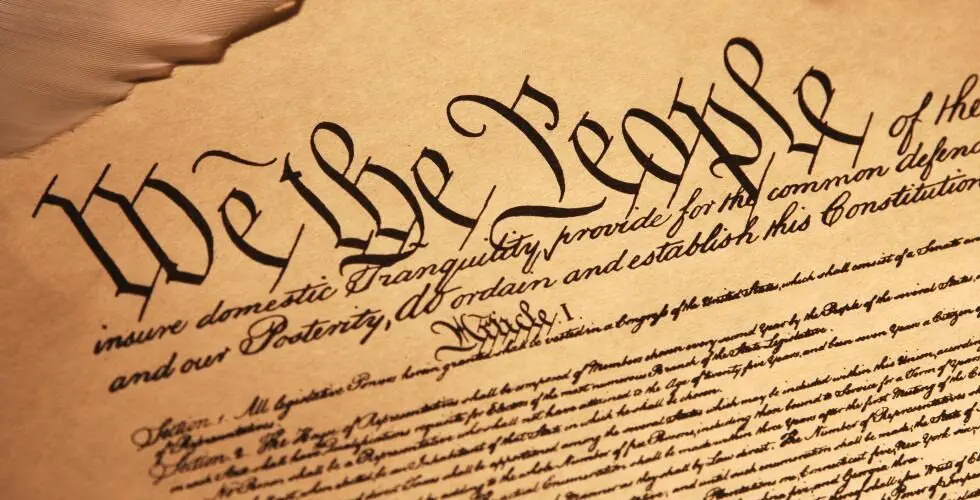
No one can read our Constitu­tion without concluding that the people who wrote it wanted their government severely limited; the words "no" and "not" employed in restraint of governmental power occur 24 times in the first seven articles of the Constitution and 22 more times in the Bill of Rights. Why this distrust, and what was their intention? These men understood the necessity of the police power in a society. But they recognized its potential dan­ger, as well, and so they designed the machinery for keeping their government limited to the per­formance of policing functions. The police power is, ideally, com­petent to maintain the peace and order of the community, which is what the policing of a society means. If the police power—gov­ernment—is limited to policing, then the society is free; the public sector is small and well defined, the private sector is large enough to give peaceful people plenty of elbow room.

The Constitution designed a federal republic with both ter­ritorial and numerical representa­tion. It is improper to refer to the government in Washington as "the federal government"; it is the na­tional government. The federal structure is comprised of the na­tional government plus the gov­ernments of the sovereign states. Government is the power struc­ture of society, and federalism limits power by dividing it be­tween nation and states. Power is divided still further by separat­ing functions within the several governments. The federal struc­ture deals with the problem of power in much the same way as a Gothic cathedral handles archi­tectural stresses. The enormous weight of the roof of one of these medieval structures presses out­ward against the walls and would level them, except for the flying buttresses which exert an equal pressure inward to maintain the building in a dynamic equilibrium. A national government tends to extend its sway over a whole na­tion unless its centrifugal force is countered by the centripetal force exerted by the states and the congressional districts.

The Philosopher-King

The structural complexity of the American system of government makes sense if we understand the premises of those who created it. They were concerned to limit and cramp the style of government in order to hamstring the proven capacity of men in power to do evil. The rather awkward ma­chinery they put together may offend against elegance, but it serves admirably the purpose for which it was designed. It is not, however, an efficient, streamlined political mechanism, such as would be erected by those who believe government should be unfettered and strengthened in order to give the wise men who wield this power increased opportunity for doing good. This idea goes back to Plato’s Philosopher King.

The Philosopher-King idea is first to create elaborate and pow­erful governmental machinery, capable of running society and do­ing wonderful things for The Peo­ple, and then to put the wisest and best men in control. This approach was repudiated in the Con­stitution, by the most sophisticat­ed political thinking on record. This thought is premised on the understanding that human nature is such that if power situations are deliberately created, the worst men will gravitate toward them, and such good men as are given arbitrary power will be corrupted by it. At stake here are two con­trasting estimates of man.

Two Views of Man

What is your reading of human nature and the consequences of power? Optimists and utopians tend to think in terms of erecting large and powerful structures of government with wise and good men in charge. Overlooking the corruption in human nature they dream of the benefits which might flow from such an arrangement. Realists, on the other hand, will try to limit the power of govern­ment in order to forestall evil men from snatching control of it and doing great harm. A federal re­public along the lines of the Amer­ican model is the product of this outlook. "When it comes to ques­tions of power," wrote Jefferson, "let no more be heard of the good­ness of man, but bind him down from mischief by the chains of the Constitution."

The very structure of constitu­tional government, then, reflects a philosophy of man; the political machinery itself disperses power and thus limits it. Then, those in the old-fashioned Whig and Class­ical Liberal tradition placed fur­ther controls on power by laying down the earmarks of good law. They may be briefly summarized. In the first place, a good law makes no pretensions to perfection. No human laws are in fact perfect, and the attempts of some to apply their "perfect" laws to imperfect hu­man beings have been disastrous. A good law will take human short­comings into account; it will re­flect our limited understanding and sinful nature.

In the second place, a good law will be written so as to correspond to what the eighteenth century referred to as the Higher Law. A good law, in other words, will not violate our ethical code; it will not supplant morality with mere legality.

Equality before the Law

Generality is a feature of a good law. Everyone should be equal be­fore the bar of justice, and so a good law is one which applies to all men alike and without excep­tion. Men are different in several important ways; some are bright and some dull; some are rich, others are poor. There are dif­ferences of nationality, color, and religion; there are employers and employees, and so on. These are important distinctions and clas­sifications—but not to the law! The law should be blind to such differences, and any law which is general, applying to one man as to all cannot have much wrong with it. Fairness in application coupled with proper enforcement induces respect for law and makes for a high level of law observance.

Besides being imperfect, moral, and general, a good law is condi­tional; it has an "iffy" quality about it. It says, if you steal, or if you defraud, or if you drive on the left side of the road, you will be punished. A good law takes the side of the negative, saying "Don’t," or "Thou shalt not." This means that it is theoretically pos­sible for a man to negotiate life without encountering the law, pro­vided he sticks to the positive. The fifth and final point in this abbrevi­ated list is something like the first; a good law reflects the customs and habits of a people—otherwise it is an attempt to reform them by law, and reformist law is bad law.

When a man thinks he’s Napo­leon, and acts on that assumption, the rest of us lock him up out of harm’s way. Things aren’t so sim­ple when a whole society is smit­ten by ideas of grandeur. When a society projects its Napoleonic fantasies onto government, the picture unfolds much as we have observed it during recent history. Current history has given many sensitive people the jitters, as any­one can confirm for himself who will inspect the present offerings of our poets, playwrights, and artists. They testify to an epi­demic sense of alienation and con­flict. Man, they say, is at war with his own creations; he can’t get along with his fellows, and he’s at odds with himself. The modern malaise is not, of course, primarily political, but if it disposes us to retrace our steps to the point where we’d seriously overhaul our understanding of man’s nature and his destiny, important polit­ical consequences would follow. Appraise man realistically and governments would lose their Na­poleonic pretensions. Limit gov­ernments to policing functions and, although that alone wouldn’t solve social problems, these would then challenge rather than threaten us. And challenge is just what we need to grow on!

Read more from the Edmund Opitz Archive.

Tags: , , , ,
Categories : Articles
Comments (0)

"I pledge allegiance to the flag of the United States of America, and to the republic for which it stands, one nation under God, indivisible, with liberty, and justice for all."

There are three holidays that cause otherwise sound-in-the-faith evangelical, conservative, and fundamentalist Christians to lose their religion.

I am referring to Memorial Day, the Fourth of July, and Veterans Day.

One of these holidays doesn’t even have to fall on a Sunday for some churches to go wild with celebration.

Memorial Day, of course, is always observed on a Monday. The other two holidays only fall on a Sunday every seven or so years. But if one of them doesn’t happen to fall on a Sunday, the Sunday before the holiday will do just as well. In some years, like when the Fourth of July or Veterans Day occurs late in the week, the Sunday after the holiday is reserved by some churches for observation.

As if the blind nationalism, hymns to the state, and exaltation of the military that occurs in some churches on these Sundays isn’t bad enough, sometimes the festivities also include the reciting of the Pledge of Allegiance, in church, by the congregation, facing the flag on the platform. The Pledge is usually led by the pastor or a boy scout or veteran, sometimes in uniform.

This is not only unfortunate; it is an anti-biblical disgrace.

There are several reasons why no one that treasures liberty, is familiar with American history, and knows the history behind the Pledge (an ad campaign to sell magazines) would waste his time saying the Pledge. I want to focus on one of them.

There are also several reasons why Christians that treasure liberty, are familiar with American history, and know the history behind the Pledge (written by a socialist minister) would waste his time saying the Pledge. Again, I want to focus on one of them.

In 2000, an atheist sued his daughter’s school district because he said that the words "under God" in the Pledge amounted to an unconstitutional establishment of religion. He lost.

After an appeal by the atheist parent, the Ninth Circuit Court of Appeals ruled in 2002 that the phrase in question was unconstitutional.

After an appeal by the school district, the U.S. Supreme Court ruled in 2004 that the father of the child lacked standing to file the lawsuit because his daughter’s mother had sole legal custody of her and that she was not opposed to her daughter reciting the Pledge. The ruling of the appeals court was then reversed.

In 2010, the same federal appeals court upheld the words "under God" in the Pledge in another case, ruling that the phrase does not constitute an establishment of religion.

The idea that the words "under God" in the Pledge of Allegiance violate the Establishment Clause of the First Amendment is ludicrous. As stated by the Ninth Circuit Court of Appeals in its 2010 ruling:

Not every mention of God or religion by our government or at the government’s direction is a violation of the Establishment Clause.

We hold that the Pledge of Allegiance does not violate the Establishment Clause because Congress’ ostensible and predominant purpose was to inspire patriotism and that the context of the Pledge – its wording as a whole, the preamble to the statute, and this nation’s history – demonstrate that it is a predominantly patriotic exercise. For these reasons, the phrase "one Nation under God" does not turn this patriotic exercise into a religious activity.

However, just because the phrase "under God" in the Pledge doesn’t violate the Constitution doesn’t mean that it belongs in the Pledge or, more importantly, that Christians should recite the Pledge.

One reason why Christians should not recite the Pledge is a simple one, and one that has nothing to do with patriotism or religion.

The United States is not a nation "under God."

The United States is in fact about as far from being "under God" as any country on the planet.

The United States leads the world in the incarceration rate, the total prison population, the divorce rate, car thefts, rapes, total crimes, illegal drug use, legal drug use, and Internet pornography production.

At least the United States is second to Russia when it comes to abortions.

According to the Guttmacher Institute, "nearly half of pregnancies among American women are unintended, and about four in 10 of these are terminated by abortion" and "twenty-two percent of all pregnancies (excluding miscarriages) end in abortion." There are over 1,700 abortion providers in the United States. And even worse, 37 percent of women obtaining abortions identify as Protestant and 28 percent as Catholic.

Only a madman would say that the United States is a nation "under God."

Oh, but the Pledge is just some words, some say, the reciting of which doesn’t really mean anything.

Then why say it? If the Pledge is just some words that don’t really mean anything, then it makes more sense not to say it than to say it.

The Pledge doesn’t say that the United States used to be one nation under God. It doesn’t say that the United States should be one nation under God. It says that the United States is one nation under God.

That is a lie.

Christians are not supposed to lie:

Lie not one to another, seeing that ye have put off the old man with his deeds (Colossians 3:9)

Wherefore putting away lying, speak every man truth with his neighbour: for we are members one of another (Ephesians 4:25)

Thou shalt not bear false witness (Romans 13:9)

Is it unpatriotic to not say the Pledge? It may be. But it is certainly right, Christian, and biblical not to.

Tags: , , , , , , ,
Categories : Articles
Comments (9)

Anthony asks a series of questions in his submission:

I might consider myself a Libertarian, except I just can’t get over that so many libertarians are atheists and against all religious expression by government. For instance, Libertarians hate Mike Huckabee for some fear of a “theocracy.” How do you address these things about your secular libertarian friends (such as Ayn Rand types)?

This question has multiple levels, and thus I want to wade carefully through the various issues wrapped in it. First off, just because there are plenty of atheist libertarians does not mean that it is a political philosophy only for atheists. On the contrary, I would argue that Christianity has lots in common with libertarianism and very little in common with statism. A philosophy that is essentially founded upon “treat others the way you want to be treated” would naturally see Christianity as favorable. See my Lessons in Liberty article for more.

As for religious expression by governments, Christian libertarians do not want to see government taking on vestments of Christianity whatsoever for two reasons: (1) the State is founded in rebellion to God and it should not be covered in Christian garb to look better than it is. We should always look to expose the State’s evils rather than “baptize” it to gain benefits; and (2) the Church universal needs to be internally protected from the trappings of the State in order to stay pure. The more governments get wrapped up in Christianity, the worse it will be for the Church.

I wouldn’t say that libertarians “hate” Huckabee because they fear theocracy (hate is a strong word anyway). Still, there is much to despise in his politics. Huckabee is a warmonger, pro-big government, pro-drug war, economically illiterate, anti-free market, anti-immigrant, and a supporter of the police state. If he supports these things because he thinks that’s what God wants, then he’s completely off his rocker and that’s worth criticizing in its own right.

I have many non-Christian, libertarian friends. Some of them love Ayn Rand, some don’t. But I have rarely had any issue in sharing my faith or dealing with sensitive topics because we have a common desire to treat others with respect. Here’s the bottom line: liberty brings people together. Libertarians come from all over the belief spectrum, but the commonality of seeking liberty transcends boundaries. As a result, you have many opportunities to live out the gospel to those around you.

********

He concluded with a statement that kind of begs a response:

Also, I can’t get over how so many Libertarians (probably not you guys) are like Barney frank on social issues but Jim DeMint on fiscal issues.

Christian libertarians do not believe that you can solve moral problems through legislation. Insofar as law exists, we seek to reduce its grasp on individual action that is not aggressive in nature. Instead, we want to use the power of social change, leveraged through the Church and local communities, to fix such problems.

Libertarians understand that the government cannot do anything right for an economy. Thus, if the government is to exist at all, it should not involve itself in anything other than the protection of basic property rights. (And many libertarians, myself included, think the State cannot even protect rights without becoming corrupt!) Hence, the government should abolish all income and property taxes and not involve itself in trade whatsoever.

Besides that, Jim DeMint is not a great example of someone being “libertarian” on fiscal issues. If you’re going to look anywhere in Congress, look to Ron Paul!

Have a question you’d like to ask? Submit yours here.

Tags: , , , , , , , , , , , ,
Categories : Articles
Comments (2)

Who is behind LCC?

Norman Horn is the creator and primary writer for LCC. Learn a little bit about him in the About Page. You can write him a note or ask a question at the Contact Page. Follow him on Twitter.

Photobucket

×

Need a good read? Check out our bookstore!