Archive for philosophy
Battle for the Mind
Posted by: |By Edmund Opitz, originally published in the April 1984 edition of The Freeman.
The term Weltanschauung is nothing more than a highfalutin label for “world view.” Everyone has a world view, although not everyone is fully conscious of it or aware of its implications. In other words, everyone conducts his life on the basis of some fundamental premises he takes for granted. The premises may not be explicitly stated, in which case they can be deduced from observations of the way a person habitually acts. Your Weltanschauung is analogous to the contact lenses you are wearing; you don’t see the lenses while you are using them to see other things. The late Cornell philosopher E. A. Burtt put it well when he said: “In the last analysis it is the ultimate picture which an age forms of the nature of the world that is its most fundamental possession. It is the final controlling factor in all thinking whatever.” That is why it is so important.
We are in the midst of a battle for men’s minds. This is obvious at the level of the news, where we read and hear about a confrontation between Communism and what, for want of a better term, is labeled The Free World. The battle for the mind goes on at the level of official propaganda, and it is also fought out in the classroom, on the podium, from the pulpit, in books—wherever the intellect is engaged and ideas are wrestled with.
The Communists are pretty clear about their world view, Dialectical Materialism, and strongly motivated by it. The people of The Free World, on the other hand, are so unclear about their basic beliefs that little dedication is aroused. Once it was different. Two centuries ago the philosophy of freedom was in the ascendant and clear thinkers declared that “We hold these truths to be self-evident.” And they spelled them out in detail. The Free World today gives little more than lip service to its heritage, half-heartedly accepts a milk and water version of the opposition’s world view. That makes for a lopsided contest, for the side that seems to be in focus and dynamic can always recruit fellow travelers from among the lackadaisical.
Two world views are in conflict: Materialism, intellectually insubstantial but passionately adhered to, versus non-Materialism, which generates only lukewarm devotion despite its intellectual and moral strengths. This paper exposes the weakness of the Materialist’s case and demonstrates the strengths of the contrary world view.
Everyone, to repeat, entertains some picture of the entire scheme of things; everyone has a mental image of what the cosmic totality is like — in the final analysis. During the past couple of centuries the most popular world view has conceived the universe along the lines of a mechanism — an immense and intricate piece of clockwork, each cog and gear meshing with the others in a self-contained system. If you like labels, this world view has been called Mechanism by some, Positivism by some, Materialism by others. Karl Marx adopted the belief that only matter is genuinely real, and he gave this doctrine enormous momentum. The Marxist version of this theory is called Dialectical Materialism, and Dialectical Materialism is the most widespread religion in the world today, numbering among its adherents millions who are not Marxists — except at the rock-bottom level of believing that matter is the fundamental reality in this universe.
I believe that Materialism is intellectually incoherent and demonstrably untrue in four essential areas. In the first place, this world view has no genuine place within it where mind, reason, and free will can find their rightful niche. Secondly, Materialism cannot accommodate the idea of inherent rights — immunities belonging to each person in virtue of his humanity. Thirdly, the idea of a moral order is incompatible with the notion that only material things are real. And finally, no one can achieve a proper view of himself as a person who accepts the Materialist teaching that he is merely a chance collocation of atoms, a by-product of physiochemical interactions. Materialism is genuinely compatible with collectivism, but it is incompatible with the freedom philosophy. The free society and market, economy need a world view which has a sound theory of mind, reason and free will; a logically grounded doctrine of inherent rights; a firmly based belief in the moral order; and an authentic understanding of personhood.
If we believe that only matter is genuinely real, we are logically committed to the corollary that mind is secondary, a derived thing dependent on that which is more basic than itself, namely matter. Mind, then, is not sui generis; it does not exist in its own right; it is not a primary ingredient of the cosmos. Mind, for the Materialist, is merely an epiphenomenon; it is matter in a late stage of development. Mind, intellect, consciousness, cognition, tea-son, rationality, will — are offshoots of matter; shadow, not substance. The really fundamental stuff of the universe — according to this theory — consists of the particles of matter which we can see, touch, count, weigh and measure.
The Reality of Matter Depends upon Reason
It is a peculiar quirk of the modern mentality to affirm without question the reality of matter, but to deny reality to mind. The catch is that it is only by using our mind that we know that matter exists! A rock does not know that stars exist; a tree is unaware of the oceans. Only we human beings know these and other things, and we know them by exercising our cognitive faculties upon the impressions gained through the senses. But our own mind is so close to us, it is so intimately a part of our very self, that we allow ourselves to be misled into downgrading our minds into something subservient to matter.
Matter is indisputably real; that is obvious. But the reality of the mental activity by which we come to know this is equally obvious; every attempt to prove otherwise must be self- defeating. Downgrade the mind, even by the tiniest degree, and you discredit any conclusion you presume to reach by the exercise of your mental powers. A rational case against reason is a contradiction in terms, for the more airtight your argument against reason the stronger the proof — contrary to your intention — of the efficacy of reason.
My proposition may be put in the form of Aristotle’s Law of Identity: Mind is Mind. Mind is not a mere attribute of something sub-mental. Mind is a primordial ingredient of the universe at the most basic level. To reduce Mind to the non-mental is to declare that Mind is non-Mind, which is nonsense. Because Mind is Mind we human beings are able to understand, to make choices, to take charge of our own lives, and to order our lives in line with human purposes. If we believe anything less than this about ourselves we lower our capacity to resist those misguided authoritarians who would make us their creatures.
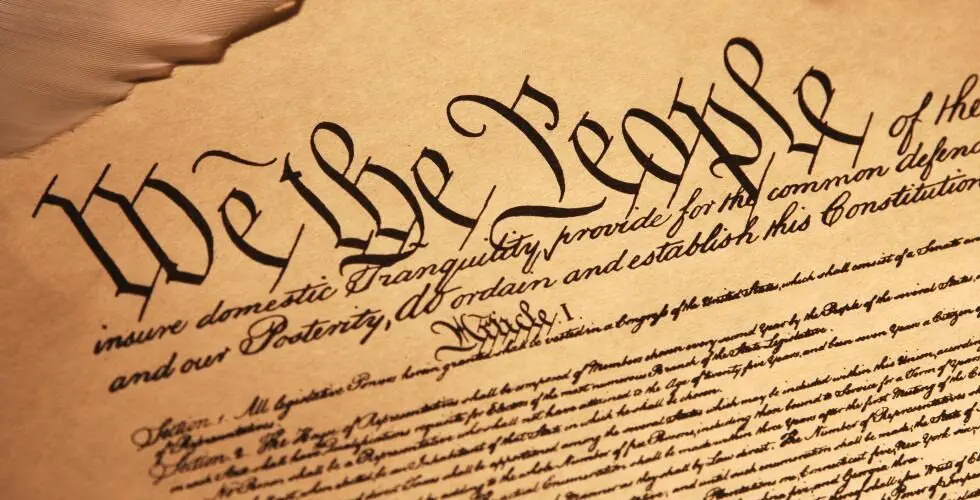
Our Declaration of Independence talks about “unalienable rights . . . endowed by the Creator,” then goes on to say that governments are instituted to secure these rights. It appears to be one of those self-evident truths that no people would make a valiant effort to structure the laws of their society so as to protect each person’s private domain and render justice for all, unless they first believe in individual rights — the idea that each person possesses an inviolable region at the core of his being. The old-fashioned Whig idea of the Founding Fathers was to limit the reach of the law to the task of securing and preserving freedom of individual action within the rules of the game, and the rules were designed to maximize liberty and opportunity for everyone, allowing everyone the elbow room each of us needs to pursue his personal goals. Only thus may each person’s rights be secured.
The Nature of Rights
The word “liberal” today is the opposite of what the word meant when it first entered the vocabulary about two centuries ago, and a similar fate has befallen the word “rights.” Formerly, rights signified individual freedom and personal immunity from arbitrary interference with peaceful action; the popular belief today is that “rights” are legal privileges entitling people to housing, medical care, education, equal pay, or whatever. How may we recover the sounder idea which was once the keystone of our political system?
There are three schools of thought as to the nature of rights. The popular “liberal” belief today is that society is the dispenser of rights, but this viewpoint depends on the verbal sleight of hand which confuses rights as immunities with “rights” as entitlements. If you define words to mean whatever suits your purpose, anything can be made to mean anything else. As Dr. Johnson said, if you call stones plums you can make plum pudding out of stones!
The second school of thought declares that nature is the source of rights. Let it be noted that rights, whatever they might be, are not material objects. Your liver, your brain, your heart are material objects; they have mass and extension, and can be weighed and measured. Likewise your body; when life has departed, your carcass can be reduced to $1.98 worth of chemicals! But your rights are like your ideas, in that neither your rights nor your ideas occupy space, nor can either be reduced to a chemical formula.
Now, nature is the material world; it’s a marvelously intricate combination and recombination of the 105 chemical elements from actinium to zirconium. To speak of chemicals as the source of our rights makes as little sense as to speak of the chemical origin of mind and thought. Nor does it make much sense for the Materialist to speak of human nature as the source of man’s rights, because his philosophy has first subordinated human nature itself to physical nature.
The world view of Materialism, I argued earlier, has no genuine place within it for Mind and thought; nor does it have a valid ground for the concept of rights—which is why it twists them into entitlements. There is a radical alternative to Materialism, but what shall we call this other world view? Call it whatever you like, but it’s the religious or theistic world view in its affirmation of the reality of a non-material, mental, or spiritual dimension of the universe. Call it the sacred or divine order, if you like. Or refer to the Mysterium Tremendum Fascinans explored by Rudolph Otto in his seminal book The Idea of the Holy.
Our forebears were not afraid of using three-letter words in public so they used the term God for the creative Power. This Power also worked within — the word enthusiasm is derived from two Greek words meaning “the god within” — and thus each person participates in an order of reality beyond society and beyond nature. He is thereby endowed with an inner sanctum which is his alone, any trespass upon which is taboo. His rights are endowed by the creative Power.
The world view which declares that only material things are real, has no place for an independent moral order, and this leads to moral relativism. Theories of moral relativism have seeped into the popular mentality to emerge as slogans and bumper stickers such as “Whatever turns you on,” “If it feels good, do it,” “Do your own thing.” The result is that the shrewd, the wily, the clever, the unscrupulous doing their thing have the rest of us over a barrel.
Moral Relativism
The U.S. News and World Report for October 8, 1984 has a story headlined “Nearly 1 in 3 Gets U.S. Benefits.” It listed the eleven biggest programs from Social Security to infants’ nutrition, involving 66 million people. Many of these recipients are into several programs, for 129,299,000 checks are mailed out from Washington regularly to these 66 million people. The report did not cover farm families, or union members, or the government bureaucrats, or those employed in schools paid for by taxpayers, or people in tariff protected industries, like those in Detroit who charge us thousands of dollars extra for the cars we buy. And there are others. We are now a nation where almost everyone is trying to live at the expense of everyone else. We have written a form of theft into our statutes. Why? Because there’s a little larceny in our souls!
It’s too easy, and too false, to blame the politicians. They’re only our hired hit men, and in cases of this sort the principal is at least as guilty as his agent. Large chunks of the American electorate decided that living off government handouts is easier than working for a living and safer than stealing, so they created political parties in their own image and elected politicians who promise them an inside track to the public treasury.
Moralists in former periods inveighed against this sort of thing, but in the modern world they were no match for the theoreticians of communism and socialism who convinced almost everyone that legal plundering was the wonderful wave of the future. Intellectuals today are not so sure, and many now side with the free society-market economy team. And it is our good fortune that many men and women in public life, people of integrity and intelligence, are fighting in their own way the same battle we are waging.
Reason to Believe in An Objective Moral Order
Is there an objective moral order? That is not possible within the world view of Materialism! Is it probable within a theistic world view? I think so. Your individual physical survival depends on several factors. You need so many cubic feet of air per hour, or you suffocate. You need a minimum number of calories per day, or you starve. If you lack certain vitamins and minerals, specific diseases appear. There is a temperature range within which human life is possible; too low and you freeze, too high and you roast. These are some of the requirements you must meet for individual bodily survival. They are not statutory requirements; nor are they mere custom. They are laws of this universe; they are built into the nature of things. This is obvious.
And it is just as obvious that there are certain requirements and rules built into the nature of things which must be met if we are to survive as a civilization characterized by personal freedom, private property, and social cooperation under the division of labor. It would be impossible to have any kind of a society where most people are constantly on the prowl for opportunities to murder, assault, lie and steal. A good society is possible only if most people most of the time do not murder, assault, steal and lie. A good society is one where most people most of the time tell the truth, keep their word, fulfill their contracts, don’t covet their neighbor’s goods, and occasionally lend a helping hand.
No society will ever eliminate crime completely, but any society where more than a tiny fraction of the population exercises criminal tendencies is on the skids. To affirm a moral order is to say, in effect, that this universe has a deep prejudice against murder, a strong bias in favor of private property, and hates a lie. We may not like living in a stringent universe which lays down a tough set of rules for individual and social survival. But let’s face it; nobody has ever come up with a better alternative to living here and now.
Of course we know that this planetary home of ours is where we belong; and it’s a pretty good place to be, even if at times it’s a pretty tough test run. Each of us came into this world chock full of potentialities and with an immense capacity for learning. At birth we were, in effect, handed a do-it-yourself kit, a do-it-yourself kit for the manufacture of a human being. And then we were given a life sentence in order to transform this raw material into a full-fledged mature adult. In the nature of the case this has to be an inside job, for each person is the custodian of the time, energies and talents which are uniquely his own. Each individual is in charge of his own life, constructing, by the choices he makes hourly and daily, the person he has it in him to become. No outsider can take over this responsibility for us.
The collectivist promise that if we give them the power they will fashion a new social environment which will create a new humanity, is a damnable lie — and I’ve chosen the word deliberately.
Becoming a human being is a full time job, and it’s for life. But there is that perennial urge in the human psyche egging us on to bigger things, like the latest dream of empire, like a “brave new world,” like one more desperate try at some newfangled model of the Tower of Babel. Every collapse of these megalomaniac dreams hurts, but it does provide some people with a clue that human fulfillment lies in a different direction; we have to begin from within. Gerald Heard used to say that we must grow as big inside as the whale has grown outside! A cartoon shows a man paying the final installment on his psychiatrist’s bill. As he hands over the money the former patient says to the doctor: “You call this a cure? When I came to you I was Napoleon; now I’m nobody.” We know that this former patient is on his way, but a gain of this sort feels at first like a loss!
Man is not God; he did not create himself, nor did he write the laws of his being; but men and women do make themselves. And as we seriously take ourselves in hand, we begin to discover who we are and what we may become. “That wonderful structure, Man,” wrote Edmund Burke, “whose prerogative it is to be in a great degree a creature of his own working, and who, when made as he ought to be made, is destined to hold no trivial place in the creation.”
Read more from the Edmund Opitz Archive.
Tags: christian libertarian, Christianity, collectivism, Edmund Opitz, ethics, liberalism, libertarianism, materialism, philosophy, theism, theology
Have you ever wondered what book you ought to give to a person inquiring about libertarianism to you? What do you do? It is actually a somewhat difficult proposition. Great books are out there, for sure, and certain books fit certain people better than others. However, there are generally two books that I categorically recommend: Ron Paul’s The Revolution: A Manifesto, and Murray Rothbard’s For a New Liberty. Today, let me introduce to you the book that, at least for me, has just surpassed both of these for the introductory libertarian reader – Jacob Huebert’s Libertarianism Today.
At its core, Jacob’s book addresses in brief the history of classical liberalism and the libertarian movement, explains the basics of the philosophy of liberty, and tells the stories of a number of modern libertarian organizations at work right now. It’s wonderfully entertaining, easy to read, and splendidly pithy.
Among Huebert’s most salient points is his excoriation of “conservatism” and its relationship to libertarianism. He completely demolishes the myth that Ronald Reagan was even close to a libertarian, and hopefully such words will shock conservatives into realizing that most, if not all, of “traditional conservatism” as enshrined in Reagan is nothing short of a lie.
I’m a particular fan of the chapter on war (read an excerpt here); it’s so great that I have to quote the first paragraph in full:
Libertarianism and war are not compatible. One reason why should be obvious: In war, governments commit legalized mass-murder. In modern warfare especially, war is not just waged among voluntary combatants, but kills, maims, and otherwise harms innocent people. Then, of course, wars must be funded through taxes, which are extracted from U.S. citizens by force — a form of legalized theft, as far as libertarians are concerned. And, historically, the U.S. has used conscription — legalized slavery — to force people to fight and die. In addition, an interventionist foreign policy makes civilians targets for retaliation, so governments indirectly cause more violence against their own people when they become involved in other countries’ affairs. Plus, war is always accompanied by many other new restrictions on liberty, many of which are sold as supposedly temporary wartime measures but then never go away.
And now I… have nothing else to say. This is it. This is what we need to communicate to everybody. War kills. War is immoral. To the Christian, aggressive war is among the greatest of all evils humans can commit. Peace is our code. Period.
Another great part of Jacob’s book is his chapter on education. Public, compulsory schooling is not libertarian. And guess what, vouchers are not a viable alternative. This principle is somewhat difficult to explain to many people, but I have contended for years that vouchers are just another back door for government control of education. Huebert does a much better job of explaining it than I ever have.
I could go on and on just describing the chapters themselves, but I want to give you a concise flavor for the book so I will stop with the praise here. However, there are a few weaknesses to the book that I would be remiss not to point out. First, I think that Jacob was a bit too critical of the Libertarian Party, and a bit too kind to the Campaign for Liberty. It’s true that the LP has not lived up to the radical vision of its founders at times, and there are questions that I still have about its future. Nevertheless, it continues to be the home of a huge number of amazing activists and thinkers, and we dismiss the effect that it can have. The LP will only fail to live up to its original purpose if we let it – Murray Rothbard said as much many years ago and prominent LP members such as Mary Ruwart and Lee Wrights say the same today.
In contrast, despite the influence of Ron Paul and the large amount of money initially invested, I am a bit underwhelmed by what the Campaign for Liberty has been able to do at the national level. In truth, the awareness that America now has of the Federal Reserve and its criminal nature is incredible, but is this the result of C4L or is it just the momentum from 2008? I personally wish C4L would be more a hub of local activism rather than another organization trying to take on the House of Representatives. Don’t get me wrong, I want to see C4L succeed, but I also want to make sure that local efforts are well-funded and well-staffed.
This leads me to another minor oversight in the book: the lack of discussion of local activism. Don’t get me wrong, I despise politics and the electoral process is completely inane. Moreover, I readily admit national politics stinks and is frequently a waste of money except in very specific situations (the Ron Paul Presidential Campaign being the most spectacular example). But on a local level (i.e. states, counties, cities) individuals can have very real impacts that truly promote liberty and help people live more freely. I wish Jacob had explored this more thoroughly, because I imagine that concrete examples of success would inspire people to get out there and make a difference.
Finally, the price tag is a bit stiff, but I still contend that you need this book on your bookshelf to have, read, and lend out. While Amazon.com generally sells the book for $35, you can get a paperback copy for $25 at the Mises Institute Store. No matter what you choose, the knowledge you will gain from reading this is totally worth it.
Please consider buying Libertarianism Today at Amazon.com and LCC will then get a small kick-back from the sale. Remember, LCC receives a small percentage of any shopping you do at Amazon when you go through an LCC link. Help keep LCC growing and growing; your support is much appreciated!
Tags: Austrian School, Book Reviews, capitalism, economics, history, libertarianism, philosophy, politics, recommended books
Let us take a brief departure from politics to some theological history, shall we?
Friedrich Schleiermacher (1768-1834) and Søren Kierkegaard (1813-1855) had an enormous impact upon the history of theology and western philosophy (besides having some really cool names). They may have been contemporaries, but they developed their ideas in tremendously different circumstances and cultural backdrops. Both had great success with their respective cultures as well, so we would be wise to understand their work.
Schleiermacher lived in a time and place where Christianity was despised by the culture because of the conflict it supposedly had wrought among them. He writes in a German culture strongly affected by the memory of the Thirty Years War, one of the most destructive conflicts in history during which Protestants and Catholics were convinced to kill each other at the whim of their corrupt political leaders. If religious diversity – a seemingly good thing – could cause so much death and destruction, then why give it any credence at all?
Kierkegaard, however, comes later in the Enlightenment era, post-Immanuel Kant. His culture in Denmark was questioning how faith was even possible in their brave new world of knowledge. Kant had cast much doubt on being certain of God, and Kierkegaard was responding to this influence (but others as well).
Their different cultural situations resulted in different doctrinal emphases. For Schleiermacher, the important point to convey was that all men had an awareness of absolute reality, of absolute truth. If men would just see this as their starting point, perhaps they could move past their conflicts. Kierkegaard, however, was primarily interested in people ceasing their indifference to religion and making a choice. He believed that God meets you when you take a leap in faith toward him, because God never enforces himself upon anyone. He wants to tell others that faith is not irrational , but rather not approached in the realm of rational-irrational dichotomies at all.
If I am certain of one thing about American culture (no offense, international readers, this may be exactly true of your culture as well), it is that American culture is not uniform. In my hometown of Austin, Texas for instance, you can walk through a grocery store and hear five different languages before you reach the bread aisle. Your colleagues at work could include three or four cultures you’ve never experienced in your life. I think we live in a culture that reflects aspects of both Schleiermacher’s and Kierkegaard’s times. Many people see religion as divisive and conflict-inducing, and thus they reject Christianity as part of the problem. Others are simply indifferent to religion, or see faith as irrelevant.
Schleiermacher’s approach may appeal to the former group – the modern “cultured despisers” of Christianity. His emphasis on inner awareness could help them to understand that Christianity doesn’t need to be about causing destruction (though Leo Tolstoy would probably do it just as well or better). The danger, though, is that an attitude that suggests “all religions are created equal” could emerge and “New Age” attitudes de-emphasizing absolute truth could develop. This is an undesirable result, but can be avoided with careful teaching.
Kierkegaard’s approach may appeal to the latter group – those who simply do not care and those who see faith as irrational. Kierkegaard pushes people to cease indifference and consider a life of faith more carefully. He challenges those who conveniently do not believe by showing them that they have a kind of religious anxiety, like any other person, and that their disbelief is primarily a matter of laziness rather than intellect. In a way, Kierkegaard frees us from solely appealing to apologetical arguments, in favor of experiencing God in the leap of faith. The danger, however, is throwing the baby out with the bath water. Reason is ultimately on the side of the Christian, and should never be abandoned. Kierkegaard reminds us that there is more than one way to talk to people about God.
Does any of this resonate with you? What questions does this bring to mind? Please encourage more discussion by commenting below…
Tags: history, philosophy, theology
The Proper Origin of Rights
Posted by: |This article was submitted by my good friends (and LCC readers) Doug Douma and Lydia Ingram. Though I personally take a “concordist” position that deontological rights are in harmony with Biblical revelation rather than ultimately nonsensical, Doug and Lydia present an interesting case and I know we can have an interesting discussion around this great topic. Many thanks to Doug and Lydia!
Libertarianism is founded on the belief that individuals have universal rights – specifically rights to life, liberty, and the possession of property. Despite fairly widespread recognition of these rights, their universal defense (that is, an explanation of why these rights apply at all times and in all places) can often be difficult to articulate. Three predominant sub-groups within libertarianism attempt such a defense, each with a unique approach. Consequentialist libertarians focus on utility, deontological libertarians look to nature, and Ayn Rand’s followers turn to what they term ethical egoism. At first glance, each of these seems to offer a reasonable defense of universal rights; but closer inspection reveals their flaws. Conscientious defenders of liberty realize that without a solid defense, protection and preservation of rights cannot be guaranteed. Fortunately, there is a firm defense to be found within the pages of God’s Word. In the Bible, God lays out laws and moral constraints, commanding humans to obey. In so doing, God establishes man’s basic human rights; these rights are based on morality and morality originates in God. Therefore, the origin and only solid defense of rights are found, not in utilitarian economics, nature, or egoism, but in the Word of God.
Tags: Ayn Rand, Bible, christian libertarian, ethics, libertarianism, Objectivism, philosophy, rights, theology, theonomy, utilitarianism
“Anarchy and Christianity” Book Review
Posted by: |Book review of Anarchy and Christianity, by Jacques Ellul. Eerdmans Publishing Company: Grand Rapids, MI. 1988 / trans. to English 1991. 105 pages. Retail: $14.00
Jacques Ellul (1912-1994) was a French sociologist, philosopher, and theologian, but his main profession was teaching law at the University of Bordeaux. He held strong views about the nature of government as antithetical to Christian faith, and is counted among the 20th century Christian anarchists.
Tags: anarchy, ethics, free market, free society, gospel, government, history, Marx, philosophy, The State, theology