Welcome

Welcome to LibertarianChristians.com! If you are new here, you may want to see the About Page for a welcome message and more information about the site. Check out the posts on the right and the Top Posts page to get started! Don't forget to subscribe for free with RSS or Email.

Archive for peace

“Do not pervert justice; do not show partiality to the poor or favoritism to the great, but judge your neighbor fairly.” Lev. 19:15

It doesn’t take much time to notice that the world is much darker than what God created it to be. Our world today is a far cry from Eden, a place of peace—often described as shalom in the Hebrew Scriptures—where humans walked with God and knew God intimately. From the beggar on the street to the rich man with no love in his life, the shalom of God often feels distant. There is poverty, hunger, slavery, and oppression all over the world.

The Scriptures reveal to us God’s plan to restore shalom. When Jesus enters the story, he reveals “the kingdom of God,” a peaceful kingdom that stands in contrast to the violent kingdoms of this world. Jesus’ own actions were peaceful and non-aggressive. He personally served the poor, left his own family to serve the needs of others, and made company with the outcasts at his own social and cosmic expense. He called on others to voluntarily sacrifice their lives and follow him. His followers were expected to be beacons of light throughout the world, shining love and peace wherever they went.

As followers of Jesus today, we must address the lack of peace and justice in the world with Jesus as our model. Our task is to seek peace, restore brokenness, and bring to justice those who trample on others. Our calling is to also enroll others to join in this endeavor. Yet with all things involving human beings, there are limits to what we can do with and to others. If we are to engage the world, Christians must ask a very critical question: what boundaries are there to seeking justice?

In order to answer this question appropriately we must deal with the imbalance of power in society. Injustice stems from abuses of power. Libertarians and Christians believe that no human has the right to exercise power over another human by means of force or coercion. In order to truly achieve justice, individual freedom must be promoted. Justice itself hinges on the freedom of individuals to exercise their respective wills. Denying this freedom not only tramples human dignity, it pushes justice farther away.

So then, what should the Christian’s attitude be toward the State’s role in the fight for justice? A consistent ethic of peace would have us exercise the power of government only to punish those who have offended the natural right of freedom. Outside of this we have no right to impose our will upon another. If each person is God’s image-bearer with unsurpassable worth, we are duty-bound to not trample upon them, whether on our own or by leveraging the State to suit our preferences. Leo Tolstoy believed that “Christianity, with its doctrine of humility, of forgiveness, of love, is incompatible with the State, with its haughtiness, its violence, its punishment, its wars.” Christians should resist looking to the State for power to fulfill the mandates of the gospel.

Those who partner with the State in order to achieve a measure of justice have an impoverished imagination. Instead of advancing the kingdom of God peacefully, they seek to restore justice by controlling the rights and property of others. If it is truly the vocation, calling, and responsibility of the people of God to not only live out but carry out God’s justice, why would we want to delegate that responsibility to an entity whose primary mechanism of operation is threat of force? Christians must think long and hard about how they regard the State.

The Kingdom of God is about greatness through servanthood, loving by sacrificing. Changing the world is not done with might or power but through love and sacrifice. This is why we ought to reject government-centered solutions to social justice.

Christians have succumbed too often to the temptation of power, believing that if we are on God’s side, our power over others is justified. It is time that Christians embrace the Kingdom of the Cross (driven by servanthood, sacrifice, and love) and abandon the Kingdom of the Sword (driven by force, violence, and coercion). The power of the gospel to change the world is not made manifest through violence but through the freedom to love and serve others.

Tags: , , , , , ,
Categories : Articles
Comments (8)

This article was released by the Wrights 2012 Campaign, for which I am currently the webmaster.

“Be always at war with your vices, at peace with your neighbors, and let each new year find you a better man.” (Benjamin Franklin)

BURNET, Texas (Dec. 31) – All libertarians should take time at the beginning of the new year to read and reflect on A Libertarian’s New Year’s Resolutions written by the late Harry Browne, said R. Lee Wrights, libertarian writer, activist and potential presidential candidate.

“Harry was gifted with an ability to communicate libertarian ideas and ideals in a clear, direct and concise way so that anyone could understand what libertarianism is all about,” said Wrights. “His New Year’s Resolutions are one of the best examples of this talent, a classic of libertarian thought.”

“What Harry wrote in 1998 is even more relevant today, and especially relevant to me as I consider seeking the 2012 Libertarian presidential nomination,” Wrights revealed. “So, inspired by Harry’s thoughts and words, and as a tribute to him, I offer these Wrights’ Resolutions as the standard by which I will conduct that effort and my life in 2011:

“First and foremost, I resolve to remain focused on the paramount issue facing the Libertarian Party and our nation – to stop all war. No matter what other issues are raised, I intend to keep returning to the central point that unless we stop all war, whether foreign or domestic, individuals can never truly be free.

“I resolve to remain committed to ensuring that whoever is the presidential nominee of the Libertarian Party in 2012, he or she is committed to proclaiming a loud, clear and unequivocal call to stop all war; and be equally dedicated to carrying a solid, uncompromised, unfiltered, unequivocal, and unapologetic libertarian message to all 50 states.

“I resolve to cleanse myself of hate, resentment, and bitterness, and focus on using the tools of peace, love, mercy and forgiveness against the weapons of war, hate, vengeance, and cruelty.

“I resolve to keep from being drawn into arguments or debates on inconsequential issues, and to always remember that my purpose is to increase people’s appetite for liberty — not to prove that they’re wrong.

“I resolve to always acknowledge my good fortune in having been born an American, to refrain from dwelling on America’s defects and past mistakes, and to focus instead on how we together can realize America’s potential and promise.

“I resolve not to adopt the political campaign tactics of Republicans and Democrats, who use coercion, character assassination, evasions, fear, and intimidation in their unbridled quest for power. Rather, I resolve to remain civil in my political discourse and treat all people I encounter with the dignity and respect that is their due as human beings.

“Lastly, I resolve never to cease working to ensure that the Libertarian Party and our presidential candidate in 2012 is committed to proclaiming loudly, clearly and unequivocally – stop all war.”

Wrights is considering seeking the presidential nomination because he believes the Libertarian message in 2012 should be a loud, clear and unequivocal call to stop all war. He has pledged that 10 percent of all donations to his campaign will be spent for ballot access so that the stop all war message can be heard in all 50 states.

The 52-year old writer and political activist was born in Winston-Salem, N.C. and now lives in Texas. He is the co-founder and editor of the free speech online magazine Liberty For All.

Tags: , , ,
Categories : Articles
Comments (3)
Nov
12

Jesus and Soldiers

Posted by: | (8)

imageMy good friend Stephan Kinsella, who is not a Christian, recently attended an event with great relevance to our time and situation within  the church today. He had the following to say on the Libertarian Standard:

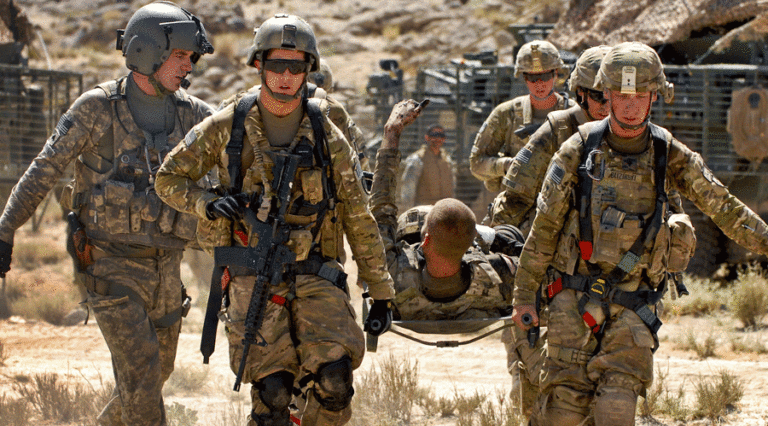
Last night, I attended “Heal Our Heroes: Ministering to the Military in Our Midst,” an event here in Houston featuring keynote speaker Colonel Oliver North. (I was invited by a friend who had a table.) It was a fundraising dinner for Military Ministry, which provides various spiritual counseling and resources to soldiers. There were parents and a singer who had lost loved ones or suffered post-traumatic stress disorder (PTSD) etc. from the Iraq or Afghanistan war, various testimonials, etc. It was very Protestant in that Jesus was mentioned repeatedly and they explicitly pushed for us to give money at the end (Catholics are a bit more discreet when they ask for money–they just pass the basket).

I can understand wanting to help those who are suffering from the effects of war–even the soldiers. But after showcasing all the soldiers’ whose lives have been ruined by the military and by war, you would think there might be a word about peace or stopping the fighting that causes such devastation. But no, not a word. I suppose this is understandable: their mission was to raise money, so they focused on that.

But two other things really shocked me, both regarding the degree to which American Protestant Christians have intermingled their faith with patriotism and love of the state. For one, an award was given out, which was a miniature replica of a statue of Jesus hugging a soldier. Now I have no doubt the idea of a loving, compassionate savior giving succor to someone damaged by war is compatible with Christianity, but this seemed to go beyond that. And this impression was reinforced by the words of a young lady who spoke on behalf of MM. She said that in this world there are only two classes of people who have directly given their lives for you: Jesus, who gave his life to save your soul; and the soldier, who gives his life to save your freedom. Jesus comforting and forgiving the soldier–fine. Comparing soldiers to Jesus? Sacrilege. I don’t think Jesus is supposed to have had guilt or PTSD over what He did. Soldiers do, for a reason: War is hell. Jesus didn’t kill and murder people. Soldiers do.

Christians in America, especially Protestants and the “right-wing” types, it seems to me, have their priorities a bit out of place. Statolatry crowds out true faith and religion.

For somebody not a Christian, it seems like he “gets” the idea of Jesus being the Prince of Peace better than most.

Tags: , , , , ,
Categories : Articles
Comments (8)

It’s been a while since I’ve posted, but it is for a good reason. I’ve been carefully writing this article and I really hope you benefit from it. If you are so moved, please share it with someone you care about today.

Featured on LewRockwell.com on September 11, 2010.

“If my people, who are called by my name, will humble themselves and pray and seek my face and turn from their wicked ways, then will I hear from heaven and will forgive their sin and will heal their land.”
2 Chronicles 7:14

People regularly email me with questions about how to communicate with other Christians about liberty and peace. The greatest conundrum the Christian libertarian has, it seems, is persuading other Christians to stop supporting the immoral wars that governments perpetrate across the globe. It is particularly difficult in the United States, where “supporting the troops” is essentially part of the new orthodoxy in most evangelical Protestant churches. You can publicly criticize a minister that he preaches too long and someone will support you, but say one word criticizing the military (or even the police) and you become anathema.

It is not as though we cannot defend our position adequately; the truth is on our side. We can easily bring forth historical data, ethics, and solid theology to make our case that war is wrong. This is good and right! We must never cease reasoning with those who disagree with us, and we should do so with gentleness and respect (1 Peter 3:15). However, we must admit that a large part of the problem is not merely failure to reason, but also a failure to show Christian compassion toward others. Churches all over forget that war really is hell, and neglect the suffering war causes. This is especially reflected in our public prayers.

In the past, even the Southern Baptists took the Word of God seriously and prayed for those affected by war. But when was the last time you heard a church pray for anyone in the Middle East, for instance, other than soldiers? When was the last time you heard a church pray for an end to war?

Recently, I was moved to step out and try something I have never heard of done before: ask the leaders of my congregation to take the lead in praying for those suffering in war. (In the Church of Christ tradition, the elders are the spiritual leaders of the congregation.) After consulting with some of my close friends, I attended the June 2010 elders’ meeting and presented the following letter to them to address the “Prayer for the Church” that we offer every Sunday morning worship service.

*********************

To the Elders of the University Avenue Church of Christ,

We have noticed an unusual trend over the past few months during our prayers for the church in Sunday morning worship. On multiple occasions, we have heard people pray for men and women in the military, that they receive “special measures of protection” as they fight to “protect our freedoms” and “serve our country.” While we understand the concerns of church members who have friends and family in the armed forces, and while we sincerely hope for their safe return immediately, we find that these kinds of prayers are neglectful of another group – those victims who suffer wrongfully from this war, to whom we are indeed responsible in part for their suffering. Regardless of one’s opinion of these wars, we think that all can agree upon inspection that this practice can and should change to be more inclusive.

For instance, we never hear prayers for our fellow Christians who live in Iraq and Afghanistan. Since the US invasion in 2003, Christians who were tolerated in the past have been repeatedly persecuted and frequently even killed by indiscriminate warfare or surging extremist groups, and nearly half of the Christian population of 800,000 in Iraq has either fled the country or died. In March 2010 alone, over 4,000 Christians were displaced from their homes following unrest in the northern city of Mosul. Many more have confined themselves to their homes for their own safety.

Moreover, we rarely, if ever, hear prayers for the innocent people in Iraq that die on a daily basis, either from indiscriminate killing by our own military or civil unrest that results from a country torn apart by war. The lowest estimates of non-combatant deaths in Iraq number greater than 100,000. Unfortunately, over time our sensibilities and attitudes toward this war – which is now the longest prolonged conflict in American history – have become desensitized and lackadaisical, and thus we often forget these innocent people.

We appeal to the elders to lead the way toward recognizing this issue with two simple proposals. First, we propose to include in the bulletin prayer requests under “Family Members in the Military” a mention of the innocent and oppressed in Iraq and Afghanistan, especially our Iraqi and Afghan brothers and sisters in Christ, and for an end to these wars. Second, we propose that the elders take the lead in consistently mentioning the same in prayer with the congregation on Sunday mornings. If the prayers of the righteous are powerful and effective, then surely instituting this practice will do good both for these victims and for our own spirits.

We support this appeal with Scripture in two ways. First, if you consider these people as we do, that they are innocent victims and have been wronged by their own leaders, by extremists, and by our own military, then may we pray to God as Jesus taught his disciples: to be “delivered from evil.” If we can pray this for ourselves, surely we can do so for others. But second, if you still consider these people our enemies, then may we do as Jesus said in Matthew 5: “Love your enemies and pray for those who persecute you, that you may be sons of your Father in heaven.” May this be the beginning of understanding what Jesus said moments before, “Do not resist an evil person. If someone strikes you on the right cheek, turn to him the other also.”

Changing our practice to include praying for the oppressed is not a political statement. In fact, this is not a political issue in the least; on the contrary it is a moral and theological issue. If we are to pray “Thy will be done on earth as it is in heaven,” then we should take seriously that Jesus came and died to proclaim peace on earth and to liberate the oppressed. We may expect that “wars and rumors of wars” will always exist, but this does not require a condoning or defeatist attitude of such events. Rather, this understanding should make us more sensitive and more compassionate toward those who suffer.

To conclude, war is arguably the most destructive human activity ever devised, and it is an intensely serious moral and theological issue because of its finality for those involved either directly as soldiers or indirectly as innocents. It is right to earnestly pray for our family members participating in war, but let us not become callous to the suffering of others, especially those to whom we are indirectly responsible for their suffering. Therefore, we should let our congregational prayers reflect our concern for them.

In Christ,

Norman Horn [Others at my church signed this letter as well, names withheld for privacy.]

Sources:
http://www.spiegel.de/international/world/0,1518,587345,00.html
http://www.un.org/apps/news/story.asp?NewsID=33940&Cr=iraq&Cr1
http://www.iraqbodycount.org/

*********************

The response of the elders was, to my surprise, extraordinarily positive. We discussed some of the ramifications of them taking this position. Only one had any concern for it being “too political.” In response, I emphasized that the effects of war are apolitical and intensely real, and therefore to ignore what’s going on is potentially even more political than standing up for what is right.

The next Sunday morning service, during the “Prayer for the Church,” the elder assigned to the task prayed for peace and for the innocent affected by war. This has continued for many weeks on end, with both elders and non-elders doing the same. It isn’t a perfect record at this point, but something is changing.

Amen!

Now, I have to admit that I have the ear of the eldership already. I am a part-time minister in this congregation, and thus they could have been generally more receptive of my proposal because it came from me. It could be that if you tried the exact course of action I did, it might not work out so well. But I still contend that anyone could work with their church in an analogous manner to change it even a little toward peace. Here are some ideas that might help you:

1) Start by setting the example yourself. When you are asked to pray in public for the congregation and its concerns, include those oppressed by war with any prayer offered for family and friends in the military. Furthermore, make sure that you are praying for peace in your private life.

2) If and when you engage your congregation more directly, initiate it by making a request that requires no justification at all. Don’t be afraid to just ask! Send one of your church leaders a very simple request, something like this: “When we pray for soldiers in Iraq, could we also pray for the Iraqis who are suffering, especially our Christian brothers and sisters there, and that God would bless our enemies and bring them peace.” You don’t even have to justify such a request. That’s straight out of Scripture, right?

3) Find others to make the same request together. Talk to some of your elders/leaders together. Again, keep it simple, but up the ante a little bit each time.

4) Keep it apolitical. You are not trying to “make people into libertarians” or anything of the sort. This message is first and foremost about the people affected by conflict. Our concern is for them, not for our egos or political views.

5) If at first you don’t succeed, try again. You may not get a good hearing initially, but be patient. Gently keep pushing back. If it becomes necessary, use the letter above as a model to give to your church leaders. Keep in mind, I really think this should be a “letter of last resort” to be used if your leaders refuse to listen to simpler reason. I carefully constructed this with feedback from multiple sources, so that it could easily show the self-evident principles involved. It gives no quarter and I don’t apologize for that, but know your audience and appeal to their sensibilities.

Of course, some in your church will respond negatively to this kind of request. They may ask how you can ask a church to pray for this war, for instance, when there are millions of other things for which we could pray. What about apartheid in South Africa, earthquakes in Haiti, or persecuted Christians in China? Could not the list go on forever if we wanted?

Those critics have a point, but our response should be that there is a fundamental difference between, say, praying for apartheid in South Africa – where we are aware of no national influence (and in my church’s case, have none of our church members as missionaries there) – and these wars. The difference is that this country, the United States, claims responsibility for their country now, and hence we are already involved. It is not “our fault” that Haiti had an earthquake or that Christians in China are being persecuted (though we may pray for them anyway), but it is in part our fault that the United States has torn apart the Middle East. Moreover, churches continue to condone and support such aggression with little thought either to the consequences for the Arab peoples or the internal subconscious changes that this has on our own churches. And what better way to change our own hearts than through the power of prayer? And what better way to start that process than through the leadership of the church?

Imagine what would happen if churches across the United States (and internationally!) were to stop praying for the military alone and to begin including those oppressed by war in their public prayers as well. Don’t you think that God will help make our hearts ever more attuned to the oppressed?

If the Bible says that the prayers of the righteous are effective, and if we believe that prayer affects us as much or more than prayer affects God, then let us never cease to pray for and support those who suffer from the horror of war and let us encourage others to do the same.

Think about some ways that you can be a peaceful voice for peace in your church. Maybe emulating the story above is one way you can make a difference. I truly believe this simple idea can change hearts and minds across the world if, with God’s help, we are brave enough to try.

“Blessed are the peacemakers, for they will be called sons of God.”
Matthew 5:9.

A modified version of this text will become a permanent page at LCC as an open letter to all American churches.

Tags: , , , , , , , , , ,
Categories : Articles
Comments (34)
Jun
02

Stop Statism

Posted by: | (4)
This entry is part 18 of 22 in the series Great Libertarian Memes

This article is #18 of a weekly series highlighting the former memes of Bureaucrash, an organization once headed by my friends Pete Eyre and Jason Talley of the Motorhome Diaries. The memes were originally authored by Pete Eyre and Anja Hartleb-Parson, and were intended as means of communicating ideas about liberty in catchy and succinct ways.

Statists are anti-progress. Statists claim their policies are for the common good. For some this claim is just a front to get more power, but for others it is a genuine goal. Nevertheless, even the most well-intentioned statists, who believe that granting government the power to control individual actions will result in a better outcome, violate rights and cause harm. One need only consider historical fact to disprove this statist belief. For most of history, people were not free to decide how to live their lives because they lived in servitude to a noble or king. The vast majority of people were wretchedly poor, worked from dusk until dawn six or seven days a week, were prone to encounter devastating diseases, and died in their twenties or thirties. Even the privileged few — the kings, nobles and clergy — had nowhere near the standard of living that the ordinary worker in western countries enjoys today. It was classical liberalism — the ideas of British Enlightenment philosophers, Adam Smith, John Locke, John Stuart Mill, and the American “founding fathers” — that unlocked the true human potential. Classical liberalism set man free from servitude to another and gave him the right and the responsibility to care for his own life. As a result of the emergence and subsequent dominance of liberal democracy and capitalism in the last two hundred years, the world has seen progress unparalleled in human history: according to renowned economist Angus Maddison, “[w]orld per capita real income has risen twenty times as fast since 1820, than it did in the eight centuries from 1000 to 1820.”

Statism is anti-growth. Statists often justify their policies claiming that they want to reduce inequality and poverty. In reality though, statists achieve neither and often exacerbate both because their policies discourage economic growth, which is particularly detrimental to low income and poor people. For one, politicians and bureaucrats are limited in their knowledge, as is any individual. No matter how smart an elected official, bureaucrat, or committee is, there’s no way they could adequately plan and control the actions of millions of individuals to achieve maximal economic growth. Moreover, statism encourages rentseeking and protectionism, the activity of groups seeking government enforced advantages and insulation from the outcomes of free trade. This harms the consumer, who is forced to pay higher prices due to lack of competition and fund the rent through higher taxes. This statist action disincentivizes increases in production and job creation, thus depriving low income and poor people of better opportunities to make a living.

Statism causes conflict. Though statists claim to work for the common good, their actions benefit one group at the expense of another. Nazis favored the “Aryan” at the expense of all other nationalities and ethnicities; affirmative action proponents favor blacks, Hispanics and women at the expense of whites and males; socialists and unions favor workers at the expense of business owners; protectionists favor their native industry at the expense of that in other countries; rent-seekers favor their business, organization, or cause at the expense of other businesses, organizations, and causes at the expense of consumers; many religious people, but especially fundamentalists, favor their followers at the expense of those of another religion and at the expense of atheists; and earth liberation environmentalists favor nature at the expense of humans.

Hence, statists create friction and conflict among individuals, groups, and nations. The long stretch of peace during the mid-19th century was at least in part the result of limited government and laissez-faire economics in places like Britain and the United States. The free movement of people was widespread; Russia, the only country that required a passport, was considered backwards. The bloody wars and atrocities committed by governments during the 20th century were the consequence of a move toward state intervention to control people’s lives, ultimately leading to the emergence of ultra-statist regimes such as Nazi Germany, Fascist Italy, Communist Russia and Maoist China, and many other totalitarian experiments including a United States that interned over 110,000 individuals of Japanese descent, drafted many more individuals, and implemented wage and price controls.

Previous | Next | All Memes

Tags: , , ,
Categories : Articles
Comments (4)

Who is behind LCC?

Norman Horn is the creator and primary writer for LCC. Learn a little bit about him in the About Page. You can write him a note or ask a question at the Contact Page. Follow him on Twitter.

Photobucket

Top Ron Paul Sites - Ranking the best Ron Paul related Freedom and Liberty Websites