Welcome

Welcome to LibertarianChristians.com! If you are new here, you may want to see the About Page for a welcome message and more information about the site. Check out the posts on the right and the Top Posts page to get started! Don't forget to subscribe for free with RSS or Email.

Archive for culture

This guest post is by Doug Newman, and was originally published on Strike-The-Root on January 20, 2005. But as you will see, it is a timeless piece…

In 2003, the Barna Research Group released a well publicized study indicating that only about 10 percent of Christian students possessed a biblical worldview.1 I was reminded of this after talking with a friend recently after church.

My friend is not a political person, which probably speaks well of her. However, she seemed perplexed when I calmly implied that it was an outrage that Uncle Sam confiscates half our income before we can buy groceries. She responded that ‘we get a lot of things’ for those taxes we pay.

I heard millions of people speaking. She did not recognize that taxation is theft. She had no clue that things like oppressive taxation, gun control, government education and government welfare have no scriptural basis. I told her that this just may be the first time anyone had ever told her that the Bible has something to say about a limitless array of social and political issues.

If she had never heard this in church before, it would not surprise me one bit.

America’s churches are as ‘dumbed down’ as its schools. In all fairness, several generations of pastors have been lied to about the political themes in the Bible. Our call to be ‘salt and light’ goes beyond loving our neighbors, telling the truth and being faithful to our spouses. It extends to all aspects of life including politics, economics, law, education, medicine and any societal issue you can think of. Read More→

Tags: , , , , ,
Categories : Articles
Comments (22)

This was originally posted on the Shotgun Blog

The Economic Argument
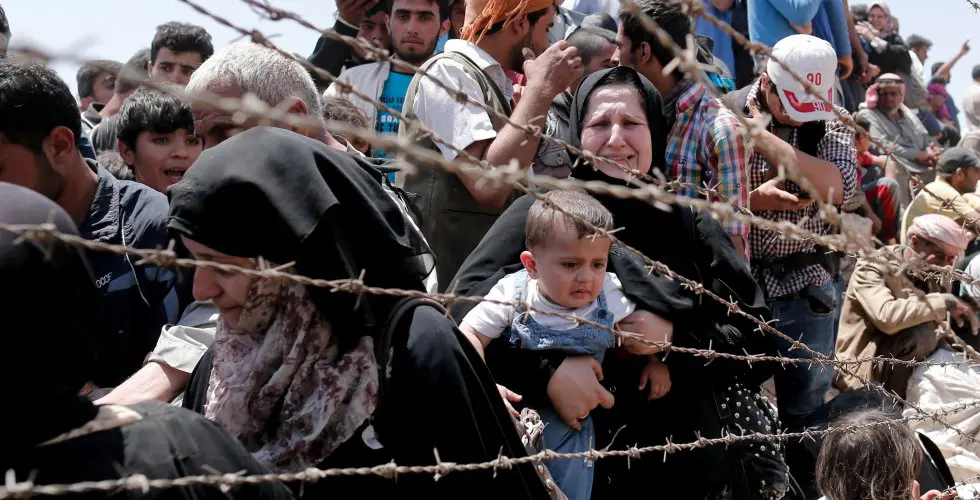
Arguments against immigration on economic grounds basically boil down to “They took our jobs!”. Some feel that allowing people to freely cross borders will result in a flood of low-wage labor that will “steal” jobs from natural born citizens. Labor is a factor of production, just like raw materials or financial capital. Restricting the flow of capital and labor will always decrease economic prosperity. Access to more resources – human or otherwise – always increases wealth and opportunity. If this does not make sense to you, I recommend Frederic Bastiat’s “What is Seen and What is Unseen”, chapter 7, as well as his brilliantly satirical “Candle Maker’s Petition.”

The Culture Argument
Others argue that immigration must be restricted in order to protect the nation’s unique cultural heritage. I submit to you that any culture which must be maintained by force is not an authentic culture and is probably a bad one. Cultures freely arise because they provide benefits to those who participate in them. Cultures are always changing. Getting government in the business of protecting culture is dangerous and counter-productive. First, who gets to define what constitutes culture? Bureaucrats don’t have the best track record in such matters. Second, do we really want to live in a culture that is forced upon us by government prohibitions, restrictions and mandates?

The Welfare Argument
Advocates of limited government sometimes argue against immigration on the grounds that immigrants make use of the welfare state and increase the cost of government. State-sponsored welfare programs are a problem. Stopping immigration because immigrants might use welfare programs treats one tiny symptom, not the disease itself. If you routinely dumped garbage on your front lawn and found critters frequenting your property, would you try to ban critters or would you clean the up the garbage? Though I think the vast majority of immigrants immigrate for jobs, freedom and opportunity, I’m sure some come and make use of government handouts (though far less than U.S. Citizens, and on average less than they pay in taxes). The handouts are an attractive nuisance and should be addressed on their own merits, not by attempting to ban the free movement of people.

The Safety Argument
Some argue that allowing easy immigration will bring bands of criminals into their country and make them less safe. First, if something is a crime it is already, by definition, illegal. Threats to life and property are already protected against via the existing police/military operations. Putting up a wall and stopping anyone from crossing it on the grounds that some of them may be criminals is ludicrous. By this logic, governments should perpetually engage in random home searches because they might discover criminal activity. Closed borders probably don’t stop criminals, but let’s pretend that they could; if we could keep foreign criminals out by keeping out anyone foreign, what would we gain? We’d have spent tons of resources keeping out foreigners, most of whom aren’t criminals, and we’d have that much less to use fighting domestic crime. Banning people from movement because some of them may be criminals is even dumber than banning gun ownership because some people may use them for crime. I trust LCC readers to see the many problems with preemptive Minority Report style crime fighting.

The Right Argument
Freedom to immigrate can be defended from several angles, but I believe the most important argument is based on rights. Imagine you and I have pieces of property that share a border. You wish to traverse my property and I wish to let you, but lawmakers prohibit it. What business do they have dictating whether we can make decisions about our own property? Sure, they were democratically elected, but what business do others have of voting to determine how you and I peacefully use our property?

What if government issued a decree that business owners were prohibited from hiring anyone born on a Tuesday? It’s no different when they prohibit hiring anyone born in another country. Shouldn’t the business owner be free to hire whom he wishes? If an individual wishes to travel, work, buy, or sell peacefully and all other parties involved agree, why should government prohibit it?

When you think up other arguments against immigration, ask yourself why they should not also be applied in state to state immigration? City to city? Home to home?

At bottom I think much anti-immigration sentiment comes from a fear of people unlike us. I support anyone’s right to be prejudiced, or to associate only with those of like culture. But putting that attitude into public policy not only hampers wealth and progress, it violates my right to associate peacefully with whom I choose.

Tags: , , , , ,
Categories : Articles
Comments (3)

Highlighting the interesting and notable events of the past week…

I love this post by my dear friend Anthony Gregory at the Independent Institute: “Saved from the Precipice of Doom!”

————————

Thank goodness for the Republicans and Democrats, who in the eleventh hour, put aside their differences and compromised to avert the catastrophe of a government shutdown. You see, the Republicans wanted to cut something like $78.5 billion from what Obama wanted to spend—itself more than $78.5 billion over the year before. The Democrats were initially willing to talk about “cutting” much less. And now, thanks to the greatest political compromise since the one in 1850—and surely one that will be as permanent in preventing a national crisis—we can all sleep at night knowing that Yosemite and the National Archives will continue to be open for business. The Washington Post reports:

The final pact on 2011 spending called for $38 billion in cuts to federal agency budgets compared with last year’s levels, about $78.5 billion below the president’s initial funding request for 2011. The White House, which initially resisted any funding reductions, started touting all the cuts it signed off on in a statement that praised reductions of $13 billion in funding for education, health and labor programs.

Oh my, oh my! $38 billion cut from Obama’s budget proposal? I guess everyone gets what they want. Obama gets to pat himself on the back for avoiding a shutdown. The Republicans get to pat themselves on the back for avoiding a shutdown, and the American people are satisfied as well.

Oh, wait. Those who love government spending are not so satisfied. You see, the cuts appear to target hot-button social programs. And those who want (at a bare minimum) for government to live within its means might also be dissatisfied. They might protest that even if we go by Obama’s projected deficits, these cuts will only shave a few percent of the amount deeper the U.S. goes into the debt hole in a year.

Yet we should forget about all this and just be glad the government didn’t shut down. For if it did, we would surely awake to a dystopian nightmare, coastal cities collapsing into the ocean, civil unrest at every corner, whole swaths of previously populated centers abandoned, disease and lawlessness rampant in every direction. Thank goodness Congress and the President got together and stopped this.

After all, we all remember when happened when the government shut down in 1995. Traffic lights didn’t work. All the prisoners were running wild in the streets. The US military was completely put out of commission, allowing the Soviet Union to spring back to life and take over half of the world. In the Great Government Shutdown of 1995, an estimated 150 million Americans died of starvation, pertussis, rubella and acute cynicism. Cats were chasing dogs, telephones and plumbing ceased to function completely, and only 75 channels were available on cable television.

Some will respond that these claims are preposterous—that in fact, not only do modern “government shutdowns” only close down a handful of functions (including such programs as tax refunds and national museums, just to annoy the American people)—but that, in the United States, such shutdowns are so superficial an example of the government truly shutting down that they actually cost more money than allowing the government to run as normal.

Sure, refuse to take such a catastrophe seriously. But as our Dear Leader says, “Americans of different beliefs came together. . . [i]n the final hours before our government would have been forced to shut down. . . [to pass] a budget that invests in our future while making the largest annual spending cut in our history.” Thanks to these courageous and selfless efforts, “when 50 eighth graders from Colorado arrive in our nation’s capital,” they might “get a chance to look up at the Washington Monument and feel the sense of pride and possibility that defines America.”

Doesn’t that make your burn with patriotic fever? Red-white-and-blue fumes are just making their way up my esophagus right now. The two parties put aside their vast disagreement—over whether to borrow another trillion or so of to be paid back by these eighth graders or whether to cut that amount down by a few percent—and they agreed to meet in the middle. Just like their parents and grandparents, these kids will have the pride to know that they live in a country where every generation has the chance to grow up with much more money owed by the government on their behalf that the generation before it.

Tags: , , , , , , ,
Categories : News
Comments (0)
Apr
06

PETA and the Bible

Posted by: | (1)

It is old news now that the new edition of the NIV Bible uses gender-inclusive language. The radical animal rights group PETA wants to take this a step further. PETA has written to the Committee on Bible Translation in charge of the NIV to suggest that its next translation also remove “speciesist” language by referring to animals as “he or she” instead of “it.” “Calling an animal ‘it’ denies them something,” said Bruce Friedrich, PETA’s vice president for policy.

Clearly, there is a great divide in the Bible between animals and humans. Although the Bible does say: “A righteous man regardeth the life of his beast (Pro. 12:10), that doesn’t preclude him from putting said beast to work, sacrificing him, and then eating it (sorry, “him”). The opening chapters of the Bible show some uses that God allowed for animals. God himself made Adam and Eve “coats of skins” (Gen. 3:21). And when Cain and Abel each made an offering, God only accepted the one that included an animal to be sacrificed (Gen. 4:3-5).

Referring to an animal like it was a human being elevates animals to a place that the Bible never does.

Tags: , ,
Categories : News, Random Thoughts
Comments (1)

By Edmund Opitz, author of The Libertarian Theology of Freedom and Religion and Capitalism: Allies, Not Enemies. This article, slightly abridged, appeared in The Lutheran Scholar, October, 1970.

Most human differences are set­tled peacefully. Collisions of in­terest occur sporadically, but when intelligence and good-will com­bine we work out a modus vi­vendi. Conflicting opinions are resolved by an appeal to reason; patience and persuasion ease the frictions arising out of personal encounters. Thus it is in most areas; we carve out survival pat­terns and get along with each other. But there are periods of history more violent than others when arbitration works poorly and conflict intensifies; we are living through one such.

Warfare of unusual ferocity has plagued the West for more than half a century—despite lip service to peace in the form of nominal pacifism and humanitarianism. But international strife is not the only plague; domestic ten­sions break out of bounds with increasing frequency; riots, dem­onstrations, assault, kidnappings, bombings, strikes, and acts of sabotage barely make the front pages, so commonplace have they become. Out of the woodwork come spellbinders to lecture uni­versity audiences on gun barrel politics, revolution for its own sake, and the beauties of violence. Professors of philosophy are in­voked to provide a specious ration­ale for destructionism. A cult of violence and systematic terror comes into being. There’s no longer time to take thought, we are told; men must act. Incessant and strident calls to action are directed toward the base emotions of hatred and fear, drowning out quiet appeals to the mind. The demand that we do something results in thoughtless action, and mindless violence breeds more of the same.

Read More→

Tags: , , , , , ,
Categories : Articles
Comments (0)

Who is behind LCC?

Norman Horn is the creator and primary writer for LCC. Learn a little bit about him in the About Page. You can write him a note or ask a question at the Contact Page. Follow him on Twitter.

Photobucket

Top Ron Paul Sites - Ranking the best Ron Paul related Freedom and Liberty Websites